
 E-Paper



After 45% July deficit, expect good showers this month: IMD
After 45% rain deficiency in July, Punjab is likely to receive near-normal showers in August. This was suggested in the forecast for the second half of the monsoon, released by the India Meteorological Department (IMD) on Thursday.


Weatherman admits it couldn’t predict July rain correctly
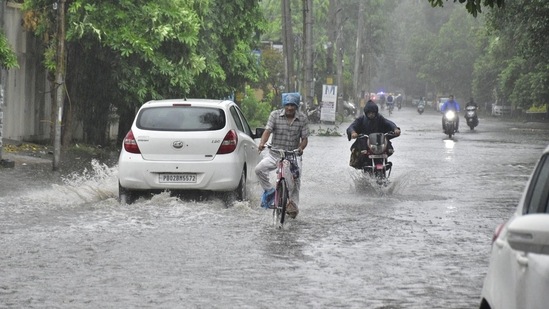
Patiala: After 45% rain deficiency in July, Punjab is likely to receive near-normal showers in August. This was suggested in the forecast for the second half of the monsoon, released by the India Meteorological Department (IMD) on Thursday.
Surender Paul, director, IMD, Chandigarh, said, “It will be above normal rain in the first week as heavy rainfall is expected. The showers will be weak in the second and third week, but will be on the higher side in the last week. Overall, it will be near normal in August.”
The IMD said Punjab had the highest rainfall deficiency in July with 45% less rainfall than the long period average (LPA). Punjab was followed by Haryana with 41% rain deficiency in July.
Read more: Heavy rain lashes Haryana, Ambala records 141 mm
Ironically, the July rainfall has been contrary to the IMD’s forecast of above-normal rainfall. The IMD admitted that there was a deviation from its forecast for the northwest region, including Punjab and Haryana. “Below normal rainfall over some areas (Punjab and Haryana) of northwest couldn’t be correctly predicted in outlook (forecast) of July,” the IMD mentioned in a press release.
The IMD had on July 1 predicted above-normal rainfall in July for the northwest region, including Punjab and Haryana.
Read more: Above normal rainfall predicted in India in August, September: IMD
There will be no relief from high temperatures in August. The IMD stated the maximum temperature in Punjab would be above normal. Similarly, there is no relief in the minimum temperature (night temperature) in August.


