
 E-Paper



Haryana cabinet nod to land pooling policy
Landowners will be offered 50% saleable area, ₹1 lakh/acre annually for 4 years, with project completion reduced to 4 years

 Prefer HTon Google


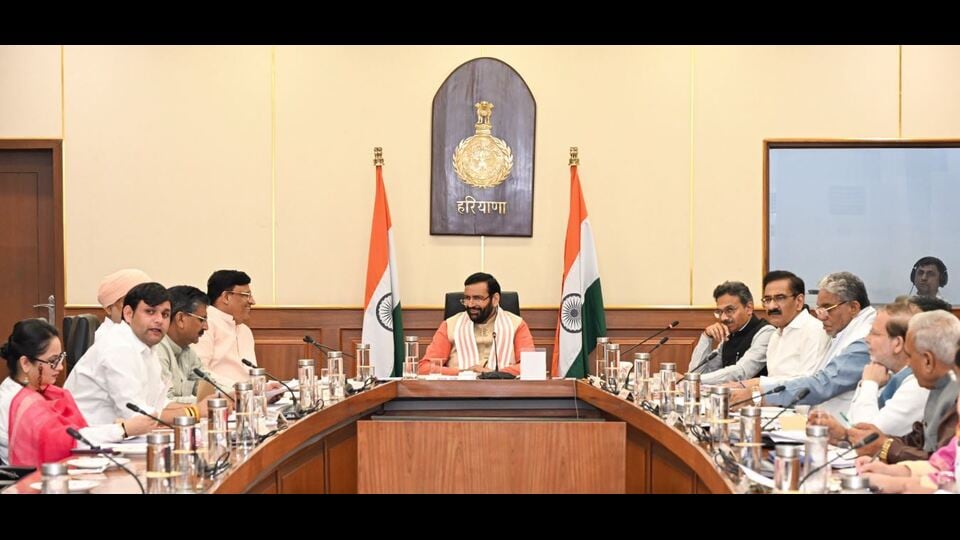
The Haryana cabinet, which met here under the chairmanship of chief minister Nayab Singh Saini, on Tuesday approved the land pooling policy-2026, replacing the existing policy of 2022, and facilitating landowners’ participation in development projects.
Under the new policy, landowners will be offered 50% of the total saleable area of the project as per the approved layout plan, while the remaining 50% will be retained by the development organisation. The earlier provisions linking the landowners’ share to market value have been removed, an official spokesperson said.
Within the landowners’ 50% share, commercial sites will be offered according to the prescribed entitlement, remaining area will be allotted as residential, industrial or institutional plots, depending on the purpose of the project.
The policy provides annual interim financial support of ₹1 lakh per acre, proportionate to the land contributed, for four years from the date of registration of the sale deed. If the amount is not transferred within 15 days of the sale deed, the landowner will be entitled to simple interest at 9% per annum for the period of delay.
The project completion period has been reduced from five years to four years. The development organisation will be required to complete infrastructure facilities within four years from the date of final approval of the project, failing which the land will revert to the landowners.
The minimum sizes of developed plots to be offered to landowners have been fixed at 100 square metres for residential plots, 250 square metres for industrial plots, and 500 square metres for institutional plots. The actual area allotted will be determined in proportion to the land contributed. Commercial plots in the form of kiosks or booths will be allotted, as applicable, where the land contribution exceeds 2,000 square metres.
According to the spokesperson, landowners contributing less than 999 square metres will receive monetary compensation under the Right to Fair Compensation and Transparency in Land Acquisition, Rehabilitation and Resettlement Act, 2013, or at the reserve price of the plot, whichever is higher.
Holders of land entitlement certificates will be able to club their certificates and jointly apply for larger developed plots. The period for buyback of allotted plots by the development organisation has been extended from one year to three years.
The policy also fixes the land aggregator’s remuneration at 0.5% of the collector rate for agricultural land in the concerned revenue estate. This remuneration will be borne by the development agency and paid after completion of the project’s sale deed process. Land pooling through e-Bhoomi has been excluded from the new policy, the spokesperson said.
Qualifications revised for junior lecturer assistant appointments
The cabinet approved amendments to the Haryana Educational College Cadre (Group- C) Service Rules, 1986, revising qualifications for appointment to the post of junior lecture assistant and updating other service provisions.
Under the revised provisions, candidates seeking direct recruitment to the post of junior lecture assistant must have passed Class 12 in the science stream with physics, chemistry and mathematics (PCM) or physics, chemistry and biology (PCB). They must also possess five years’ experience as a laboratory attendant in a recognised college.
Revised licence renewal provisions
The cabinet approved an amendment to Clause 9.2 of the New Integrated Licensing Policy (NILP)-2022, revising the provisions governing completion of projects and renewal of licences.
Under the amended provision, projects shall be completed within five years. If a project is not completed within this period, its licence shall be renewed in accordance with Rule 13 of the Haryana Development and Regulation of Urban Areas Rules, 1976, upon payment of the applicable licence renewal fees.
The amendment brings licence renewal for NILP colonies on a par with group housing colonies. It replaces the existing provision requiring project completion within seven years, comprising an initial licence validity of five years and a two-year renewal, beyond which renewal required payment of 100% of the licence fee.
Amendment in HPSC regulations {BOX}
The Haryana cabinet approved amendments to the Haryana Public Service Commission (HPSC State Service Group-C) Regulations, 2002, to include newly created Group-C posts in the commission and align existing provisions with current government rules.
The official spokesperson said the amendment will update the sanctioned strength of various Group-C posts in the HPSC, in view of the increasing workload due to a rise in the number of examinations and other related functions.
As per the amended regulations, the total number of sanctioned Group-C posts in the HPSC will be 85, including 15 newly created posts. The cabinet-approved amendments also provide for changes in the eligibility conditions for the appointments. The eligibility provisions will now be restricted to citizens of India and subjects of Nepal and Bhutan. However, the appointment of subjects of Nepal and Bhutan will be subject to the condition that an eligibility certificate has been issued by the government.
In another change, the existing requirement of Hindi up to matric standard in appendix-B of the regulations will be substituted with Hindi or Sanskrit as one of the subjects at matric level or Hindi as one of the subjects in higher education.


