
 E-Paper



Ludhiana: Commuters hit as indefinite transport strike begins
Over 90% of buses at the Ludhiana depot remained off the road, according to Praveen, general secretary of the contract workers’ union, leaving students, working women and job seekers who rely on affordable public transport to contend with disrupted journeys and steeper commuting costs

 Prefer HTon Google


Permanent and contractual employees of Punjab Roadways, PUNBUS and PRTC launched an indefinite strike on Wednesday to press for their long-pending demands, throwing government bus services in Ludhiana into disarray and leaving daily commuters scrambling for alternatives.
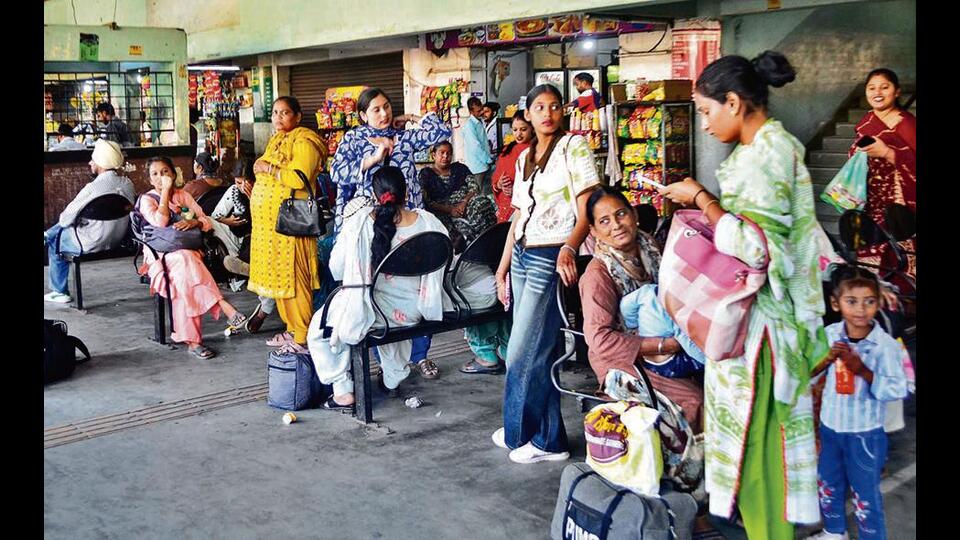
Over 90% of buses at the Ludhiana depot remained off the road, according to Praveen, general secretary of the contract workers’ union, leaving students, working women and job seekers who rely on affordable public transport to contend with disrupted journeys and steeper commuting costs.
More than 300 permanent and contractual transport workers gathered at the Ludhiana Inter-State Bus Terminal (ISBT) around 10 am and began the protest after a meeting with the government failed to resolve their grievances. The unions announced plans to stage another protest outside the transport minister’s residence in Dirba on Thursday (October 22).
With government buses largely off the roads, commuters were left to seek alternatives to reach colleges, workplaces and other destinations. Although private buses continued to operate, travelling by them or hiring an auto-rickshaw or cab meant additional expenditure for passengers already managing tight budgets.
For students and working women who travel daily, even a modest increase in commuting costs can add up over the month.
“I depend on government buses because they are affordable. When these buses do not run, we have to find other options and spend more money. Not everyone can afford to pay extra for daily travel,” said Jashan, a college student.
Shreya, a working woman, said the disruption had made her daily commute difficult. “We have to reach our workplaces on time. We cannot simply stay at home because buses are not running, so we have to find another way to travel even if it costs more,” she said. Job seekers travelling for interviews and other work have also been inconvenienced, as delays or difficulty finding transport can disrupt their plans.
Over 70 meetings held over their demands
Addressing protesters at the Ludhiana depot, union leaders Satnam Singh and Jatinder Singh Soni accused the government of failing to honour its commitments to employees and address their long-pending demands. They said that despite 70 to 75 meetings with the government, no concrete solution had emerged.
The union claimed that no transport employee had been regularised under the present government and that no new government bus had been added to the fleet in the past five years. It also opposed the kilometre-scheme model of bus operations, alleging that it promoted privatisation and undermined employment opportunities for young people.
The workers are demanding the regularisation of contractual employees, an end to the contractor system, equal pay for equal work and greater employment security. They have also sought the withdrawal of cases registered against employees during protests and reiterated their opposition to the kilometre-scheme model.
Union vice-president Gurpreet Singh and Sukhwinder Singh Babbu said the government had introduced a bill in 2026 to facilitate the contractual appointment of outsourced employees, but alleged that its implementation had been delayed. They also demanded that employees who had completed the required process and had been working on contract for 11 years be regularised under the applicable service rules.
The union further alleged that employees were facing mental and physical harassment because of the failure to implement service rules. It claimed that cases had been registered against protesting workers to suppress their agitation.
The workers have urged the government to implement the 2026 legislation, regularise contractual employees under the applicable service rules, withdraw cases registered against protesters and issue the necessary notifications without further delay.
Praveen, general secretary of the contract workers’ union, said the workers would continue their agitation until their demands were addressed.
The strike has left daily commuters bearing the immediate cost of the impasse.
Calls and texts made to Navraj Batish, Punjab Roadways general manager, yielded no response.


