
 E-Paper



Put the training wheels back on Chandigarh tricity area’s public bike-sharing system
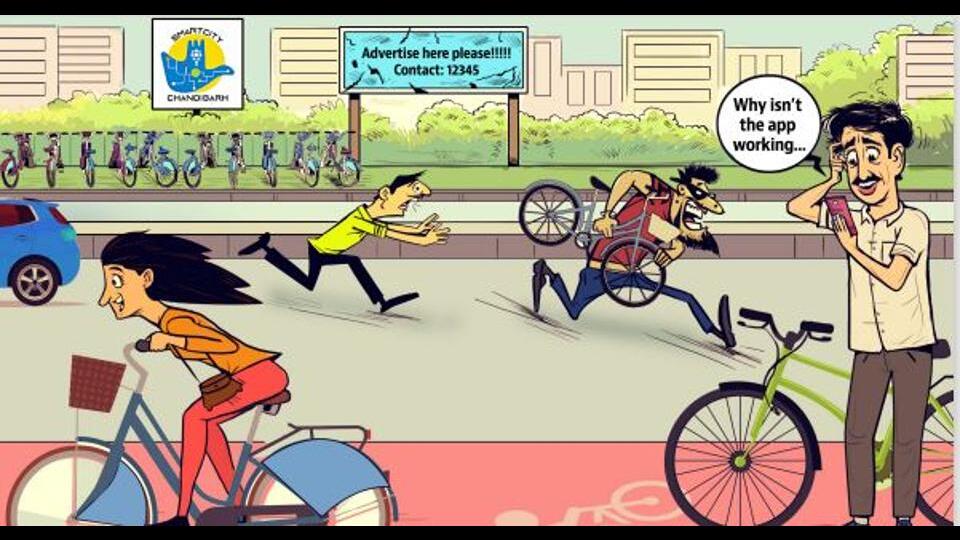
Most tricity residents agree that the admn rushed through the bike-sharing project’s development stages, where issues of glitches in the app & maintenance could have been fixed. They say, like in the process of learning to ride a bike, laying a strong foundation right at the start is key — adding it isn’t too late to start afresh & fix the mistakes.

 Prefer HTon Google


Chandigarh The administration’s decision to launch the cycle sharing project without much assessing the issues of lukewarm acceptance in Panchkula was hasty and ill-advised. Single roads for traffic adjacent to unprotected cycle lanes has led to close shaves, while poor maintenance, unviable locations of docking stations have further discouraged the public response. The people need to go back to the basics and start afresh, take into consideration the issues plaguing the current set-up and relaunch the project — and most importantly, go slow with the expansion and take each problem head-on one at a time.
Deepak Kumar, Panchkula
Minor fixes in the otherwise useful smart bike sharing system could go a long way in helping city residents commute long distances with ease. The administration should focus on maximising the public information on the system, put up standard operating procedures at each docking station for easy use and ensure proper maintenance through regular drives. Lastly, before putting up more docking stations to maximise coverage, installing CCTVs at the present stations can prove useful to prevent misuse and theft.
Col TBS Bedi (retd), Mohali
The city’s growing population has resulted in the need of an efficient transportation sharing system for its development, which the administration attempted to meet through the bicycle sharing system. The system got off to a solid start, generating a lot of buzz in its trial phase. However, glitches in the system and a lack of awareness among citizens have stopped it from achieving the desired goals. The facility can be improved by upgrading the back-end and making the experience more user-friendly.
Vineet Gandhi, Chandigarh
The UT administration has not done the proper homework to get the desired results from this ambitious cycle-sharing project. Merely launching a mobile app and allotting land for docking stations is just not enough to bring a city to adopt a new mode of commuting, it needs a strong base. A widespread awareness campaign for the public, akin to the one run at the time of the campaign launch and initial phase, is needed to help a bigger number of people to understand the working of the system. Leaving everything on the managing agency will not yield results.
SC Luthra, Chandigarh
In order to put the cycle sharing system back on track, there needs to be an urgency in informing more people about the benefits of not just the system, but also cycling at large. As the residents are going through a phase where each and every individual is experiencing stress, we need to culminate benefits — both physical and psychological.
Gurjot Kaur, Panchkula
Chandigarh administration’s bicycle-sharing project has received a lukewarm response. Despite adequate infrastructure in place and specific lanes for cyclists, few people have openly embraced the novel project due to teething problems. Primarily, people’s enthusiasm has waned owing to the limited number of docking stations at places of high traffic congestion. Rather, these are localised in well-to-do neighbourhoods such as sectors adjoining VIP Road for aesthetic purposes without adding any value. Being a smart city, Chandigarh should emulate the successful model of other metro cities across the world — the affordable system in Singapore for instance — so as to enhance the viability and profitability of the cycle-sharing project.
Surbhi, Zirakpur
For the success of the bicycle sharing scheme, separate dedicated tracks that ensure the commuters’ safety are key. Cyclists on bigger roads will become sitting ducks in front of other vehicles. There also needs to be some infrastructural improvement to the bicycle stations and they should be brought under surveillance to avoid possibility of thefts and vandalism. There should be a strong public grievances redressal system. All of these tweaks put together could pave way for more cycles to be pressed into service.
Kidar Nath Sharma,
Chandigarh
No good scheme can succeed if not implemented in letter and spirit. The public cycle sharing project is not well supported by the smart bike app, which is in turn depriving people of the facility as a whole. The smart bike app must be made simpler and glitch-free. The bikes, not being used by residents, will only collect dust the longer the wait for an improved app drags. The project can effectively check the environment decay and help city residents adopt a healthier lifestyle, but no benefits will come of it if the target audience is not able to use the service to start with.
Capt Amar Jeet, via email
The UT administration launched its ambitious public bicycle sharing project amid a positive public. However, due to various collecting reasons, the launch of the next phase was unfortunately delayed. Before looking ahead, the administration needs to address some of the existing shortcomings such as safety measures at docking stations, regular maintenance of cycles, ensure strict action defaulters and spread more awareness among the people on the system’s benefits. A discussion with Panchkula and Mohali civic bodies could also help streamline the existing network as well user experience.
Prabhjot Nagpal, Zirakpur
The administration’s push to promote the cycle as an alternative means of transport was not the planned move as cycling is not the most popular activity among city residents, most of which prefer cars. Cycling first needs to be popularised as a leisure activity and the public needs to be incentivised to take it up. Free bicycle service within a launch period, especially near educational institutes, would be a good starting point. One could pick up a cycle at will from a convenient point and leave at another docking station. Cycling could also be promoted as a leisure activity near such spots as the Sukhna Lake and nature trails.
DS Banati, Mohali
The bike-sharing project has faced one roadblock after another since its launch. There is a lack of awareness among residents about the project. Bike sharing should be popularised as a people’s project and resident welfare associations (RWA) can be roped to not only send out messages and information related to the project, but also be enlisted to keep a check on the smooth functioning.
Sunny Dhaliwal, Chandigarh
Despite the one-lakh plus downloads of the mobile app, the UT administration’s ambitious bicycle-sharing project has failed to have the desired impact. At present 2,500 cycles, manual and battery-operated, are in use. However, there are often glitches with the mobile app such as problems in unlocking the bicycles and complaints about damaged cycles and vandalism at docking stations. A total of 617 docking stations are planned, 310 of which are already operational. The administration really needs to slow down and assess the project’s problems. At the end of the day, the project is a new experiment which needs detailed discussion to ensure both smooth functioning and promotion. Consulting city administrations with prior experience in such ventures and studying their model could well help us find a few answers.
Usha Verma, Chandigarh
The UT has become infamous for its traffic snarls and congestion during peak hours in spite of prominent widened roads. To mitigate the same, a cycle track project was introduced, but the response to the same can be described as mixed at best. Smart bikes with docking stations are laudable on paper only as the upkeep of both the stations and the tracks by the administration and particularly the municipal corporation has been poor. The neglect has turned a positive step into sheer wastage of money as the project cannot thrive without proper attention to cleanliness and safety. If manned with assistants, the docking stations can become much more user-friendly.
Kundan Lal Sharma,
Mohali
The cycle-sharing project’s failure to gain traction can largely be attributed to the poor condition of the cycle tracks, which only discourage the people from undertaking the bikes for both commuting and leisurely activities. The lack of maintenance is apparent, with the occasional vandalism only adding to woes. The authorities concerned must pay urgent attention to the cycle tracs and their misuse by motorised two-wheelers and four wheelers should be brought to an end.
AK Sharma, Chandigarh
Chandigarh’s bicycle-sharing project, which took off with much fanfare a year or so ago, has been rattled by roadblocks. The ambitious flagship project got stuck midway due to lack of proper maintenance, recurring incidents of theft, vandalism and, of course, unviable docking stations — ending up with underwhelming public support. The dispensation needs to recalibrate the ambitious project to make it a hit with the beneficiaries. A strict round-the-clock vigil around the docking stations would go a long way in checking incidents of thefts and vandalism. Bicycles in a rundown condition need immediate replacement, sooner the better.
Ramesh K Dhiman,
Chandigarh
While it is laudable that the administration is working towards stopping environmental degradation and helping city residents explore alternative means of commuting, the project needs to be channelised by fixing the shortcomings. The administration must settle on a single, focussed strategy to encourage the use of bicycles as not only will it solve the problem of there being few takes, but also help clarify doubts in the minds of the pre-existing users. It will be highly appreciable to make docking stations in places of higher demands after considering the suggestions of the locals.
Amanpreet Kaur Bains,
via email
With the fuel prices going through the roof, more and more people are gravitating towards the bike stands only to be greeted with defective bikes and an app that works in fits and starts. The project was launched on December 10, 2020, with an aim to provide 5,000 bicycles to residents at a nominal fee of ₹5 for half an hour for members and ₹10 for non-members. At just over a year-old, the public bike-sharing system launched with much fanfare in Chandigarh is in need of urgent repair. Though the Smart Bike app promises an annual subscription, it doesn’t allow you to subscribe; QR codes of some bikes have been torn, making it difficult for users to scan the code; battery-operated bikes are often out of charging, and all of these combine simply do not make for a pleasant experience as promised. And to top it all, there is no grievance redressal system. The number given on the app is seldom attended and the executive is unable to resolve the problem. Quick fixes are not the way to go here as these major issues need to be tackled with sincerity for the system to stand a chance at success.
Sanjay Chopra, Mohali
The bicycle sharing project was a good starting point to help solve some of the city’s emerging problems (traffic congestion and air pollution, but due to lack of support by the administration and poor handling of the project’s resources on the part of the public has resulted in it turning counterproductive. To begin with, the administration should install CCTV cameras at every station to ensure no more damage is caused to the resources bought using public funds. People should also be aware about the proper handling of the bikes so as to reduce chances of damage. Struct action is also required against the people who vandalise the property. A city cannot benefit from a project that is in shambles and this is where the most work is needed at this point.
Aviansh Goyal, Chandigarh
The public bike-sharing project is a great step towards making the UT a Smart City. However, even the best of ideas come with their own set of problems and roadblocks. The less than satisfactory condition of bikes and the glitchy Smartbike app are some that stand out in this case. Many potential users are not tech savvy so have a hard time seeking help so a fallback in the form of an assistant or a helpline needs to be put in place. The same would solve some of the most apparent problems plaguing the current system.
Manjit Singh Johar,
Chandigarh.
Chandigarh Administration has constructed a 210-km cycle track but has overlooked the various hurdles/risks faced by cyclists. Most of the cycle tracks are on roads where traffic is moving at a fast pace, making for an unsafe experience — especially for those using the mode for leisurely purposes. There need to made dedicated efforts to make the city safer for cyclist before we push for the success of a sharing system.
Sateesh Dadwal, via email


