
 E-Paper



Civic apathy — breaker of many hearts
From “I love Najafgarh” to “I love Bhikaji Cama Place,” these installations were intended to beautify neighbourhoods, boost civic pride


The sign in Karol Bagh is meant to invite affection. “I love Delhi,” it declares in bold white letters, perched on a platform near a bustling street. But the paint has faded, the platform is crumbling, and the heart at the centre of the message—which was notoriously stolen in May 2022—bears a long streak of a liquid spill down its middle, like a wound that never healed. The city’s heart, sadly, appears broken.
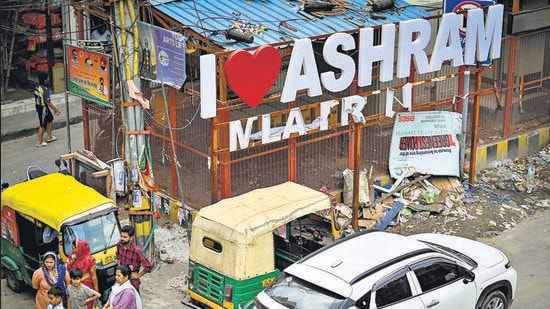
Over the past few years, Delhi has witnessed the rise of giant Instagram-ready signs modelled after the iconic “I love NY” campaign.
From “I love Najafgarh” to “I love Bhikaji Cama Place,” these installations were intended to beautify neighbourhoods, boost civic pride, and maybe even turn into local landmarks. But as the gloss wears off and the signs fall into disrepair, many residents are asking: What’s the point?
They put up the sign, but this has not been fixed,” said Rajesh Kumari, 55, who runs a tea and snack stall in Babarpur, pointing to a crater in the road just beside her shop, barely covered by a splintered wooden plank. The adjacent “I love Babarpur” sign — its letters chipped and missing pieces — has been broken for nearly a year, she said.
“No one pays attention to it anymore.”
The signs, which have popped up outside metro stations, in markets, on traffic islands, and at neighbourhood entrances, are fast becoming a study in contrast — aspirational declarations of love that stand alongside crumbling pavements, overflowing drains, and broken civic promises.
Rohit Sharma, the secretary to Najafgarh MLA Kailash Gahlot, explained that signs near the Dhansa Bus Stand Metro Station were installed after the government recommended that unused space in front of the station be spruced up. “We suggested the fountain and signage,” he said. “The metro authorities implemented it.”
But in conversations across Delhi — from Karol Bagh to Dabri, from Bhogal to Ashram, from Alaknanda to Najafgarh — residents appeared to have differing views. They questioned the wisdom of spending public money on decorative signage when basic infrastructure remained ignored.
Lalit Gupta, who sells electronic goods from a small shop behind one such sign in Ashram, offered a blunt assessment. “There is no cleanliness, no bus stand, no toilets, no place for the elderly to sit. Money should be used to benefit the public.”
Several signs were reportedly installed at the behest of local politicians. Former MLA Praveen Kumar said he placed 10 such signs across the Jangpura constituency, each costing around ₹1 lakh. “ They were to brighten up dark corners, and mark entrances to colonies ,” he said.
But in Ashram, Kumar’s name — once attached beneath the sign — was later torn off by residents. “If it said Ashram, why did he have to write his name?” asked Ram Jiyamand, 45, who sells fruit next to the sign.
Others questioned the broader priorities. “The money should have gone to build a school for poor children,” said Jitendra Verma, a cigarette vendor in Dabri. The sign was installed as part of a ₹25-30 lakh beautification project ordered in 2020. The sign itself, according to the area councillor, cost around ₹3.5 lakh, with another ₹1-2 lakh spent on maintenance since.
But in several areas, even that maintenance seems absent.
In Bhikaji Cama Place, chaat seller Amar Singh recalled the day the “I love Bhikaji Cama” sign first went up. “It looked good,” he said. “Lots of people came to take photos.” But over time, the heart and most of the letters have been stolen. “Now no one comes to fix it.”
In Bhogal, only the skeleton remains.
“It was stolen just days after it was installed in November,” said Kartik Saini, 29, who runs a mattress shop nearby. “Now it’s just an empty frame.”
But signs that remain are not in any better shape. Most are weathered, stained, and dented. Kumari, in Babarpur, noted that the narrow road beside the sign sees heavy bus and tempo traffic that frequently scrape the sign as they pass. The “B” on the sign is half damaged, and so are a few other letters”.
“The board is bound to get hit,” she said.
Karol Bagh MLA Vishesh Ravi insisted that maintenance is carried out at these signs regularly in the area. “Routine maintenance does take place. We are going to put out a tender soon,” he said
But for many Delhiites, the signs have become symbols of misplaced priorities—public declarations of civic affection that ring hollow when daily life remains difficult. The people, it seems, are not feeling the love.
Outside the “I love Delhi” sign in Karol Bagh, a group of homeless men sleep under the overhang, invisible to the message above. The pavement is broken, and flies buzz over a pile of discarded food nearby.
“How is this sign supposed to help us?” asked Sanjay Kumar, 50, who sells fruit across the road from the sign in Najafgarh. “People stop to take pictures, then move on. No one comes to my shop.”
For many, the signs are reminders of promises made, funds spent, and civic needs unmet. What was meant to inspire pride now provokes bitterness.
“If you pool the money spent on all these signs across the city,” Verma mused, “you could have built one small school.”
According to Swapna Liddle, historian, author and former convenor of INTACH’s Delhi chapter, that it would be more meaningful to invest in upgrading a local area in every neighbourhood that would give a unique identity to the place.
“As a person who has been observing cities, I would say that every area and locality has something unique like a park, garden or even a small heritage structure in a city like Delhi, that can be improved and maintained so that it organically becomes a pleasant identity for that area, rather than just a sign. How can a sign add to the quality of life of the people of the area? Such small parks or other structures can actually instil a sense of pride in people and become a local identity,” Liddle said.
The signs still stand—some proudly, others barely—but the sentiment they once tried to project has slowly drained away, letter by letter. In the end, they may look to project love. But the city doesn’t appear to feel the love back.

Stay updated with all top Cities including, Bengaluru, Delhi, Mumbai and more across India. Stay informed on the latest happenings in World News along with Delhi Election 2025 and Delhi Election Result 2025 Live, New Delhi Election Result Live, Kalkaji Election Result Live at Hindustan Times.


