
 E-Paper





Gargi Shukla is a correspondent with Hindustan Times. She reports on schools, colleges and issues that affect students, teachers, parents, and educational institutions in India's capital. She closely tracks the political economy of education, student politics, and policy developments shaping the sector in Delhi. She earlier worked as a sub editor with Outlook Business.
College students safety: Lights, CCTVs installed, but last-mile stretches still unsafe
Weeks of student-led protests across educational institutions seeking women’s safety around colleges led to a string of measures introduced by authorities – installation of streetlights, CCTV cameras, and police pickets outside college gates
Published on: Nov 26, 2026, 07:36:10 IST

Share via
Copy link
Weeks of student-led protests across educational institutions seeking women’s safety around colleges led to a string of measures introduced by authorities – installation of streetlights, CCTV cameras, and police pickets outside college gates. But an HT ground check at four major campuses revealed an unmistakable pattern — while authorities have secured the optics, real issues remain unaddressed. Women’s safety effectively ends a few metres away from the college gate, the moment students step onto the last-mile stretches leading to metro stations, bus stops, and paying guest (PG) hubs.
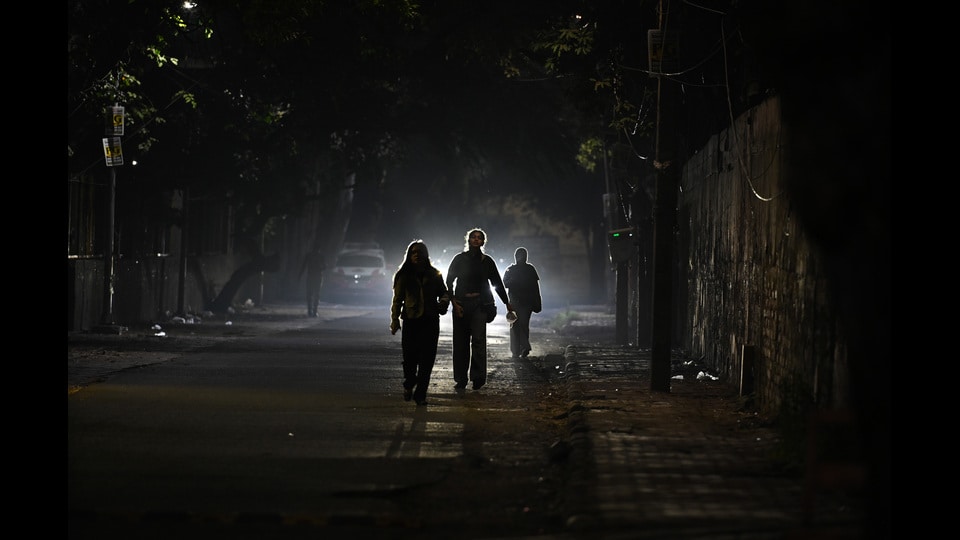
Outside the back gate of Lady Shri Ram (LSR) College for Women, a 350-metre stretch now boasts additional streetlights, CCTV cameras, and a permanently deployed PCR van. The upgrades followed protests triggered by the alleged gang rape of a 17-year-old schoolgirl inside Aastha Kunj Park near Kalkaji in September -- similar demonstrations were also reported in Jamia Millia Islamia (JMI) and Dr BR Ambedkar University Delhi (AUD).
However, the improved stretch — located less than two kilometres from the Aastha Kunj Park — is part of a larger road network connecting Amar Colony on one end and Moolchand Metro Station on the other. These adjoining stretches remain poorly lit, with streetlights covered by dense tree cover on both sides, and passing vehicles largely serving as the only source of illumination, LSR students said.
“Beyond installing a few streetlights, I don’t think much of our demands has translated into action on the ground. The main road that leads to the front gate remains dark after 6pm, and the back gate is used by students to go to Amar Colony where many live in PGs, whereas day scholars use Moolchand Metro station—the stretch to both these areas remains dark,” said Evia, 21, an LSR undergraduate.
She added that police presence at the nearest pink booth remains irregular. “Certain days, you will find two personnel; other days, you will find one who is also occupied on the desktop.”
North Campus: Main stretches lit, lanes dark
Similar concerns were raised by students of DU’s North Campus. A spot check of surrounding lanes between 5pm and 7pm on Saturday found that while main stretches near college gates were well lit, roads leading to hostels near the DU Sports Complex and Cavalry Lane, which connects to Vishwavidyalaya Metro Station, remained shrouded in darkness. The eerie silence along these stretches was broken only by the occasional headlights and honking of passing two-wheelers.
“Even if there are four of us walking, there’s a different sense of safety when the group is joined by a male. If we stay late after classes for society events, there’s an unsaid rule that a male friend would accompany us back. We still turn our heads back when we walk, especially if we leave college after 5 or 6pm, to ensure we aren’t being followed,” said Pallavi Singh, 23, who stays in Hudson Lane.
She highlighted that catcalling and stalking remain persistent concerns for students living in Hudson Lane, Vijay Nagar, and Kamla Nagar.
These concerns have added to teachers’ responsibilities. Latika Gupta, a DU professor, said, “Whenever there’s a field visit or a seminar after routine classes, male students are excited to join, and the reaction I get from female students is different. Their parents would ask for my number, and hours after the trip, I have to ensure they have reached home safely.”
Officials of the Delhi University did not respond to requests for comment.
A senior Delhi Police officer from the southern range denied the allegations. “Our staff is regularly sensitised and conduct patrolling in the morning and night outside colleges and at parks, especially after the Aastha Kunj Park incident. If something happens inside, we keep in touch with the college administration and their private security for prompt action.”
The Public Works Department (PWD) said it is equipping stretches between campuses, hostels and metro stations with smart LED streetlights. “PWD is integrating these stretches with the ongoing Smart LED Street Lighting project. The work is being expedited and is expected to be completed shortly, with the objective of improving visibility and safety for students and other commuters,” an official said.
AUD and JMI: Concerns continue
Women’s safety isn’t an isolated DU issue. Students of AUD had staged an indefinite 17-day protest over infrastructure concerns, which included demanding access to the university’s front gate, citing safety issues. “The main gate on Lothiyan Marg has been inaccessible for nearly one-and-a-half years. The back gate is near lanes with godowns and a residential area. Catcalling is common, and there have been instances where students reported being inappropriately touched,” said a 19-year-old UG student, who sought to remain anonymous.
Officials of AUD did not provide a response until the time of going to print.
At Jamia Millia Islamia, the issue became a key demand for students seeking restoration of the students’ union.
Shifa Ali, 20, said bus stops near the campus—Batla House, Gafar Manjil, and Tikona Park next to the JMI Metro station—are particularly unsafe. “After 6 or 7 pm, groups of intoxicated men loitering around the campus are a common sight, while women students routinely encounter men on bikes following them and asking for names and phone numbers.”
A JMI spokesperson said in-campus safety, particularly around women’s hostels, is tight with layers of checks at multiple entry points. “There is a main entrance gate, followed by separate entry points to hostels and academic buildings. The hostel premises are well-guarded and adequately lit. The university is situated in one of south Delhi’s busiest localities, ensuring steady movement of people and vehicles. We have not received any complaints of Eve-teasing or misbehaviour towards female students on campus,” said chief PRO Saima Saeed.
ABOUT THE AUTHOR
Catch every big hit, every wicket with Crickit, a one stop destination for Live Scores, Match Stats, Infographics & much more. Explore now!
Stay updated with all top Cities including, Bengaluru, Delhi, Mumbai and more across India. Stay informed on the latest happenings in World News along with Delhi Election 2025 and Delhi Election Result 2025 Live, New Delhi Election Result Live, Kalkaji Election Result Live at Hindustan Times.


