
 E-Paper



‘Concealed proceeds of crime’: Court denies bail to Delhi minister Satyendar Jain
Jain had knowingly done such activity to obliterate the tracing of the source of ill-gotten money, said court.


A Delhi court on Thursday denied bail to minister Satyendar Jain and two others in a money laundering case, saying that he was “actually involved in concealing the proceeds of crime”.
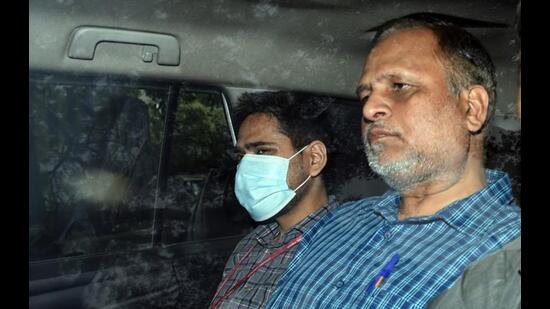
Special judge Vikas Dhull said that Jain “had knowingly done such activity to obliterate the tracing of the source of ill-gotten money and accordingly, the proceeds of crime was layered through Kolkata based entry operators in a way that its source was difficult to decipher”.
The court also denied bail to co-accused Vaibhav and Ankush Jain, saying that there is material on record to show that income declared under the Income Declaration Scheme (IDS), 2016 by the co-accused was not their own but part of the money that also belonged to Jain in the form of “proceeds of crime”, which has been prima facie established on record from the statement of witnesses and Vaibhav Jain.
Jain was arrested on May 30 under the provisions of the Prevention of Money Laundering Act (PMLA) and is currently lodged in the Tihar jail.
The case is based on a 2017 CBI FIR lodged against the minister in the Aam Aadmi Party (AAP) government. ED has accused him of having laundered money through four companies allegedly linked to him and where he was holding shares, while amassing disproportionate income.
According to ED, Jain transferred money to Kolkata through hawala channel and got it back from dummy companies in the form of accommodation entries, even though he could not show the source of the money received.
The court said that Jain laundered money by giving cash to the Kolkata-based entry operators and brought it back to three companies-- M/s Manglayatan Developers Projects Pvt Ltd, M/s Akinchan Developers Pvt Ltd and M/s Paryas Infosolutions Pvt Ltd --- against the sale of shares to show that income of these three companies was “untainted one”. It added that Jain and the co-accused converted proceeds of crime and unaccounted cash into the income of the companies.
The court also rejected Jain’s contention that he could not be held liable in the companies, since he is neither a share holder nor a director. It said that the accused can indirectly enjoy the proceeds of crime by way of concealment or claiming it as untainted.
Jain’s counsel had said that he has not accrued any benefit as money has been transferred into the accounts of the three companies, where he is neither a director nor a shareholder during the period when the alleged transactions took place. He added that even the shares were bought back in the name of co-accused Vaibhav Jain and Ankush Jain and therefore, no offence of money laundering is made out.
In September, when the hearing on the bail pleas by Jain and the co-accused was in the final stage, the ED filed an application seeking transfer of the case from the court of Special judge Geetanjali Goel to a new judge, raising an apprehension of bias.
On September 23, the Principal and sessions judge Vinay Kumar Gupta allowed ED’s application that had stated “a grave likelihood and a reason to believe that the issues (in the case) have been premeditated”.
Even though Jain and other accused challenged the transfer of case to a new judge hours within it was pronounced, the Delhi high court rejected the plea on October 1, saying that the ED’s apprehension of bias by a trial court judge is reasonable and not based on flimsy ground.
Jain challenged the high court’s order in the Supreme Court, but later withdrew his petition and commenced the bail hearing in the trial court before Special judge Vikas Dhull.
On Thursday, while denying relief to Jain and others, the court rejected the submission by Jain’s counsel that the bail should be granted, as the Delhi high court has quashed the proceedings against Jain under the Benami Property Transactions Act, 1988 (amended in 2016)
“Even otherwise, the proceedings under the Benami Property Transactions Act, 1988 and under the Income Tax Act, 1961 are separate proceedings,” the court said.
Reiterating that money laundering is a serious economic offence, the court said, “The Supreme Court of India has held that the economic offences have deep rooted conspiracies and involve huge loss of public funds need to be viewed seriously and considered as grave offences, affecting the economy of the country as a whole, and thereby posing serious threat to the financial health of the country.”


Stay updated with all top Cities including, Bengaluru, Delhi, Mumbai and more across India. Stay informed on the latest happenings in World News along with Delhi Election 2025 and Delhi Election Result 2025 Live, New Delhi Election Result Live, Kalkaji Election Result Live at Hindustan Times.


