
 E-Paper



Farm fires spark bad air alarm in Delhi
The air quality in Delhi is expected to worsen in the coming days as the number of farm fires in neighboring states increases, according to officials. Punjab recorded over 100 farm fires in a day for the first time this season, while Haryana has seen a total of 120 farm fires so far. These fires contribute to Delhi's annual pollution problem, as northwesterly winds carry the smoke over long distances. Last year, Punjab had a total of 49,922 fires and Haryana had 3,661 fires. Both states have committed to reducing stubble burning this year.


The Capital’s air quality will worsen in the next few days with the number of daily farm fires gradually picking up in the neighbouring states of Haryana and Punjab, and winds beginning to blow towards Delhi and the nation capital region (NCR), according to officials aware of the matter.
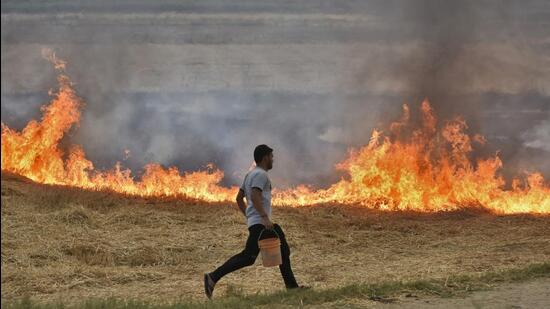
On Sunday, the daily count of farm fires in Punjab crossed 100 for the first time this season — 123 fire counts were captured on Nasa’s satellite imagery. On Monday, it recorded another 119 farm fires, taking its total to 456 fires so far this year. The other agrarian state of Haryana has so far witnessed 120 farm fires , including 21 on Sunday and 24 on Monday, according to data collated by the Indian Agricultural Research Institute (IARI) in Pusa.
The two states are largely responsible for Delhi’s annual pollution woes during the Winter season, as northwesterly winds exacerbate the problem by carrying the smoke over a long distance, all the way up to the Capital, and shooting its PM2.5 levels to dangerously high levels.
Last year, Punjab 49,922 fires in total and Haryana 3,661 fires. Both the states have committed to substantially reduce stubble burning in this year’s winter action plans, and also said they will take efforts to eliminate the practice entirely in some districts. Delhi has also prepared a pollution plan for the year, besides having at standby its regulatory measures under the Graded Response Action Plan (Grap).
On Monday, the System of Air Quality and Weather Forecasting And Research (SAFAR) — a body under the ministry of earth sciences, which calculates the daily contribution of stubble burning to Delhi’s air, said it plans to start releasing daily stubble data from October 10 onwards, which will give the Capital an estimate of the contribution of farm fires in relation to its local sources.
Gufran Beig, founder project director at SAFAR, said that at present, the contribution to Delhi was negligible, but as the daily count starts rising further in the coming days, the pollution will start increasing.
“The fire count is beginning to increase and depending on meteorological factors such as wind direction and speed, Delhi will begin to get impacted. Normally, the impact on Delhi’s air becomes prominent in the second half of the month, but we plan to show daily data from October 10 onwards, as it will give us an early trend,” he said.
In north India’s food-bowl states, farmers set aflame paddy stalks around October to clear their fields for their next crop. This releases millions of tonnes of smoke, carbon dioxide and toxins leading to a deadly spell of air pollution in Delhi and NCR.
Delhi’s 24-hour average air quality index (AQI) was recorded at 146 (moderate) on Monday. It was 147 (moderate) on Sunday. Forecasts by Early Warning System (EWS) in Delhi – a model developed by the ministry of earth sciences — shows that AQI is expected to remain in the “moderate” range and below 200 till October 11.
Last year, Delhi recorded an AQI of 450 (severe) on November 3 — the highest in the previous season — according to Central Pollution Control Board (CPCB).
SAFAR has been calculating the estimated contribution of farm fires to Delhi’s daily PM 2.5 load since the last few winters. Last year, data showed a drop in overall fire count and favourable meteorological conditions also contributed to a smaller peak.
The highest single-day contribution of farm fires to Delhi last year was 34%, which was recorded on November 3, 2022. In comparison, the single-day peak in 2021 was 48% on November 7, while in 2020, the peak came on November 5, when the contribution was 42%, SAFAR data showed.
“Last year, due to lesser number of fires and relatively favourable meteorological conditions, the impact of stubble burning was almost half of what it was in 2021,” Beig added.
As part of its measures ahead of the pollution season, the Delhi government recently unveiled a 15-point action plan, which called for the complete ban on the use of firecrackers in surrounding states, while also urging them to take necessary measures to check stubble burning and eliminating dependence on diesel generators for electricity during power cuts.
It will also roll out the annual pollution control measures in phases under Grap, which is rolled out on October 1 and when the AQI crosses the 201 threshold. However, on Sunday, the measures were not kicked as the air quality remained moderate.
An AQI between zero and 50 is considered “good”, from 51 to 100 “satisfactory”, 101- 200 “moderate”, 201-300 “poor”, 301-400 “very poor”, and 401-500 “severe”.

Stay updated with all top Cities including, Bengaluru, Delhi, Mumbai and more across India. Stay informed on the latest happenings in World News along with Delhi Election 2025 and Delhi Election Result 2025 Live, New Delhi Election Result Live, Kalkaji Election Result Live at Hindustan Times.


