
 E-Paper



Over 1.3 million migrants left Delhi during 2nd wave of Covid-19, shows data
In a report submitted to the parliamentary panel of home affairs on Monday, and using data sourced from the rail ministry, the ministry of labour and employment said that nearly 517,073 migrants left for their homes from Delhi using trains during the second wave.

 Prefer HTon Google


A little over 500,000 migrant workers (and their families) left Delhi for their homes during the second wave of the pandemic, and a consequent lockdown, starting mid-April, the Union labour ministry has said, taking the total number of migrants that left the Capital to a little over 1.3 million.
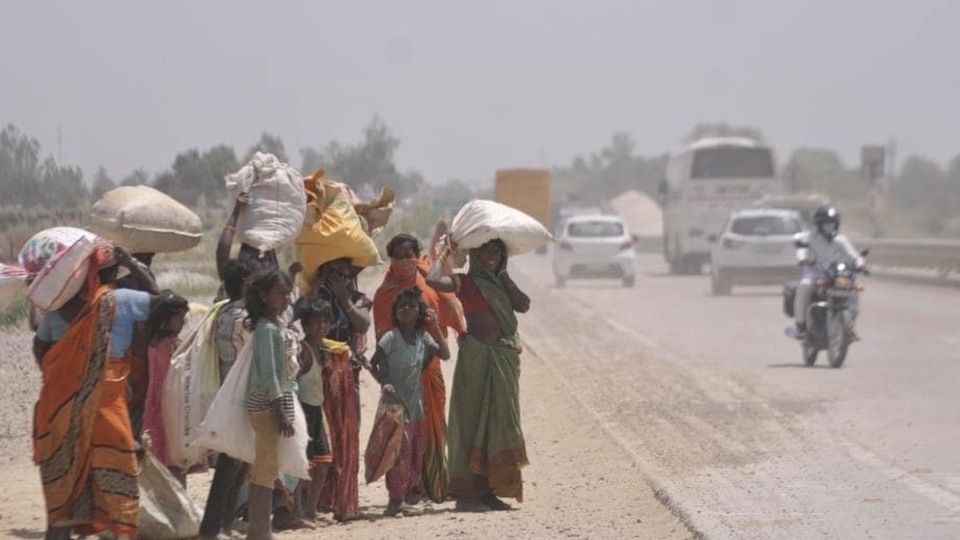
In a report submitted to the parliamentary panel of home affairs on Monday, and using data sourced from the rail ministry, the ministry of labour and employment said that nearly 517,073 migrants left for their homes from Delhi using trains during the second wave. HT has reviewed a copy of the report.
Click here for full Covid-19 coverage
The Delhi government said last month that nearly 800,000 migrants used buses to leave the Capital between mid-April and mid-May.
The report pointed out that unlike the migrant crisis seen in April and May last year, when many tried to reach home (with no transport being available) , this time, the exodus remained smooth, and attributed this to the partial nature of lockdowns.
To be sure, there was no nationwide lockdown during the second wave, although most states did enforce lockdowns. But both trains and buses continued to run. For instance, according to the Delhi government, between April 19 and May 14, around 800,000 passengers took buses from three interstate bus terminals (ISBTs) in Delhi to go to other states. These buses were arranged by the governments of Delhi, Uttar Pradesh and Uttarakhand specially for migrant workers in addition to the daily buses plying from the terminals.
Delhi endured a punishing fourth wave of Covid-19 infections between April and May that left health infrastructure overrun, overwhelmed medical workers, and led to crematoriums running out of space.
Over 760,000 people were infected in that period, while over 13,000 died of the infection in April and May alone. Cases in the city begin to peter out towards the middle of May on the back of a lockdown, which the state government imposed from April 19 onwards.
Interestingly, the report added that, unlike the first wave, many states did not see an exodus. It said the ministry held at least eight meetings with state governments with prominent migrant worker populations in April and May to ensure that “food security, health safety and transport facilities were provided to the workers”.
“It was observed that the initial apprehension of large exodus of migrant workers in the wake of the series of lockdowns announced by the state government was gradually dispelled. No extraordinary exodus was seen… due to non-disruption of industries, building and construction works and public transport… the movement this time was mainly due to harvest, marriage and holiday season,” the report said.
Railway officials in Mumbai said nearly 600,000 people left Maharashtra in the month of April, during the peak of the state’s second wave and the statewide lockdown. Nearly 300,000 of them left from Mumbai, according to data provided by Central and Western Railway.
In April, the two zonal railways operated 370 special trains to accommodate the increase in passenger numbers.
To be sure, railway officials said that all passengers were not necessarily migrant workers, and that the increased demand is normal for the summer months. “A majority of the passengers had booked their travel before the lockdown was implemented in Maharashtra,” a railway spokesperson said. “There were hardly any unreserved passengers as they had booked well in advance.” Maharashtra imposed a “mini lockdown” on April 13, and upgraded the restrictions further on April 22.
A majority of the special trains that operated in April from Mumbai and Pune were headed for north and north east India, including Uttar Pradesh, Bihar, Jharkhand, Assam, Odisha and West Bengal.
Talking about the steps taken by the government to aid the labourers, the report said that as a part of relief measures, ₹ 1,034 crore has been disbursed by states to five million building and construction workers in the second wave of the pandemic as compared to ₹5,618 crore transferred to 18.3 million workers during the first wave.
In addition to this, 20 control centres across the country were reactivated by the ministry to manage distress calls from migrant labourers, the report said. From April 21 to June 23, 1,311 complaints were received by the ministry, of which 861 pertained to the states and 450 to the centre. The calls were primarily about termination, medical assistance, travel assistance and ration. Of these, 830 grievances have already been resolved and 49 others are in the process of being addressed, the report added.
On Tuesday, the Supreme Court cited the tribulations of migrant workers during the pandemic and said “the apathy and lackadaisical attitude by the ministry of labour and employment is unpardonable”. It asked the Union government to make the national portal for registration of unrecognised workers operational by July 31 so that benefits could reach migrant workers. It also ordered all states and Union territories to implement the “One Nation, One Ration card” scheme to help migrant workers avail subsidised food ration anywhere in the country.
Anindita Adhikari from the Stranded Workers Action Network (SWAN) said that the best possible estimate of the number of migrants who left would come from train data, but added that the numbers are likely to be an underrepresentation. “We all know that with mobility this time, as there were no restrictions of interstate travel, it is likely the figure is an under representation.”


