
 E-Paper



Satya Niketan: A hub of affordable PGs that carries a hidden cost
NEW DELHI: For 17-year-old Shekhar Kumar, the phone has barely stopped ringing since Sunday

 Prefer HTon Google


NEW DELHI: For 17-year-old Shekhar Kumar, the phone has barely stopped ringing since Sunday.
His parents, relatives and friends have been calling, urging him to leave the paying guest (PG) accommodation in Satya Niketan that he moved into barely a month ago. The calls have carried the same question: what if he had been inside the building that collapsed?
Kumar, who came from Sitamarhi in Bihar to study in Atma Ram Sanatan Dharma College, said he chose Satya Niketan for two simple reasons – it was affordable and close to his college. Living nearby also meant saving on the daily cost of commuting.
“It can obviously not be for amenities,” he said with a sigh.
His “room” is more accurately a partitioned section of a room, barely 10ft by 8ft, on the second floor of a six-storey building. The walls are damp, paint is peeling off and the roof is prone to flooding. Bare plywood separates his side from others. There are no obvious fire-safety measures.
“The owner of the building has been dodging our calls since yesterday,” Kumar said.
It is not quite the life Kumar or his parents had imagined. But for students arriving in Delhi from to study at DU such compromises are routine.
Satya Niketan has existed around that demand. The neighbourhood, once a low-density resettlement colony, is now a tightly packed student ecosystem of PGs, rented rooms, messes, cafes and shops. Buildings rise three, four, five and sometimes six storeys, with multiple twin- and triple-sharing rooms squeezed onto each floor.
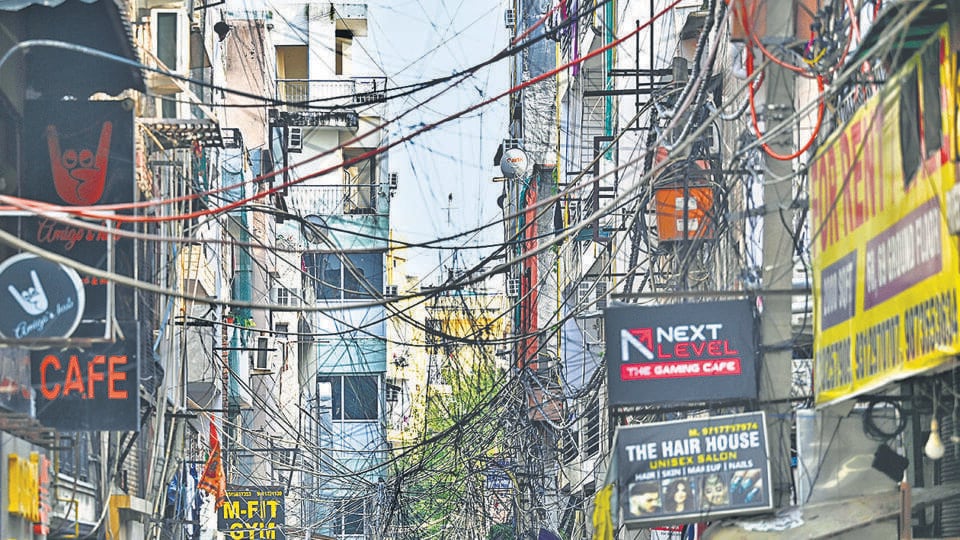
A visit by HT on Monday found buildings with poor ventilation, dilapidated furniture, weak walls and narrow corridors. Exit routes were cramped or obstructed by wires. In some lanes, two-wheelers are packed so tightly that there is barely room for a four-wheeler. Balconies on opposite sides of the narrow streets sit so close that residents can almost reach across to one another through the web of dangling wires.
On rent here are beds, not rooms.
At another six-storey PG, 21-year-old Jai Narayan, a first-year student at Motilal Nehru College from Ara in Bihar, said he too had moved in about a month ago. He stays on the second floor. “The building is tilted,” he said, pointing towards the structure.
Narayan pays ₹10,000 a month for his bed, with electricity, laundry and food charged separately. Like many students here, he shares his room with others.
On the fourth and fifth floors of the building, students said, residents were asked to vacate after the collapse. For 20-year-old Ankit Yadav, a third-year student at ARSD College, that created another problem. “The owner has asked us to leave but they are not giving us the security deposit back. It is also the start of the month, so we had just paid the rent,” he said.
Yadav pays ₹15,500 for a fifth-floor room, which he shares with a friend. He pointed to the railings, which he said moved when pressure was applied. There was not a single fire extinguisher in the building, he pointed out.
On the terrace, one of the water tanks had overflowed, leaving the area clogged. “How will such a building survive?” Yadav asked.
At another PG on the main road opposite the colleges, cracks have appeared in the walls and wooden partitions divide the rooms. Ansh Raj Toppo, 18, a first-year student from Jharkhand, moved in a month ago and pays ₹8,500 per bed. Students from colleges including ARSD and Venkateswara College live there.
Here too, electricity, food and laundry come at additional cost. Students said electricity was charged at around ₹13 per unit. The washroom has no ventilation, Toppo said. “The corridors are so small and cramped. There are no fire exits or safety measures. We all live in such accommodations because we can’t afford the rooms at higher rent,” he said.
On Sunday night, students said they called the owner to raise their concerns. According to them, she replied: “There is no problem and if you wish to leave, it’s your problem.”
The stark economics of Satya Niketan explain why students continue to stay. The shortage of affordable accommodation near colleges pushes them towards PGs where several people share small rooms and basic services are added to the monthly bill.
But the building collapse has changed the equation. What was once a trade-off between space and affordability has become, for many students and their families, a question of whether the structures can be trusted.
MCD has since begun issuing demolition notices to damaged and ruinous buildings around the collapse site. A senior civic official said buildings number 13 was “barely standing” and had been evacuated. Three other structures, including building number 15 next to the collapse site, were also being examined.
The notices, issued under Section 348 of the Delhi Municipal Corporation Act, give owners three days to demolish buildings deemed ruinous or dangerous, failing which the MCD can carry out the demolition and recover the cost.
The collapsed building was property number 14, the MCD said. Built in the 1990s on about 55 sq yds in the resettlement colony, it had no sanctioned building plan, according to senior civic officials. The civic body has yet to explain why the unauthorised construction work was not stopped by its field teams.
For students, however, the question is simpler. After coming to Delhi for a chance at a better future, how much danger should they have to accept simply to afford a place to live?


Stay updated with all top Cities including, Bengaluru, Delhi, Mumbai and more across India. Stay informed on the latest happenings in World News along with Delhi Election 2025 and Delhi Election Result 2025 Live, New Delhi Election Result Live, Kalkaji Election Result Live at Hindustan Times.


