
 E-Paper



The haveli’s last pulse: Village culture in an expanding city
In Shenzhen, a fishing and farming county that became a metropolis within a few decades of 1980, the state acquired the surrounding farmland while the villagers kept their residential plots

 Prefer HTon Google


In Shenzhen, a fishing and farming county that became a metropolis within a few decades of 1980, the state acquired the surrounding farmland while the villagers kept their residential plots. On those acquired plots, they built upward until neighbouring blocks stood close enough for residents to shake hands from their windows — which is why these buildings acquired the local nickname “handshake buildings.” They are usually read as a failure of planning, but they also record how a community contracts when a city closes in, keeping its ancestral halls, lineage ties and collective ownership inside a footprint that shrinks every year. A place compressed in this way stores force, and what is released when it is broken can be far greater than its size suggests.
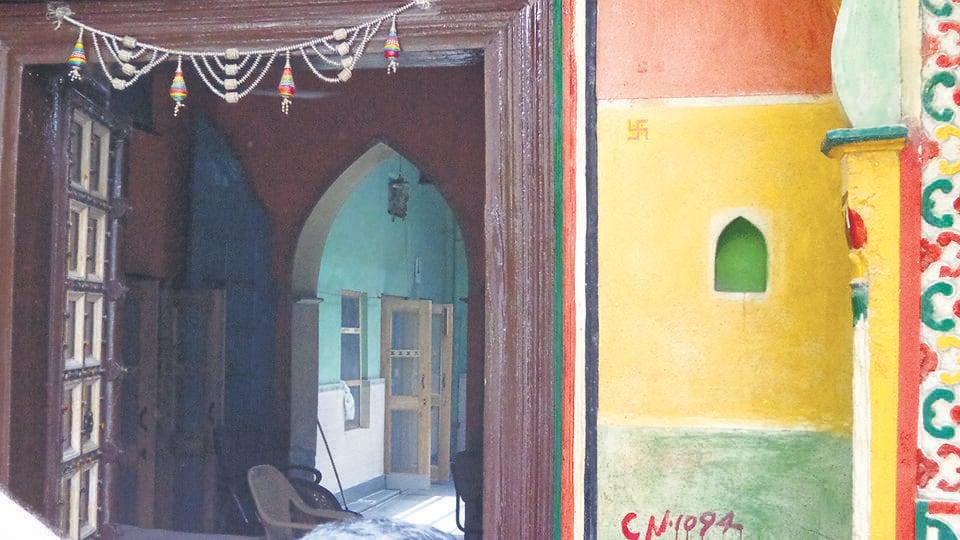
Rural Delhi has undergone a similar contraction on different terms. For that reason, the villages work as cultural islands, where older habits of marriage, worship and hospitality are carried on with less dilution than in the colonies around them. Inside the lal dora — the village settlement long exempt from municipal building rules — the haveli has been divided among sons, rented to migrants and raised to several storeys, so the old house now occupies a smaller share of its plot each decade.
The way the house absorbs this pressure can be followed from its entrance inward. The deodhi was where a household first announced itself, and the satiya painted in geru and chuna on the wooden doorframe at Dev Uthani Gyaras, the thapi pressed onto the wall after a birth, and the Sanjhi Mai modelled in clay and cow dung during Navratri were all made on surfaces that every guest passed on the way to the baithak. Today the satiya and thapi appear on the tiled or steel entrances of rebuilt houses, and Sanjhi, to whom women sing each evening until Dashmi, is made on a kitchen or courtyard wall wherever one remains. A few families have kept an arched entrance or a kiwad from the village house as the one fixed point from which the rest of the ritual is arranged.
The baithak that the deodhi opened into was furnished with a khaat and a hukka, and these objects did not stay in one room. The khaat that received guests was carried into the chowk when the house filled for a wedding, and the hukka that passed among the men also marked where they sat when kajal ghalai and sehra bandhi were performed on the outward side of the courtyard while women gathered inward around the saalh and obras. Where the courtyard has gone, these ceremonies are performed on a rooftop, at a local temple or in whatever corner remains, and the ghud chadi still sets out from the place where the deodhi stood, so the ritual keeps the address of a door that no longer exists. In many new houses the front room near the entrance serves as the baithak, with a khaat and hukka brought out when guests or neighbours arrive.
Behind the chowk, the saalh was where women churned milk with the bilona and ground grain on the chakki, work that was accompanied by the geet sung at festivals and weddings. Both implements have largely left the household, along with the hal, jua and kassi of agrarian work, yet the songs persist at ceremonies, and brass and copper vessels, matkas, sil-batta and wooden chests are retained for ritual use or because they hold family memory. The thapi on a wall, the geet in the mouth and the vessel in the hand are what carry the haveli’s arrangement of space into flats and rooftops where its walls no longer stand.
This is the same contraction that produced the handshake buildings of Shenzhen, but Delhi’s villages are early enough in it to be given a different course. A haveli replaced by a multi-storey block gains units and rental income, and it loses the courtyard, the threshold and the inner hall that gave each practice its place, so that families keep their rituals without the ground on which they were performed.
Tokyo offers a working precedent in Nerima, where owners of farmland inside the city receive a large reduction in property tax for as long as they keep farming it. The arrangement is renewed in ten-year terms, and the land can be leased to a new cultivator when an heir does not want it. The Master Plan for Delhi 2047 provides an opportunity to recognise urban villages as living cultural landscapes. Its provisions for cultural precincts, Transferable Development Rights (TDR) and Heritage Funds could be extended through context-sensitive planning and community participation to sustain traditional havelis, chaupals, akhadas, ponds, wells and other spaces that continue to shape the cultural and social life of these settlements.
Anica Mann works on archaeology and contemporary art in Delhi; Dr Shekhar Tokas is assistant professor of urban studies at Dr BR Ambedkar University, Delhi. The views expressed are personal

Stay updated with all top Cities including, Bengaluru, Delhi, Mumbai and more across India. Stay informed on the latest happenings in World News along with Delhi Election 2025 and Delhi Election Result 2025 Live, New Delhi Election Result Live, Kalkaji Election Result Live at Hindustan Times.


