
 E-Paper



Ggm cycling tracks lie unused due to encroachments
Poor design, encroachments, and lack of maintenance have rendered the four cycling tracks in Gurugram, India almost unusable, forcing cyclists to avoid them. Despite plans to expand the existing tracks, residents say the tracks are often used as parking lots and encroached upon by food cart vendors. In the last seven years, more than 150 cyclists were injured and 75 killed in road accidents due to the lack of road infrastructure and dedicated lanes. The Gurugram Metropolitan Development Authority has pledged to take measures to maintain the tracks and curb encroachments.

 Prefer HTon Google


Gurugram: Parked vehicles, encroachments, poor design and bollards are some of the factors that have rendered the four cycling tracks in Gurugram almost unusable, forcing cyclists to avoid them.
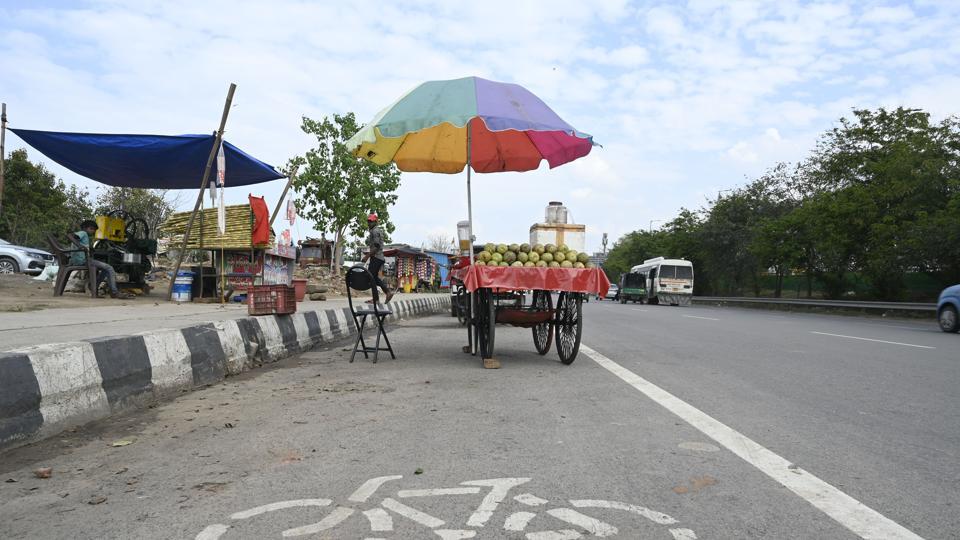
The Gurugram Metropolitan Development Authority (GMDA) in October 2020, had constructed the city’s first cycle track on Netaji Subhash Marg. Later, the authority built cycle tracks on the Bijwasan-Rezang La Chowk stretch, the Maharana Pratap Chowk-Atul Kataria Chowk stretch and Hamilton Court Road, but all of them lie unused due to lack of maintenance.
Experts say the tracks have design defects and are used as parking lots at several places.
Sudesh Mangal, a daily commuter who travels from Fazilpur Jharsa in Sector 72 to Udyog Vihar, said there are no dedicated lanes available for cyclists as promised during the launch of the project. “It is difficult to ride a bicycle during peak hours on the stretch. The cycling tracks on the Cyber Park stretch are used for parking vehicles and are in a poor state. We are forced to use the main lanes as the condition of the tracks are in a shambles and motorists often unnecessarily honk at cyclists or hurl abuses. I have met with accidents thrice due to the non-availability of exclusive cycle tracks,” he said.
Residents say the cycling tracks are also encroached upon by food cart vendors.
In April 2021, in a move to decongest Rezang La Chowk, one of the city’s worst traffic bottlenecks, the GMDA had constructed a 1.1-km cycle track but soon after the track was turned into a parking zone and was being used by street vendors.
Mukesh Yadav, a resident of Sector 17, who works in Palam Vihar, said he used the cycle track for a month but later the dedicated lanes got merged with the main road and the stretch was used by street vendors. “This was a temporary arrangement, and the authorities did not even maintain the tracks. There is no safe passage for cyclists on the stretch and it is difficult to ride on the main roads. Every day, we witness an accident and speeding vehicles hitting cyclists is common,” he said.
GMDA had planned to expand the existing tracks. Officials said a cycling track between Iffco Chowk and Southern Peripheral Road (SPR), measuring 15 kms and another one between Iffco Chowk and Sikanderpur Metro station measuring five km are in progress and tenders have been initiated for both the tracks.
As per the comprehensive mobility management plan for Gurugram, a total of 800 kms of cycle tracks is envisioned by 2031, said officials.
In the last seven years, more than 150 cyclists were injured and 75 killed in road accidents. Such accidents are a matter of concern due to lack of road infrastructure and the absence of dedicated lanes.
Gurugram deputy commissioner Nishant Kumar Yadav said they will direct the GMDA to ensure the tracks are maintained well and users find them convenient. “We will direct their mobility advisors to ensure the tracks are clean and free of encroachments. They should maintain the existing tracks and their teams must visit them to check the condition and whether the tracks are used by cyclists or not,” he said.
A senior GMDA official said that adequate measures to curb the issue of encroachments on cycle tracks will be taken up and the issue will be resolved at the earliest.
Amit Godara, GMDA executive engineer, said that to further develop the infrastructure for non-motorised transport in the city, various projects are being planned by the authority to equip Gurugram with a well-planned cycle track network. “Presently, approximately 19kms of cycle tracks are already existing on key locations and development of such tracks at similar key locations will soon be underway,” he said.
Sarika Panda Bhatt, a road safety expert and director of Nagarro and co- founder, Raahgiri Foundation, said that the cycle tracks are not integrated into a comprehensive network, nor are they as per the Indian Roads Congress (IRC) guidelines.
“These tracks are only about one km in length, and they terminate at inconvenient locations, forcing cyclists to merge onto the main road to reach their destinations. All of these tracks are encroached upon and have encroachments. The city needs to create a bicycle corridor, a network that effectively links origins and destinations for city-based cyclists,” Bhatt said.
Bhatt said departments such as the GMDA need to take these factors into account while constructing new cycle tracks, or else they will always be under-utilised and they can’t blame the users.
The primary reason that cyclists stay away from using the tracks is attributed to their poor design and maintenance, accompanied by a lack of enforcement. For instance, one of the tracks is only demarcated through a paint on the road and is not barricaded, leading to frequent encroachment by vehicles and vendors.
In fact, the IRC guidelines state that cycle tracks that run parallel to or along a carriageway should be at a higher level than the roadway to avoid encroachment and ensure that the space is dedicated specifically to cyclists, a guideline which has not been followed in Gurugram, experts said.


