
 E-Paper



Mumbai almost gets back on track with train services for all
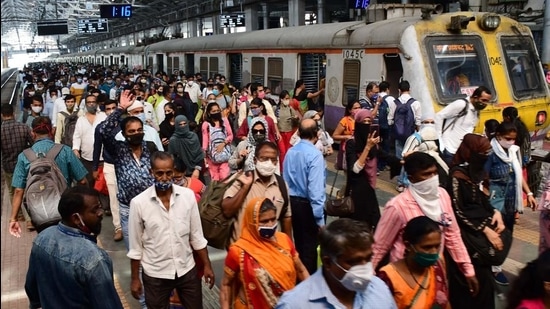
Some things have changed: timings are staggered, Covid-19 protocols are in place. Some things haven’t: people still crowd the footboard. A fortnight on, 5 Mumbaiites explain what it feels like to use the city’s lifeline after nearly a year of suspended services.


At least 15 million people have travelled by local trains on the Central, Western and Harbour lines since February 1 when the suburban train network allowed general commuters after nearly a year. All 1,774 Central Railway trains and 1,367 Western Railways trains in the network were stopped on March 23, 2020, to prevent the spread of the coronavirus pandemic.
Four months later, in July, chief minister Uddhav Thackeray allowed essential care workers like doctors, nurses and medical staff to use local trains. In the following months, women, persons with disabilities, and lawyers were also allowed to travel.
Now, with everyone back on the trains, restrictions have been put in place in an effort to prevent the spread of the coronavirus. The timings are staggered and it will be so till the government takes a call on complete resumption of services: 4.45am to 7am; 12pm to 4pm; 9pm to 11.30pm. Those found without a mask are fined ₹200 by the Government Railway Police. Railway Protection Force personnel have been deputed to control the crowds.
A fortnight on, the positivity rate in Mumbai has begun to rise — experts cite the crowding in trains as one of the factors responsible — we speak to five Mumbaiites to ask them why they’re boarding the local. Read their profiles:
‘My commute has come down from 7 hours to 2’
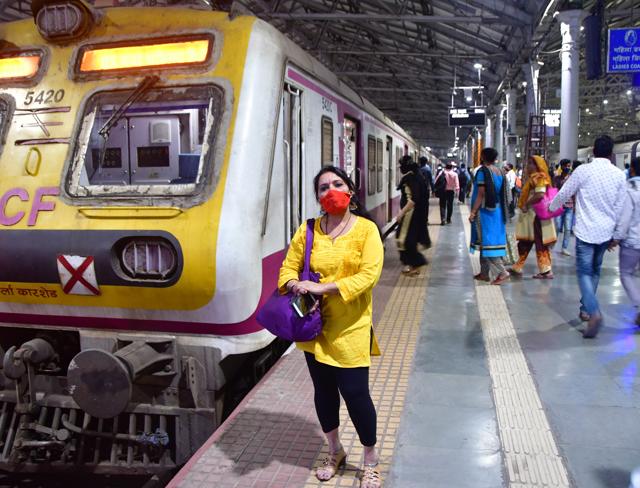
“There is no Mumbai if there are no local trains operating,” Jyoti Nair, a resident of Dombivli, Thane said, as she took a seat in the train compartment last week. She has been travelling by local trains on the Central and Western lines for the past 20 years.
The 44-year-old works as an office assistant in a private firm that sells pipe valves, located in Masjid Bunder. Her husband works with the Brihanmumbai Electric Supply and Transport (BEST) as a depot manager and her son goes to school.
When Nair resumed office in August, her commute often took up to seven hours.
“I began to take a bus to work. The journey took two hours in the morning and nearly five hours in the evening because of the evening rush hour. It was simply horrific,” Nair said.
Not only was it expensive — Nair would spend ₹400 every day travelling in the AC bus — it also meant that she would barely get a few hours of sleep she also had to leave her home early. “I would get up by 3am to do the household work before heading to the office. I developed a back pain travelling on the bad roads,” she said.
Then, in October, Nair was robbed close to the bus stop near her house.
“I have never had such a terrifying experience. Somewhere near the bus stop, a few people snatched the chain I was wearing,” Nair recalled.
Now that Nair takes the local, she said, her life is easier. She still leaves early — she takes the train in the earliest time slot — but she’s saving on both time, and money.
“I am not just saving money but also travelling time. My commute time has come down to two hours,” said Nair.
What would help is if more trains begin to ply, Nair said.
Nair is not worried about crowds, she said. “Crowding inside local train compartments is bound to happen. I take precautions, wear a face mask and use hand sanitizer,” she said.
‘Normalcy once all offices open’
Train commuters often kept time with the 5,000-strong network of dabbawalas who delivered home-cooked food to office goers from Ambernath and Virar to Colaba and Churchgate between 12.30pm to 1.30pm every day (except Sundays). However, once the nationwide lockdown came into effect on March 25, the dabbawalas went out of work.
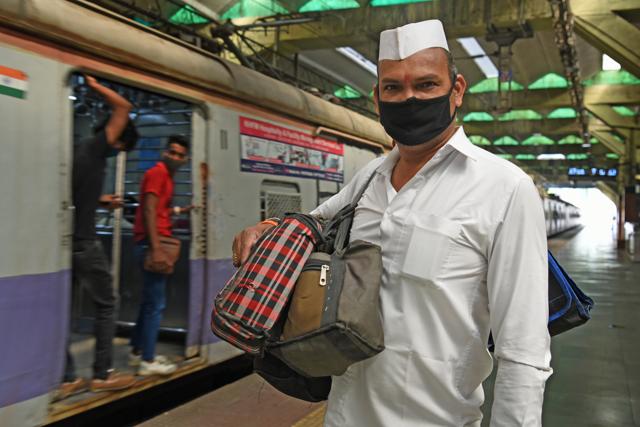
Sandeep Gaikar, who has been a dabbawala for 30 years, missed his itinerant lifestyle. “I travelled everywhere by the local train to deliver tiffins across the city. I travelled on the Central and Harbour lines,” said the 45-year-old.
Though Gaikar’s landlord waived his ₹5,000 rent for some months during the lockdown, his family faced hard days. The Kalyan resident was the only earning member of his family till the pandemic hit. As his monthly income, which ranged at around ₹15,000 came down to zero,
Gaikar eventually moved back to his village in Junnar in Pune district — which he had left at 15 to work in the big city — where he farmed on his family’s small landholding. Gaikar returned to Mumbai in three months and took up a part-time gig as a security guard.
Gaikar’s wife, Kavita (37) now works in a small tailoring unit while daughter, Pratiksha (18), will begin college this year. Son, Sahil (16) will now attend school in the village.
“The cost of education is high in Mumbai,” Gaikar said.
“It is a blessing that the local train services have finally resumed for the general public. We have suffered for one year as no other mode of public transport is possible for moving the number of tiffins we do,” Gaikar said when we met him at Sanpada station.
It’s not the same however, he said. “Many dabbawalas have returned to their village. People are working from home, so there are not many tiffins to deliver,” he said.
“Earlier, one dabbawala would carry 30 tiffins. Now we carry barely eight,” said Gaikar, who collects tiffins from Kalyan and delivers them to the Agricultural Produce Market Committee in Vashi.
The staggered timings do not affect Gaikar. In fact, he said, he often finds the trains empty enough for him and his tiffin stand. But he isn’t happy about it.
Only after all offices resume, our work will get back to normal,” he said.
‘I’m worried about putting my grandmother at risk’
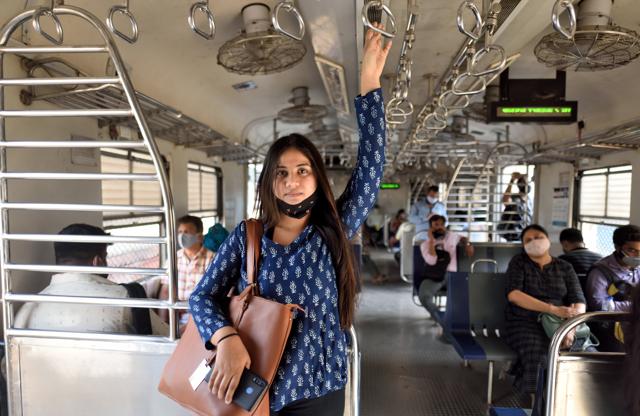
“Travelling by local trains is a compulsion and no passenger follows the coronavirus protocol,” 21-year old Vishwa Shah said, on her way to Bandra.
A student of clinical psychology at RD National College, Shah has been a regular commuter on the local trains since her school-going days.
Now, a whole year after she last boarded the train, Shah, a resident of Kandivli’s Mahavir Nagar, has begun travelling to college to submit her assignments in person. Physical classes will resume on February 15 at 10am sharp, Shah said.
Once classes resume, Shah will have to leave in the first slot (4.45am to 7am) of staggered timings — a full three hours before her first class. Her classes will end by 8pm, which means Shah will have to wait an hour before she takes the train back home. Shah said the other option of travelling by auto and cab is too expensive — she will have to shell out ₹500 both ways.
“I don’t have any other option,” Shah said.
For Shah, this is all the more worrisome as she lives with her grandparents (both 75; her grandmother is on medication for hypothyroidism) and her parents (her father aged 51 is diabetic; her 47-year-old mother does not have any co-morbidities).
Travelling frequently by local trains will increase her exposure to the virus, and in turn put her family at risk, she said. “At least I follow all the coronavirus protocols and wear gloves and masks during commuting,” she said.
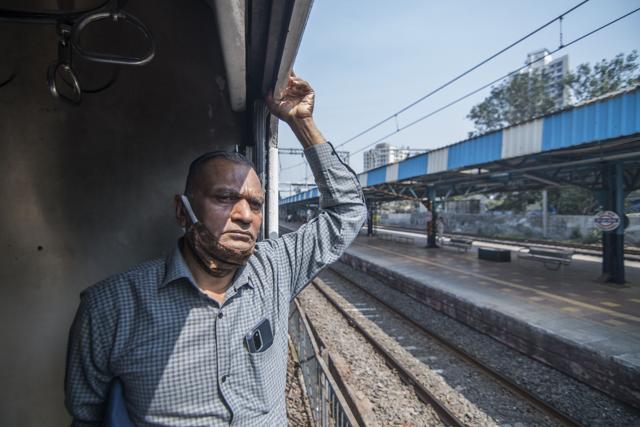
‘Traffic made travelling by road a horror’
The local train has been Kalbadevi resident Nirmal Jain’s trusted mode of transportation since he started his garment wholesale business. His business takes him to Santacruz and Thane frequently besides other parts of the city, visiting shopkeepers and increasingly, online sellers.
But when the lockdown was announced in end-March 2020, thousands of businessmen like Jain were affected. The 62-year-old began to use his Hero Honda motorcycle to make his rounds once restrictions on movement were eased.
From spending two hours in the local, his commute went up to four hours a day on road. “I could not travel everyday because of the cost of fuel, which increased significantly.” said Jain. “I was forced to spend four to five hours commuting. Traffic in the western suburbs and on the Eastern Freeway made travelling a horror,” he said.
Now that the trains are back on track, albeit with staggered timings, Jain is happy. The lone breadwinner of his family— he lives with wife, Manju, children Swagat and Prashansa and daughter-in-law, Sohi—Jain is happy that he’s back to saving money on travelling.
On average, Jain said that he spent up to ₹1,000 every day on fuel, travelling from his south Mumbai home to the western suburbs and Thane.
“The fuel cost was double of what a railway pass costs. Initially I had to dip into my savings for this additional cost,” Jain said.
The local train timings work well for Jain as he begins his work day only after lunch and returns late. “I finish my meal and then take a local train from Marine Lines railway station. I visit multiple shops and online store owners throughout the day and return home at night,” Jain said.
Jain said that a majority of his fellow passengers stick to the protocols, but crowding is a difficult issue to manage.
“A few passengers do not wear masks inside the compartment but they are immediately told off and asked to mask up by the others around them. People are knowledgeable about the virus but there are incidents of crowding inside compartments. All passengers want to board at once,” Jain said.
Nevertheless, he is happy the trains have resumed. “Even with restricted timings the local trains are a boon. Like me there are other businessmen who are saving time and cutting down on travelling costs. The city will come back to normalcy as the markets slowly open,” he said.
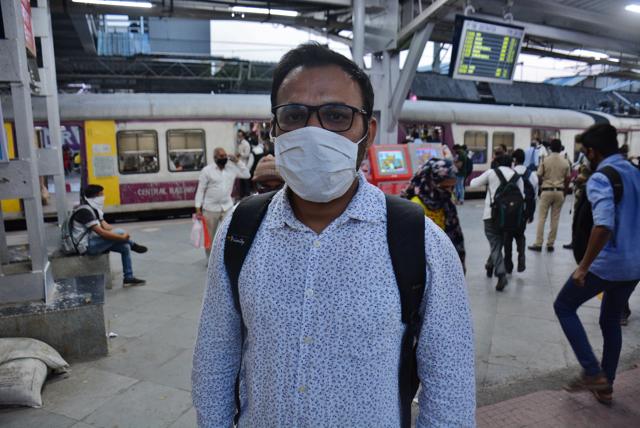
‘It’s impossible to board the train’
Rakesh Patil, a 32-year-old resident of Kasara, works as a coordinator in the district collector office in Thane.
“My work involves a lot of travelling,” said Patil, who lives with his wife Sadhna, 28; daughter Sarah, 4; and his brother’s family.
Patil’s work involves inspection visits to forest sites. He is also required to meet officials from different government agencies like Thane Municipal Corporation (TMC), Kalyan Dombivli Municipal Corporation (KDMC).
Though this involves a good deal of travelling, Patil uses the bus and other public transportation modes quite regularly. So the staggered timings do not affect him, he said.
“It’s the people coming from far away areas like Igatpuri to reach Kasara station who are most affected by the restricted timings. I live close to the station,” he said.
Patil has been travelling by local trains for 16 years — as a student, and later, for work — so he was excited when the trains resumed on February 1.
But he gets worried when he sees crowds, Patil said. “It’s almost impossible to board a train,” he said.
“It is not possible to avoid crowds completely. I wear facial masks and wash my hands regularly. It is necessary to take precautions and I follow the protocols,” Patil said.
Stay updated with all the Breaking News and Latest News from Mumbai. Click here for comprehensive coverage of top Cities including Bengaluru, Delhi, Hyderabad, and more across India along with Stay informed on the latest happenings in World News.


