
 E-Paper



Hinjewadi-Shivajinagar line opens to commuters today
The new corridor, connecting Maan-Hinjewadi’s information technology (IT) hub with Shivajinagar, is expected to provide a faster commuting option to thousands of IT employees and residents.

 Prefer HTon Google


Pune Metro to expand by 44 km; four new corridors planned under phase 2
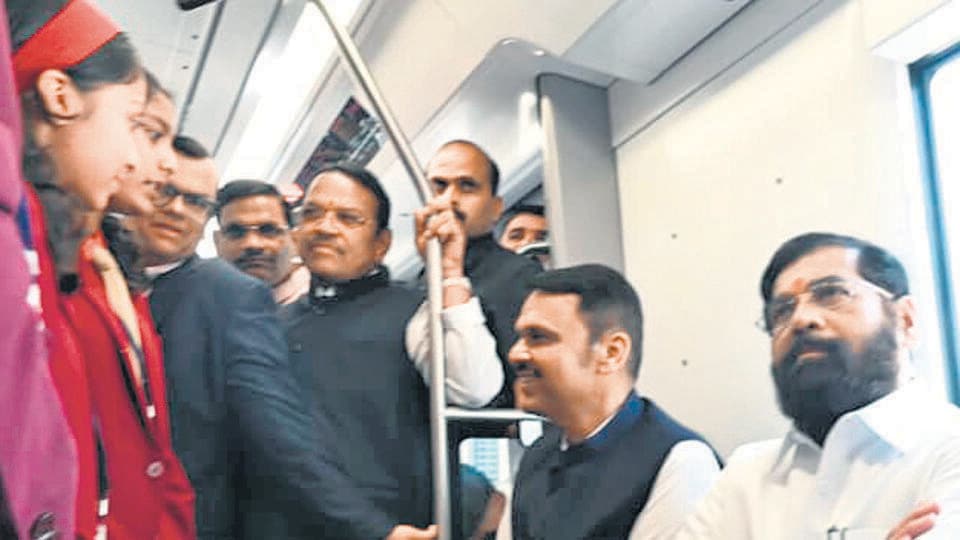
PUNE: The Pune Metro is set for a 44.39 km expansion, with four new corridors proposed under phase 2; even as the 23.2 km Hinjewadi-Shivajinagar metro line 3 is scheduled to open to passengers from Wednesday. Prime Minister Narendra Modi on Tuesday inaugurated the new corridor and laid the foundation stone for the next phase of expansion, describing improved public transport as essential to Pune’s economic growth and urban development.
The new corridor, connecting Maan-Hinjewadi’s information technology (IT) hub with Shivajinagar, is expected to provide a faster commuting option to thousands of IT employees and residents. Developed at a cost of ₹8,313 crore under the public-private partnership (PPP) model, the elevated corridor has 23 stations and is also known as the Pink Metro.
“Despite several challenges, the metro line was completed and is now operational,” Chief Minister Devendra Fadnavis said.
Addressing the inauguration ceremony virtually, PM Modi said, “The expansion will strengthen connectivity between the older parts of Pune and its rapidly developing eastern and western suburbs.” The PM described Pune as an important centre for information technology, automobiles, pharmaceuticals, startups, innovation and manufacturing, and said improved metro connectivity will support its economic growth.
The proposed phase 2 network will add 44.39 km and 41 elevated stations at an estimated cost of ₹13,484.09 crore. It will cover four corridors through a combination of new lines and extensions to the existing network; connecting major residential, commercial and employment centres across the city.
The proposed expansion includes line 4 from Kharadi to Khadakwasla, spanning 25.52 km with 22 stations; and line 4A, a 6.12 km spur from Nal Stop through Warje to Manik Baug, with six stations. Together, these two corridors are estimated to cost ₹9,857.85 crore and are proposed to be completed over five years.
The other two corridors will extend the existing metro network westwards and eastwards. The 12.75 km expansion, comprising 13 stations, will cover the Vanaz-Chandani Chowk stretch and the Ramwadi-Wagholi/Vitthalwadi stretch, at an estimated investment of ₹3,626 crore.
The expansion is expected to improve connectivity to Kharadi, Wagholi, Magarpatta, Hadapsar, Swargate, Khadakwasla, Bavdhan, Chandani Chowk and the Sinhagad Road belt. Interchange facilities are proposed at Swargate, Nal Stop and Kharadi bypass to integrate the new corridors with the existing metro network.
According to project estimates, the expanded network is expected to carry around 4.09 lakh passengers daily by 2030. The larger network is intended to reduce dependence on private vehicles, ease congestion, and improve access to major IT parks, educational institutions and commercial centres.
About the broader expansion of metro infrastructure, Modi said, “India had only 248 km of operational metro lines in 2014. The network has since grown to nearly 1,200 km, with services available in 26 cities and more than one crore passengers using the system daily.”
According to Modi, Maharashtra had around 10 to 11 km of operational metro lines in 2014 but now has nearly 200 km of operational routes, while work is underway on more than 680 km. “Investments exceeding ₹2.5 lakh crore have been made in metro infrastructure in the state.”
Modi said that metro services have helped reduce commuting time, improve urban productivity and contributed to economic growth. Modern public transport, he added, is essential to improving the competitiveness of cities and the quality of life of their residents.
Referring to the Hinjewadi-Shivajinagar corridor, Modi said, “Its development under the PPP model demonstrated how the government and private sector could work together to create infrastructure and new development opportunities.”
The PM also referred to the Centre’s ₹1 lakh crore ‘Urban Challenge Fund’, aimed at developing cities as growth centres and attracting investments in urban infrastructure.
The new line 3 is the country’s first metro project developed under the PPP-DBFOT (design, build, finance, operate and transfer) model, according to the project details. It also places emphasis on women’s participation, with around 90 women train operators expected to operate services on the corridor. Women are expected to constitute nearly 50% of its workforce.
The inauguration ceremony was attended by governor Jishnu Dev Varma, Union housing and urban affairs minister Manohar Lal (virtually), chief minister Devendra Fadnavis, deputy chief ministers Eknath Shinde and Sunetra Pawar, Union minister of state Murlidhar Mohol, state minister Chandrakant Patil, minister of state Madhuri Misal, Pune mayor Manjusha Nagpure, Pimpri-Chinchwad mayor Ravi Landge, and MP Shrirang Barne among others.


