
 E-Paper



Navale Bridge crash puts pending gradient correction back in focus
The latest crash has once again exposed the difficulty of managing the descent through enforcement and short-term safety measures alone

 Prefer HTon Google


The death of a 22-year-old worker who was killed and six others injured after a container rammed into multiple vehicles on the Navale Bridge–Bhumkar Bridge stretch of the Mumbai-Bengaluru highway on September 19, has brought focus back on a permanent engineering fix that has remained pending despite repeated accidents on the descent.
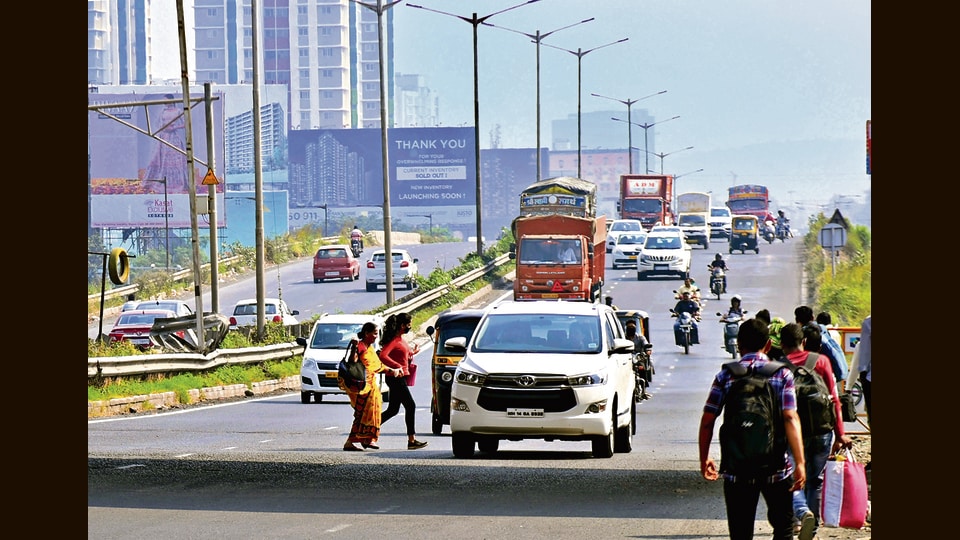
The stretch between Jambhulwadi Dari Pool and Navale Bridge Chowk has been identified by the National Highways Authority of India (NHAI) as a critical safety concern because of its steep gradient. Following an earlier joint inspection, NHAI officials had proposed reducing the gradient from 3.4% to 2.5% and prepared a detailed project report for the work. The correction, however, is yet to be carried out.
The latest crash has once again exposed the difficulty of managing the descent through enforcement and short-term safety measures alone. The corridor has witnessed several serious crashes involving heavy vehicles, with officials and road-safety experts pointing to speeding, loss of control and road geometry among the factors behind accidents.
A senior NHAI official said the gradient correction involved substantial engineering work and could not be completed through routine safety interventions.
“Gradient correction is a major engineering intervention and requires planning, approvals, funding and execution. Until the permanent work is completed, we have to depend on enforcement and safety measures such as rumblers, speed monitoring and signage. But every fatal accident shows why the long-term engineering solution cannot be delayed,” the official said.
After previous crashes, authorities had introduced or announced a series of measures, including additional rumblers, speed-gun checks, inspection of trucks at the Khed-Shivapur toll plaza and measures to close road gaps and improve service roads. The possibility of diverting heavy vehicles through alternative routes was also examined.
NHAI has also moved ahead with plans for escape ramps for heavy vehicles that lose control while descending the stretch. A contractor has been appointed for the ramps and work is expected to begin shortly.
For residents, however, each new crash is a reminder that the problem has not gone away.
“Every time there is a major accident, officials visit the spot, and new measures are announced. But after a few days, the attention reduces, and we are back to the same situation. Heavy vehicles continue to come down the slope at high speed, and residents have to live with the fear of another crash,” said Kedar Mane, a resident of the Navale Bridge area.
Another resident, Jay Lahigude, said policing alone would not solve the problem.
“We have seen rumblers, speed checks and signboards being added, but accidents continue. The authorities have been talking about changing the gradient and improving the road infrastructure for a long time. Unless these permanent works are actually completed, people living and travelling here will remain at risk,” he said.
The September 19 crash has thus revived questions over the implementation of the long-term safety measures proposed for the accident-prone corridor, particularly the gradient correction that authorities had identified as an engineering intervention more than a year ago.


