
 E-Paper



Pune students use algae, moss to develop natural building-cooling system
The students have developed a porous coating using locally available materials such as recycled brick powder, silica fume, expanded clay and kaolin


In an attempt to find nature-based solutions to rising urban temperatures, a team of students from MIT World Peace University (MIT-WPU) has developed a biological coating using algae, moss and cyanobacteria that could help cool building exteriors and reduce dependence on conventional cooling systems.
The project, titled ‘Bioreceptive Façade System for Passive Cooling in Indian Climates’, was named a winner of the Youth for Earth (Y4E) Campaign 2026, organised by the Mobius Foundation and The Climate Reality Project. The team received recognition at the 8th International Conference on Sustainability Education (ICSE) 2026, held at the India Habitat Centre in New Delhi.
The interdisciplinary team comprises four final-year BTech students from the university’s Department of Bioengineering and two students from the Department of Computer Science and Engineering. The project was developed under the guidance of faculty members.
Unlike conventional green walls that require soil and irrigation infrastructure, bioreceptive façades use specially designed coatings that provide a surface for biological growth, including algae, moss and cyanobacteria. These living layers can help reduce heat through evapotranspiration, which draws heat away as water evaporates, and solar shading, which limits direct sunlight reaching the building surface.
The students have developed a porous coating using locally available materials such as recycled brick powder, silica fume, expanded clay and kaolin. The research also involves identifying heat-tolerant Indian algae and moss species and developing a carrageenan-based bio-gel to support biological growth.
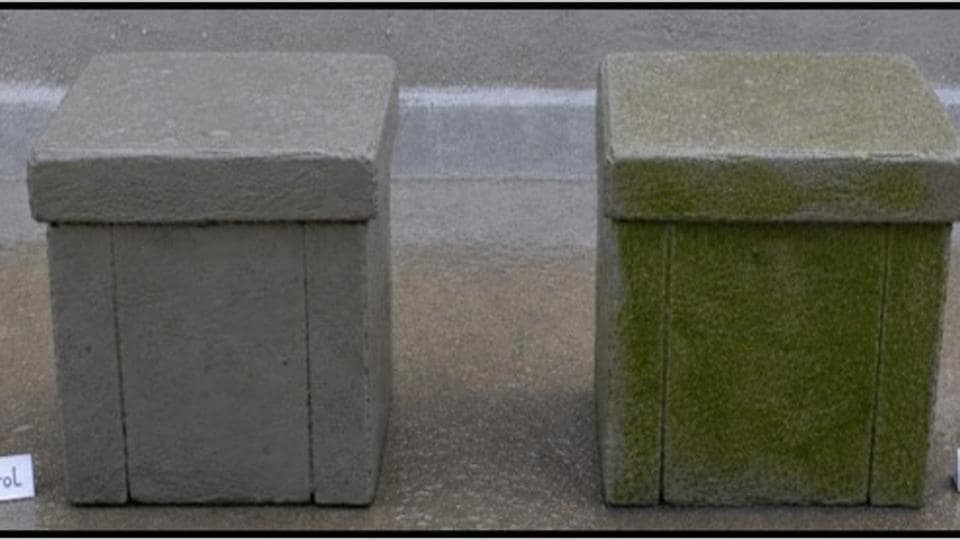
As part of the initial research, the team built a prototype using a five-brick clay wall section with a 10-mm cement base. The surface was coated with locally sourced green algae and Chlorella vulgaris. Its thermal performance was monitored twice a week between June 7 and July 7, 2026, and compared with an identical cement-coated wall without biological growth. The north-facing prototype was observed during both pre-monsoon and monsoon conditions.
Research on similar systems in countries such as the Netherlands and Belgium has reported surface temperature reductions of up to 30°C. The MIT-WPU project explores whether such technology can be adapted to India’s hotter and more variable climatic conditions. The research examines the potential for biological façades to reduce building surface temperatures by 15–30°C, although further testing is required to establish their performance under Indian conditions.
Sharbani Kaushik, programme director, Department of Bioengineering, School of Engineering and Technology, mentor of the project, said, “Algae and cyanobacteria use sunlight and carbon dioxide to manufacture their own food, making them interesting candidates for sustainable building coatings. Our focus is to identify species and materials that can withstand Indian climatic conditions and explore how biological systems can help make buildings more climate-responsive.”
Sheetal Kulkarni, assistant professor, Department of Computer Science and Engineering Technology, and mentor, said the project has enabled students from different disciplines to work together on a real-world challenge.
“By combining bioengineering with application development and real-time data display, they are exploring how technology and biological systems can work together to develop practical solutions,” she said.
The team is now exploring the coating’s long-term durability, its performance on buildings with different orientations and its potential alignment with India’s National Building Code and GRIHA green building framework. The project aims to offer a nature-based approach to urban heat mitigation, reduce dependence on mechanical cooling and promote urban biodiversity.


