
 E-Paper



Startup Mantra: From railway linen checks to multi-tasking AI robots
Over three and a half years, Sakar Robotics has grown into a team of 35, expanding its portfolio beyond railway solutions to develop new products

 Prefer HTon Google


A problem with inspecting Indian Railways’ linen gave Sakar Robotics its starting point. Today, the company is looking beyond that first application to build robots capable of handling different tasks across industries.
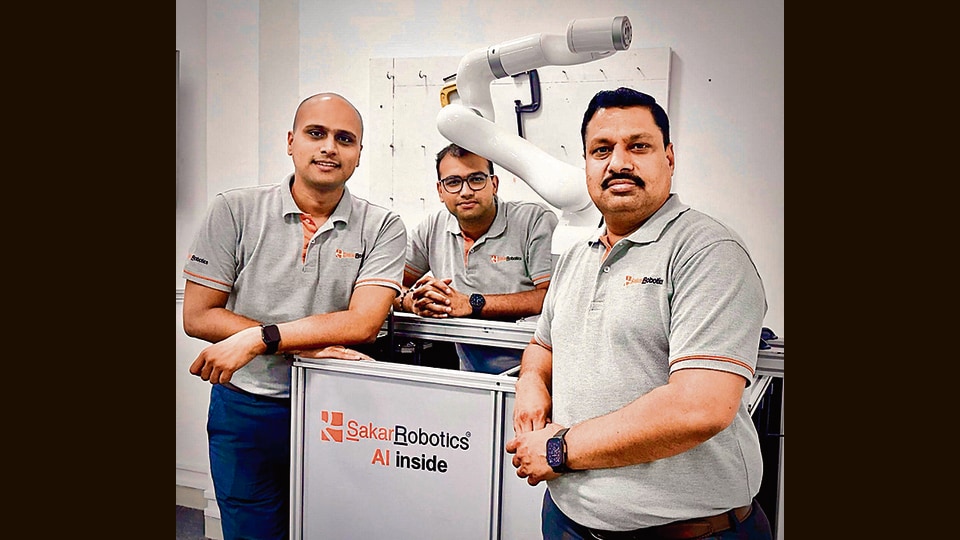
The journey began with an ambition to become an entrepreneur. Karan Patil, 27, who had completed his Masters from College of Engineering, Pune (CoEP) in 2022, always wanted to be an entrepreneur. Says he, “I never even looked for a job. I used to read books on business and listen to podcasts, looking for a way to get started. The lesson that stayed with me was that an idea need not arrive as a sudden flash of inspiration. It could emerge from conversations too. So I started by talking to people, asking them what problems I could solve for them using AI and robotics.”
Initial steps
Those conversations brought Karan and his two co-founders, Manoj Pochat, 41, and Dhruv Patil, 24, to zero in on quality inspection requirements for railway linen. The three began examining the problem and concluded that it offered both scale and a fit with their skills.
The first proof of concept was built within four months of the company’s start. Developing it into a product took considerably longer, with about seven iterations so far. Says Karan, “The Railways outsources its laundry needs. They have contractors who do this for them. We have our robots placed at their site, which then examine four parameters for the Railways: whiteness of the sheets, stains, the intensity of the stains and if the linen is torn or not.”
Over more than three-and-a-half years, Sakar Robotics has now grown into a team of 35. Alongside refining its railway solution, it has developed other products for its portfolio.
Challenges
Getting the first employees on board was difficult. The founders had to convince prospective recruits to back a young company and its robotics plans.
“Initial hiring took a lot of convincing and sharing our vision of how robotics can change lives,” says Karan. “The passion for building robots is shared amongst all 35 of our team members.”
The company’s development has depended on investment in people, machines and capital. For the founders, bringing these together has been essential to turning technical capabilities into products customers will buy.
Indian Railways provided an opening for the first sale through its innovation programme. The founders say they received a commitment of support if they could build the required solution. But demonstrating that it worked in an operating environment was challenging.
“The first sale was both easy and difficult,” the co-founder says. “There was a commitment that, if we could build it, the railways could fund us through their innovation programme. But proving the technology in that environment was a very big challenge.”
Scaling across different railway divisions took additional time. The experience helped shape the company’s approach to acquiring customers: use demonstrations and proofs of concept to establish the value of automation.
To the market
Its sales pitch centres on showing customers improvements in efficiency, quality and costs. The company believes a working demonstration makes the investment easier to assess.
Sakar Robotics currently sells complete solutions and takes upfront payments. Says Karan, “We have deferred subscription and robot-as-a-service models because of the cash needed to support a growing hardware business. Since we are growing as a company, cash is always required.”
Funding and revenue
According to Karan, Sakar Robotics revenues reached ₹1.2 crore in the previous financial year. It expects to exceed ₹5 crore in annual revenue in the current year. The three co-founders have invested more than ₹25 lakh in the business. The company has raised pre-seed and seed funding, reporting approximately ₹12 crore in equity and ₹5 crore in debt.
Says Karan, “We plan to raise a further ₹50 crore in the coming months. This would support work on “physical intelligence”, particularly vision-language-action models that connect visual information and language instructions with robotic actions. The aim is to deploy these models on available hardware to solve a wider range of customer problems.
SakarBot is central to that ambition. Combining mobility with the ability to handle objects, it is intended to bring multiple tasks into a single automation system.
Path ahead
“SakarBot is one of the most important products in our journey because mobile manipulation can bring many jobs into a single automation system,” says Karan. They completed a project for a refrigeration company where their robots pick, manipulate and place certain objects of a larger part of their machine.
Newer areas of focus have also been an industrial floor cleaning robot that can clean up floor spaces over 1 lakh sq ft. Says Karan, “We want our customers to be able to train the robot for their specific requirements. We see huge opportunities in semiconductor, pharmaceutical and food-processing industries.”
Big picture
For now, their challenge is to translate that broader vision into reliable products, while managing the demands of recruitment, development, customer acquisition and cash.
Says Karan, “Over five years, we aim to cross ₹1,000 crore in annual revenue. Achieving this ambitious target will mean taking our technology into more customer environments, demonstrating its usefulness and scaling deployment.”
Its experience with railway linen has already shown the founders that building a prototype is only the beginning. Converting it into a business requires repeated improvements, patient selling and the money to keep building.


