
 E-Paper



Five major political trends from 2018
The turning of the cycle is the biggest political trend of the year

 Prefer HTon Google


That politics, like business, follows cycles was evident in 2018.
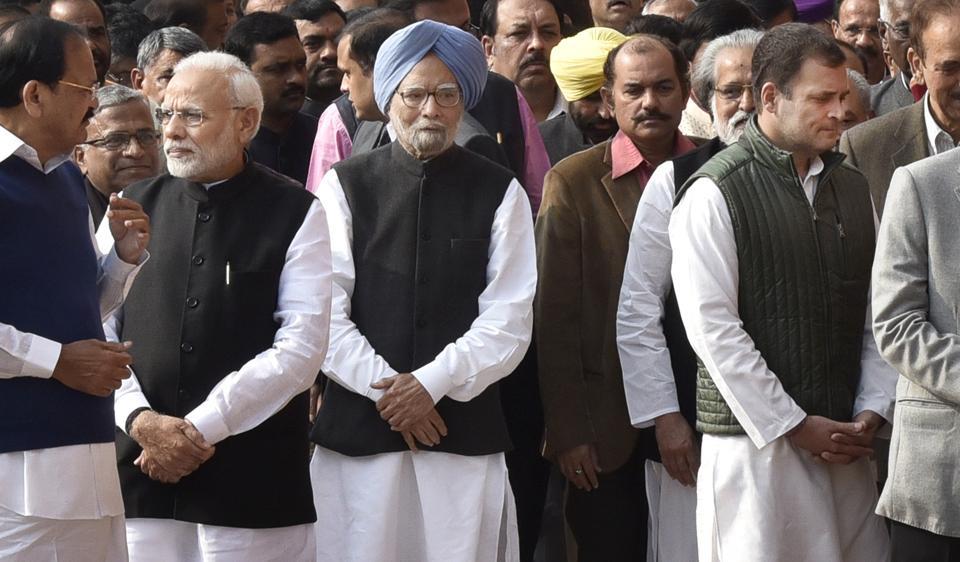
At the beginning of the year, the Bharatiya Janata Party (BJP), despite scraping through to win Gujarat in late 2017, was still on a high. The opposition, especially the BJP’s main rival, the Congress, appeared in tatters. The BJP looked invincible, and Prime Minister Narendra Modi seemed a shoo-in for 2019.
Modi may still be the most popular political leader in the country as the year ends, but a lot of other things have changed.
The BJP is now in power in five fewer states than it was at the beginning of the year. The air of invincibility that once surrounded the party is gone. The Congress is resurgent. Through the year, it has held Parliament to hostage, belying the fact that it won a mere 44 of the 545 seats in the Lok Sabha in 2014. To be sure, this isn’t something any party should be proud of in a Parliamentary democracy, but the BJP, when it was in opposition between 2004 and 2014 patented a disruption-led approach as its own; the Congress has followed suit. Other opposition parties also seem energised. There is a sense that it is possible to defeat the BJP — something that seemed inconceivable at the start of the year.
And so, the turning of the cycle, is the biggest political trend of the year.
In state after state, a clear non-BJP political axis in emerging.
It is now certain that the Congress, the Dravida Munnetra Kazhagam (DMK) and the Left parties will form a grouping in Tamil Nadu. In Bihar, a coalition of the Congress, the Rashtriya Janata Dal, the Rashtriya Lok Samata Party, and four others is already in place.
In Uttar Pradesh, there is speculation that the Samajwadi Party (SP), the Bahujan Samaj Party (BSP), and the Rashtriya Lok Dal have already forged an alliance, although the Congress may still be in play (there is buzz that Congress President Sonia Gandhi is meeting BSP supremo Mayawati, with whom she shares a warm relationship, in Delhi).
The Congress and the Telugu Desam Party will probably come to an understanding in Andhra Pradesh (if they already haven’t). In Maharashtra, the Nationalist Congress Party and the Congress are in talks, and look likely to fight the 2019 election together.
Then there are Gujarat, Rajasthan, Madhya Pradesh, and Chhattisgarh, where the Congress is in a reasonably sound position to form an anti-BJP grouping given its performance in the assembly elections in these four states. In Karnataka, the Congress and Janata Dal (Secular) alliance, already in power, looks set to contest the parliamentary polls together.
That’s 350 seats where there is already a clear (or soon-to-be-clear) anti-BJP alliance. Add to the mix West Bengal, where the Trinamool Congress is likely to win the majority and Odisha, where the Biju Janata Dal is the dominant party, and it is evident that at least at the state level, the competition is quite clear for at least 75% of the seats in the Lok Sabha.
That — the re-emergence of the importance of local players who seemed to wilt under the initial onslaught of the BJP (think the SP and the BSP in Uttar Pradesh, for instance) — is the second big political trend of the year. Indeed, many analysts maintain that it is in the best interests of all opposition parties to see 2019 as a battle of the states.
The problem for the opposition is that such a battle-of-states approach may make it difficult for them to arrive at a consensus on leadership. Already, there are at least three leaders who have been spoken of as a prime ministerial candidate in these parties: Rahul Gandhi, Trinamool chief and West Bengal CM Mamata Banerjee, and the BSP’s Mayawati. There may be more.
A year ago, Gandhi may not have made this cut and the fact that he does is the third big political trend of the year. With Rafale, Gandhi managed to convert what some see as a non-issue into an issue. He has also taken ownership of the farm loan waiver issue, and the speedy announcements of waivers by Rajasthan, Chhattisgarh, and Madhya Pradesh (within two days of a Congress government taking over) is unlikely to have gone unnoticed.
Many of the recent elections were won, and lost, on issues that aren’t entirely new: an agrarian crisis; lack of jobs; and caste and class. Since late 2013, many of the elections India witnessed have seen waves, usually in favour of the BJP. With the wave ebbing, it shouldn’t surprise anyone that old unsolved issues are back. That, the end of the wave and the return of old problems, is the fourth big political trend of the year.
The fifth trend, and we need spend very little time on it because it isn’t a new one, is one that has shaped every election since late 2013: the Modi factor. It was evident in Rajasthan where the Congress should have won a landslide win but didn’t. Sure, it may be fraying at the edges as anything that is five years old will, but it is there, and will probably play a leading role in deciding what happens in 2019.
chanakya@hindustantimes.com


