
 E-Paper



Government withholds ‘munshi-maulvi at par’ proposal
The state government’s recognition to the madrasa education at par with the state board school education seems a distant dream in Uttarakhand.


The state government’s recognition to the madrasa education at par with the state board school education seems a distant dream in Uttarakhand.
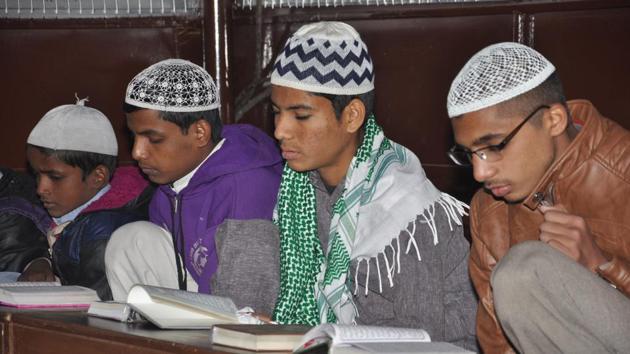
The government has withheld the madrasa board’s proposal seeking equivalent status to “munshi and maulvi” (both meaning teacher in Hindi and Urdu respectively) at the inter-school and high-school levels in the state. The government has asked the board to strengthen infrastructure and quality of education in the madrasas run by it before considering the proposal.
“We are concerned over poor quality and weak infrastructure in madrasas. We have held the proposal for the time being and have directed to upgrade status of education,” said Alok Shekhar Tiwari, the director general (DG) of school education.
There are 297 madrasas in Uttarakhand, of which only one — situated in Roorkee — is recognised by the government. Remaining 296 madrasas are running on donations.
Last year, the DG of school education had constituted 34 committees to analyse the status of madarsas in the state. During the analyses, irregularities related to infrastructure, delivery of education and distribution of mid-day meal were discovered in three madrasas of Udham Singh Nagar, following which their registration were revoked.
Sources familiar with the matter said the government isn’t in a hurry to bring the madrasa degrees at par with the state board’s degrees, as it “might lead to a business of degrees”.
“There are missionary schools whose quality of education is so high. Then why madrasas aren’t able to deliver? The government fears that bringing the (madrasa) degrees at par (with the state board’s degrees) could be misused. So, unless madarsas deliver their best, it’s not possible to allow them such a facility,” an education officer familiar with the matter said.
The committees, asked to analyse the status of madrasas, found that nearly 30% of the madrasas didn’t have toilet and drinking water facilities. Tiwari had written to the madrasas seeking a proposal, so that toilets could be constructed at the madrasas through Sulabh under the Maulana Azad Education Foundation scheme. But even after repeated reminders, no proposal was received, the official claimed.
Tiwari then directed the madrasas to ensure compliance else their registration could be cancelled. In response, 100 madrasas complied with the order and sent proposals.
Sibte Nabi, the chairperson of Madarsa Welfare Society, said, “We agree there’s lacuna in the madarsas with regard to quality and better infrastructure. But that should not block the affiliation of degrees.” Nabi threatened to start an agitation if the proposals were not accepted.
SA Farooq, an educationist, advocated the government’s efforts towards strengthening the quality of education in madrasas. “Many orphans study in madrasas and, therefore, its comparison with missionary schools should not be done. But if the government has taken up the task to ensure strengthening (of education quality in madrasas) then I am sure the condition would become better,” he said.


