
 E-Paper



UK website warns of high UV radiation rays in the next few days
If you thought the extreme heat wave sweeping through the country this year was bad news, think again. According to weatheronline.co.uk, New Delhi will have an ultraviolet index (UV) of 12 on May 30, 31 and on June 1.


If you thought the extreme heat wave sweeping through the country this year was bad news, think again. According to weatheronline.co.uk, New Delhi will have an ultraviolet index (UV) of 12 on May 30, 31 and on June 1.

A forecast of 12 on the UV index — which is the international standard measurement of the strength of sunburn-producing ultraviolet radiation at a particular place and time — is quite extreme.
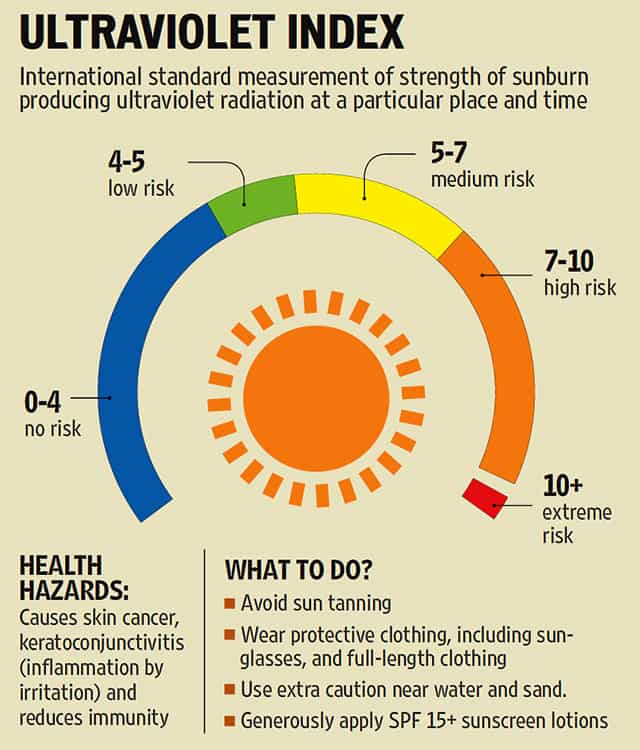
A one to four range on the UV index is considered as no risk, a range of four to five and five to seven are considered as low and medium risk respectively, with UV radiations between the seven to 10 range being classified as high risk. Anything beyond the range of 10 is termed as “critical” or “extreme risk”. Ozone depletion, as well as seasonal and weather variations, cause different amounts of UV radiation to reach the Earth at any given time.
But experts at the Indian Institute of Tropical Meteorology at Pune feel it is a crude estimate based on data provided by a global satellite and the reality may not be that grim.
Gufran Beig, programme officer at the institute, pointed out that monitoring the sun’s ultraviolet radiation has been started in Delhi since May 15, 2015 to complement the city’s air quality forecast services.
“The measurement we have carried out is using an instrument in Delhi. It shows the UV index to be 7.9 on Friday (May 29). This data provided by the UK-based weather website is based on global satellite data and is a crude estimate,” Beig, who is also project director of SAFAR (System Of Air Quality & Weather Forecasting & Research) of ministry of earth sciences, told HT.
But this does not mean that all is hunky dory either.
Dr TK Joshi, director of occupational & environmental health programme at the Centre for Occupational and Environmental Health, Maulana Azad Medical College, said the data couldn’t be taken seriously.
“The data seems suspicious but you can’t dismiss it lightly still. Exposure to UV rays causes skin cancer, keratoconjunctivitis (inflammation occurred by irritation) and reduces immunity. Children and elderly are more vulnerable and should be more careful. Also people who work in the open for hours at a stretch are far more vulnerable. This might be an operational hazard for which they are paying a heavy price,” Joshi said.

Stay updated with all top Cities including, Bengaluru, Delhi, Mumbai and more across India. Stay informed on the latest happenings in World News along with Delhi Election 2025 and Delhi Election Result 2025 Live, New Delhi Election Result Live, Kalkaji Election Result Live at Hindustan Times.


