
 E-Paper



Bihar's poverty explained in four charts | Number Theory
What explains the persistent poverty in the state, from a macroeconomic (not a rhetorical) perspective?
Updated on: Oct 8, 2025, 08:33:30 IST

 Prefer HTon Google
Share via


Copy link

Bihar will vote on November 6 and 11 to elect a new assembly. The parties leading the two major alliances in the state have ruled the state for three and a half decades now. The Rashtriya Janata Dal (RJD) ruled the state from 1990-2005 and the Janata Dal (United) or JD(U) has been in power from 2005 onwards, more than 15 years of which have been in alliance with the Bharatiya Janata Party (BJP). Despite such remarkable political stability in government, Bihar continues to be among the poorest in the country. What explains the persistent poverty in the state, from a macroeconomic (not a rhetorical) perspective? Here are four charts which answer this question.

 Bihar is still the poorest state despite an impressive reduction in povertyAccording to the National Multidimensional Poverty Index (MPI) published by NITI Aayog, Bihar’s poverty rate is the highest among all states and union territories. Multidimensional poverty estimates are based on a host of indicators – NITI Aayog’s MPI uses data from the National Family Health Survey (NFHS) -- rather than just consumption or income levels. To be sure, Bihar has also seen the biggest reduction in its poverty ratio between 2015-16 and 2019-21 which is likely a result of various welfare schemes improving the living condition of the poor. However, Bihar continuing to be the poorest state merits a deeper examination of its macroeconomy.
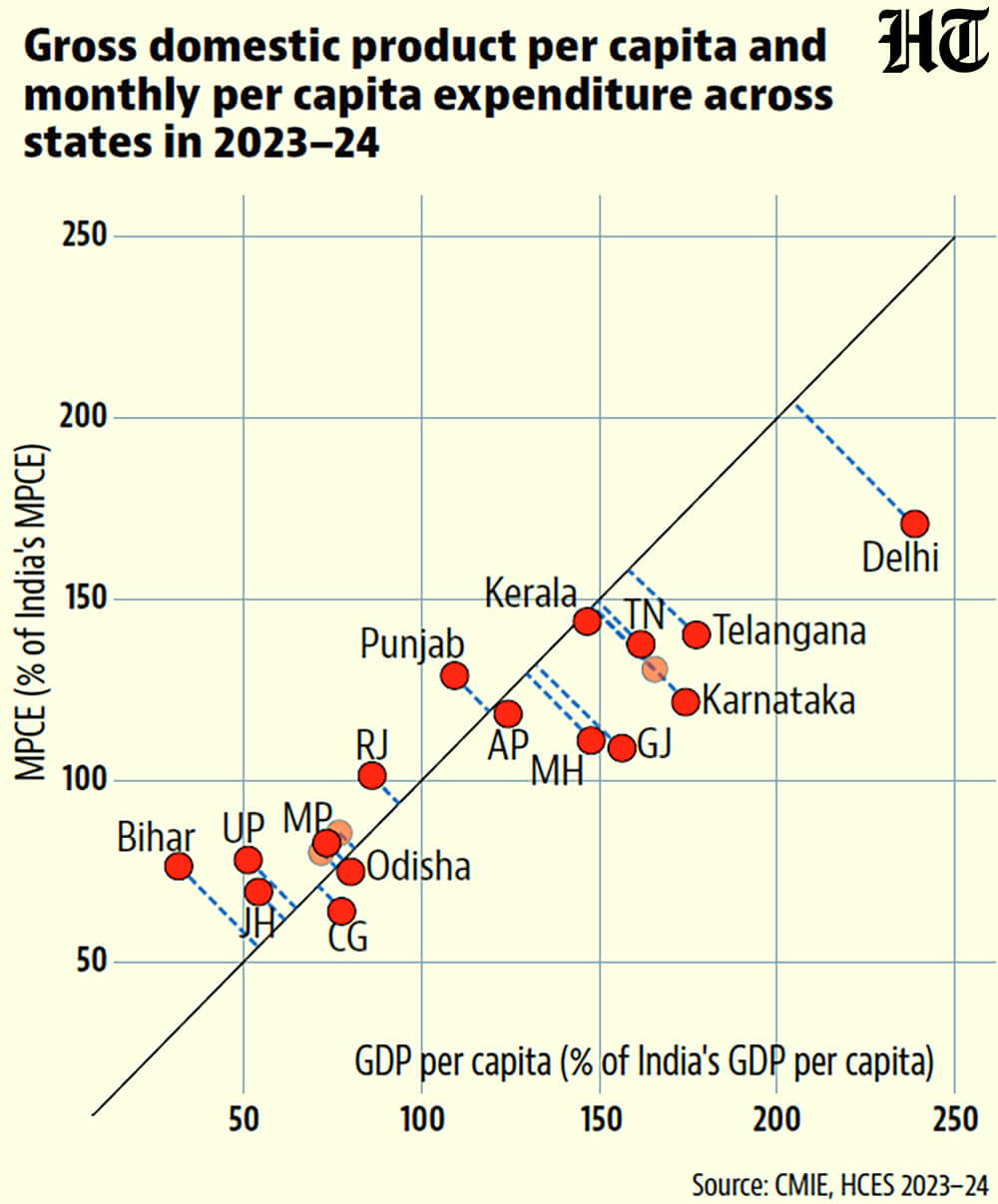
- Bihar’s consumption standards are better than its income standardsBihar’s per capita consumption level, as seen in monthly per capita expenditure (MPCE) levels seen in the 2023-24 Household Consumption Expenditure Survey (HCES) was 76% of the all-India average. This is higher than its per capita GSDP relative to all-India levels. In fact, Bihar has the biggest relative advantage in consumption over income among all major states in the country. This is perhaps a result of migrant workers sending money back home to their families in the state. To be sure, since consumption expenditure surveys are known to undercount the really rich, it is possible that the MPCE of the richer states is an under-estimate and their relative disadvantage in consumption is overstated.
- But Bihar is also a net exporter of capitalWhile poor workers migrating from Bihar to other parts of India is perfectly intuitive, what is surprising is the fact that Bihar also exports capital to the rest of the country despite being the poorest state in the country. This can be seen from the fact that Bihar’s credit-deposit ratio – credit disbursed by banks as a share of deposits mobilized in the state – is just 0.5, fourth lowest among major states in India. This means that for every rupee of deposits made by Biharis in their state, only 50 paisa is disbursed as credit in the state. This is a damning statistic when read with the fact that Bihar’s Gross Fixed Capital Formation or investment spending was just 4.6% of its GSDP in 2023-24 (this number was 33.5% at the all-India level) according to the 2024-25 Economic Survey published by the Bihar government. So why is Bihar exporting capital outside despite being completely investment starved?
- To put it provocatively, Bihar has contractors not entrepreneursCenter for Monitoring Indian Economy (CMIE) database gives the value of investment projects completed in Indian states. This data is available b public and private ownership of the projects as well. A comparison of Bihar’s all-India share value of projects completed by public and private ownership in 2024-25 shows that the state was ranked third in its all-India share in value of public projects completed but was ranked 14th in share in value of private investment projects completed among 19 major states and union territories. A long-term analysis of Bihar’s numbers shows that 2024-25 was not a one-off year in this pattern. This shows that despite doing relatively well in terms of government investments, private capital continues to bypass Bihar when it comes to investment, and therefore future growth. While part of the reason could be the state’s poor investment reputation as a result of legacy issues, questions also ought to be raised on why the state’s own business class has not invested money in the state even as banks are channeling Bihar’s deposits to other states as can be seen from its low credit deposit ratio. The provocative answer is Bihar’s so-called businessmen are happy to make money from government contracts (which is what public investment projects bring) and chase assured returns rather than chase value creation which will entail some amount of risk taking. To take the provocation further, Bihar is a state where the poor are working hard outside the state and sending money back home while the rich are happy to invest their money outside.





Unlock a world of Benefits with HT! From insightful newsletters to real-time news alerts and a personalized news feed – it's all here, just a click away! -Login Now!


