E-Paper



Logical discrepancies in SIR: Decoding the data | Number Theory
The logical discrepancy criteria did not exist during the Bihar SIR. It first attracted attention when the process was underway in West Bengal

 Prefer HTon Google


The Special Intensive Revision (SIR) of electoral rolls, which started with Bihar last year, follows a two-step process: publication of a draft roll and then a final roll. The former presented an opportunity as well as a threat to people removed or retained from the pre-SIR roll. The opportunity was in making a claim that the deletion on account of ASDD (absent-shifted-dead-duplicated) was incorrect. The threat was either being unmapped with the previous SIR roll or being flagged for a so-called logical discrepancy.
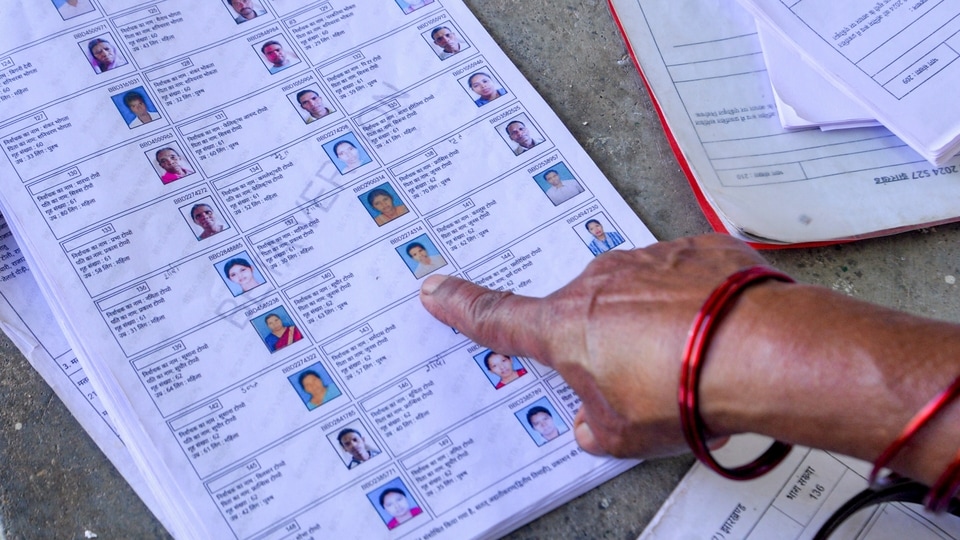
The logical discrepancy criteria did not exist during the Bihar SIR. It first attracted attention when the process was underway in West Bengal. West Bengal is also the only state where electors flagged under this category continue to face adjudication and cannot vote. This has made logical discrepancy notices a big flashpoint in the ongoing SIR debate. Not all states have published detailed data on logical discrepancies, although some in the third phase of SIR have done so. These include Delhi, Telangana, Karnataka and Uttarakhand. While the first three have published a detailed list for most booths in each assembly constituency (AC), Uttarakhand has only published summary statistics; Karnataka has additionally published a summary without giving a break-up of the notices, which can only be obtained by scraping the booth-wise PDFs. To be sure, the Maharashtra CEO also appears to have published lists, but the CEO’s website has the list for only six districts so far. It is possible that other CEOs have such lists, but HT could only find the lists on the CEO’s website for only the states/UTs listed here. What exactly can we say about this category? Here is what an HT analysis shows.
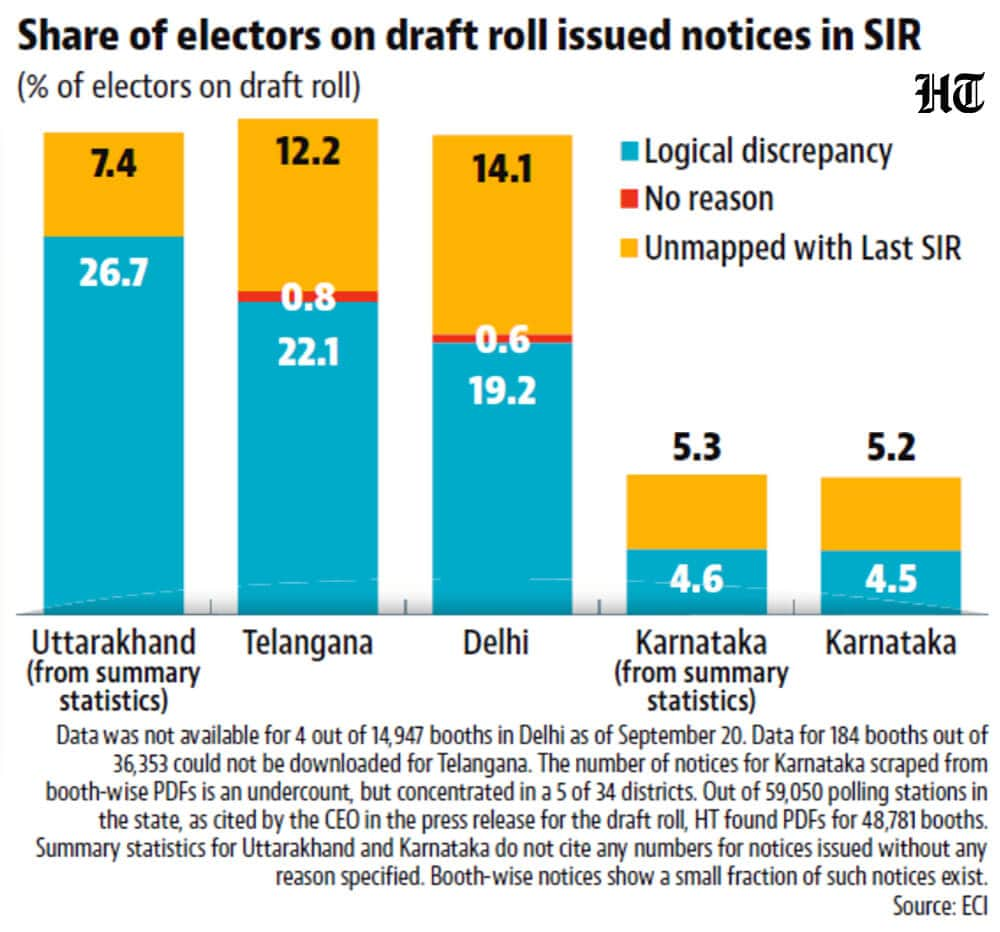
 A majority of notices seem to be issued for logical discrepancies, but not in KarnatakaOf the four states/UTs listed above, notices were issued to around one-third of the draft roll in each of Delhi, Telangana and Uttarakhand; but this share was just under 10% (of the draft roll) in Karnataka. The first three have also issued the majority of notices due to logical discrepancies, although the exact fraction varies from 19% in Delhi to 27% in Uttarakhand (again, of the draft roll). However, in Karnataka, the number of notices issued for logical discrepancies is lower and almost equal to those issued for not being mapped to the previous SIR. While summary statistics for Karnataka or Uttarakhand do not give this number, booth-wise PDFs where available also show a small number (under 1%) of notices issued with the reason column blank.
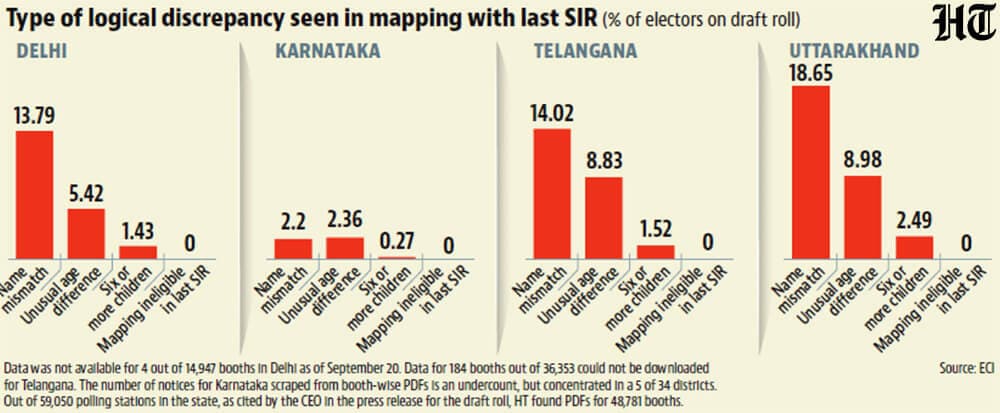
- Name mismatches and unusual age differences are the biggest reasons for logical discrepanciesThe logical discrepancies ECI has been flagging in the mapping with the last SIR are a standard list of eight in the data analysed by HT: “Parent Name Mismatch”, “Self Name Mismatch”, “Parent Age Difference <15”, “Parent Age difference >50”, “Grandparent Age difference <40”, “Progeny>=6”, and “Parent Marked ineligible in Last SIR”. The rest of this analysis summarises these as “name mismatch”, “unusual age difference”, “six or more children”, and “mapping ineligible in last SIR”. Data shows that the first two reasons are flagged the most, accounting for 5-19% for the draft roll, except in Karnataka, where the numbers are around 2%. Having six or more children accounted for 0.3% of the draft roll in Karnataka to 2.5% in Uttarakhand, while the mapping itself being ineligible was the case for a negligible fraction. To be sure, these numbers must be read with the fact that people could be flagged for one or more of these categories, as HT reported for Delhi on September 21.
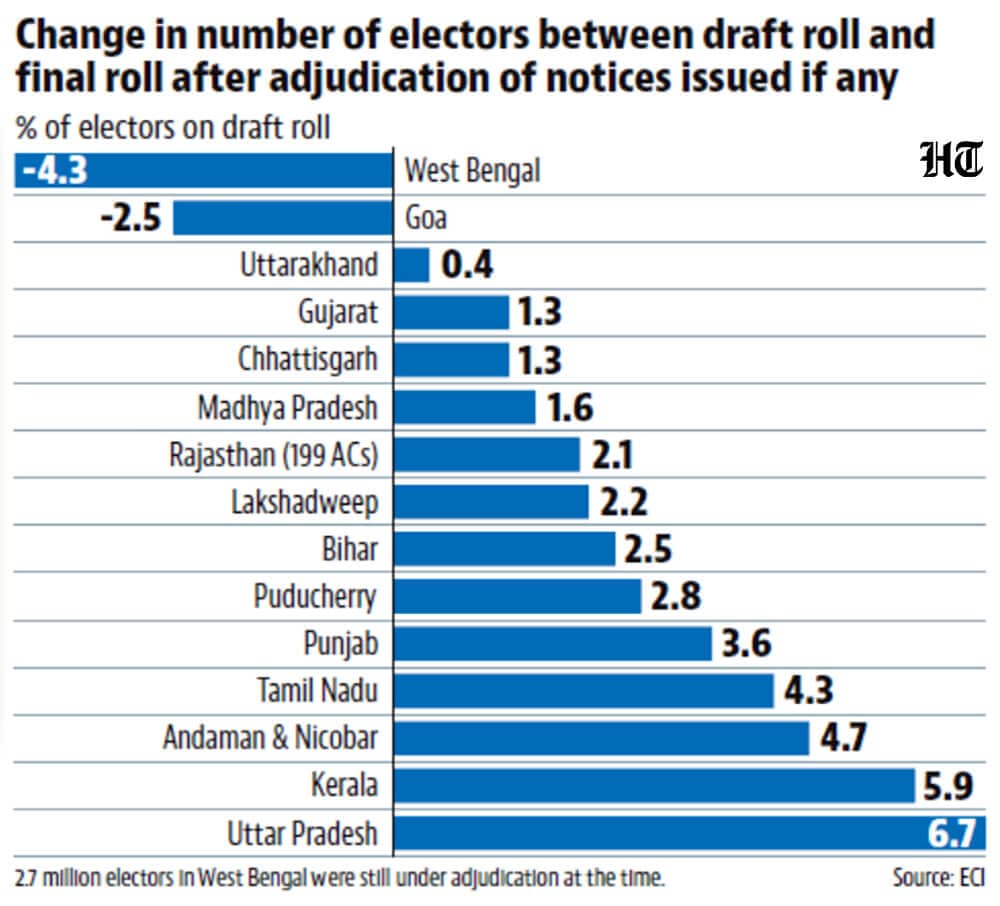
- Despite a large share issued notices, the final roll has been bigger than draft roll, except in West Bengal and GoaDespite a large fraction of the people in the draft roll being issued notices, Uttarakhand’s final roll was still larger than the draft roll by 0.4%. The final SIR roll in all other states was also larger than the draft roll, except in West Bengal and Goa. Unlike other states, where ECI officers address and resolve logical discrepancies before the publication of the final SIR roll, logical discrepancies in West Bengal continue to be adjudicated by judicial officers even after the publication of an interim “final roll”, which led to around 2.71 million people being excluded from voting in the 2026 assembly elections.