
 E-Paper



Colours in the sky on Diwali night are metals – chemistry of firecrackers, and their effects
Strontium burns red and barium green. HT explains the chemistry of firecrackers, and what the metals do to air pollution and to health.

 Prefer HTon Google


The colours of firecrackers in Delhi on Diwali depend on metal salts that burn into fine particles, whether these are the ‘green ones’ or the conventional ones sold illegally.
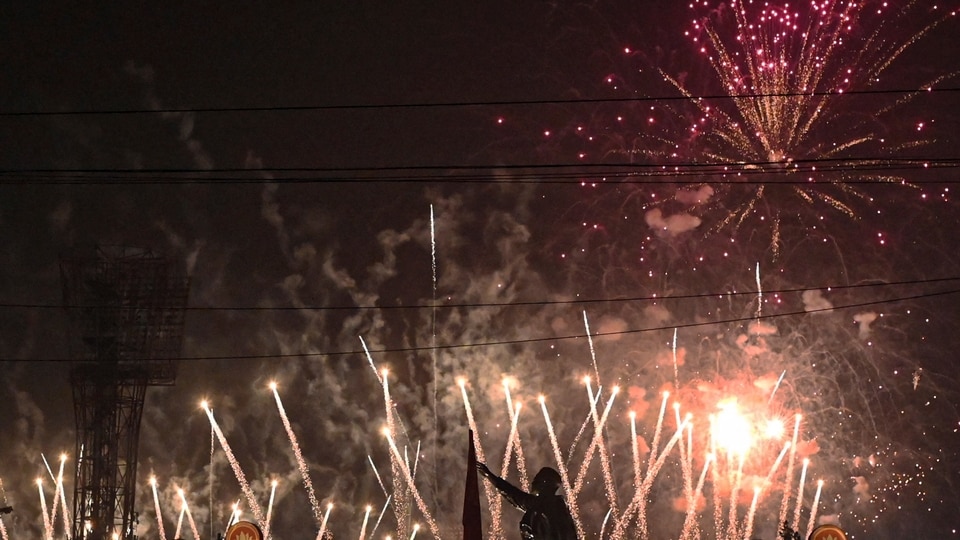
One of those salts, barium, has been banned in fireworks since 2018. But, on Diwali night in 2019, a year after the ban, a team from IIT Delhi and other institutes measured barium in Delhi’s air at up to 190 times its level of the week before. Strontium, which burns red, rose by up to 145 times.
The Supreme Court has allowed certified green firecrackers in Delhi-NCR on November 7 and 8, between 6am and 7am and between 8pm and 10pm. A day before the first window opened, HT found nearly 30 street vendors selling fireworks without licences in Old Delhi. Kartik, 22, a college student from Tagore Garden, said he had tried to check the QR codes that certified boxes of ‘green firecrackers’ must bear. “I tried to scan QR code of few, but one didn’t open. But who’s going to wait and scan… I just bought them,” he said.
How a firework gets its colours
A firecracker shell has metal salts along with a fuel and an oxidiser, a chemical that releases the oxygen the fuel needs to burn. Gunpowder is about 75% potassium nitrate, with charcoal and sulphur making up the rest. Typical oxidisers are nitrates or perchlorates, and the perchlorates double as a chlorine source for the colours.
A firework shell glows in two ways. Burning magnesium powder gets hot enough to glow white, much like the filament of an old bulb.
Coloured light depends on chemistry in the flame. For a brief moment, single metal atoms pair with single chlorine atoms, and the molecules they form emit light in a narrow band of colour. Strontium monochloride glows red and barium monochloride green. Copper monochloride glows blue, and calcium monochloride orange. Manufacturers add a source of chlorine for this reason. It is usually the oxidiser potassium perchlorate or the plastic PVC.

Sodium glows yellow as a single atom rather than as a molecule, at a wavelength of 589 nanometres (billionths of a metre). Studies of flare chemistry have found that even a trace of sodium can drown out the other colours.
Pyrotechnics chemists regard blue as the hardest colour to get right. Copper monochloride survives only below a certain flame temperature, researchers at Ludwig-Maximilians-Universität Munich explain. In a hotter flame, it breaks down into copper oxide and copper hydroxide, whose red and green glow spoils the blue.
The leftovers
The 2019 Delhi study, published in the journal Atmospheric Pollution Research, tracked chemical elements in PM2.5, the fine particles 2.5 micrometres across or smaller. The researchers took readings every half hour at two sites in the city. On Diwali night, fireworks accounted for more than 90% of those elements, against 3-6% in the week before.
At the two sites, barium rose 123-190 times over its earlier level and strontium 87-145 times. Potassium, a component of the oxidisers, rose about 20 times. The peaks fell within about 12 hours, the researchers found. In the days that followed, smoke from burning biomass, plant matter such as crop stubble and firewood, contributed more to pollution than the fireworks.
A 2022 study of Delhi’s air in the journal Environmental Science & Technology measured oxidative potential, the capacity of particles to set off chemical reactions linked to lung damage. Gram for gram, fine particles scored highest during the Diwali fireworks period of the study.
Researchers at New York University’s School of Medicine and Columbia University tested 10 types of fireworks sold for use at home in a 2020 study published in Particle and Fibre Toxicology. They set off the fireworks in a laboratory chamber and collected the particles. Particles from one of them contained about 40,000 parts per million of lead. Particles from some of the fireworks raised levels of reactive oxygen species, unstable molecules that can damage cells, in human airway cells. Particles from the firework with the most lead inflamed the lungs of mice.
Chlorine deepens the colours but leaves residues of its own. Researchers in Zurich measured chlorinated compounds in the air after Switzerland’s national-day fireworks in 2011. Dioxins and related chlorine compounds rose to roughly 10 times their levels a week before and two weeks after the event. Chemists in Munich and at the US Army have warned that burning chlorine donors such as PVC can produce significant amounts of cancer-causing compounds.
Also read: Ahead of COP31, an impasse over when the next big climate warning comes and who pays for it
Perchlorate can disrupt the thyroid gland. A 2014 review in Environmental Monitoring and Assessment named fireworks as one of the main sources of perchlorate in the environment.
The metals are toxic in their own right. Barium compounds are suspected of harming the heart, and strontium can take the place of calcium in bone.
What ‘green’ means in a green firecracker
In 2018, the Supreme Court banned barium salts in fireworks. Barium nitrate colours the flame green and also supplies oxygen for the fuel.
The court allowed only “improved” and “green” firecrackers i.e. those without barium salts. CSIR-NEERI, the government’s environmental engineering laboratory in Nagpur, was developing them.
The government announced NEERI’s first designs in October 2018. One of them, SWAS, dropped potassium nitrate and sulphur and released water vapour to damp down dust. The government said the designs cut particulate matter by 30-40%. Minutes of a February 2019 meeting, later quoted by the court, expected green firecrackers to cut PM2.5 emissions by at least 25-30%. Certified boxes bear a green logo and a QR code to tell them apart from conventional firecrackers.
Green firecrackers still burn metal salts for their colours, and the cuts claimed for them are in particulate matter.
NEERI’s improved recipe still used barium. In December 2019 it sent the explosives regulator a formulation that it said would cut particulate pollution by up to 30%. In September 2023, the court refused the formulation, which contained barium nitrate. The court said it would not allow the chemical “merely because it is indicated that the formulation as a whole would be 30% less polluting”. A 2023 study in the journal Environmental Pollution found that green crackers released 30-60% less barium than conventional ones.
This year the Union environment ministry has asked the court to permit “further reduced quantities of Barium Nitrate”. It says products tested in Sivakasi and at NEERI cut emissions by 45-50%. The court has not ruled on the plea, and its November 2 order repeats the barium ban. In September this year, the bench said it would decide on barium in a newer generation of green firecrackers after outdoor tests by NEERI and the Central Pollution Control Board in four cities, Delhi among them.
The court has found more than once that its rules are flouted. In 2021, it said that “even under the guise of ‘green crackers’ banned chemicals firecrackers are being sold”. Its November 2 order this year said conventional crackers “were sold and continue to be sold under the guise of green crackers”.
HT Immersive: The smog Delhi can’t wish away
On November 3, the court took note of an HT report on the open sale of conventional firecrackers in Delhi’s markets. “They say that notwithstanding yesterday’s order, now everything is available in the (firecracker) shops. Please look into it,” the bench told the lawyer for the Centre and the Delhi government, and asked the authorities to act. It had relaxed its blanket ban for Diwali a day earlier, in a case that began with a 2015 petition filed on behalf of three minors.
The pollution spike around Diwali
The festival shows up in eleven years of official data. In every year from 2015 to 2025, HT reported, Delhi’s air quality index (AQI) was higher the day after Diwali than the day before, by a median of 55 points. The bulletin for the day after covers the festival night, though the index cannot separate what the fireworks added from that week’s weather.
In the weeks around Diwali, other two-day stretches saw the AQI rise only about half the time, by a median of 6 points. In 2025, when the court eased its blanket ban to allow green firecrackers, Delhi’s AQI went from 296 to 351.
Delhi’s air was already bad before the festival. The official AQI for November 6 was 382, in the “very poor” band. It was the city’s worst reading since January 19. Nasa’s satellite spotted 147 farm fires in Punjab and Haryana that day, a likely undercount, as the satellite misses fires lit after it passes over in the early afternoon.
Early on November 7, a layer of warm air about 600 metres up trapped the city’s smoke near the ground. The afternoon before, the air could mix only about 600 metres high, against the usual 1,300 metres for early November.
Readings for Diwali night are yet to come in.


