
 E-Paper



As crowds fill streets from France to Albania, the science of how protests take off and spread
Protests over school funding and living costs have spread across Europe. Research has shown why crowds grow, and how support spreads.

 Prefer HTon Google


As protests over school funding and the high cost of living spread from France to several European countries, decades of research offer a guide to how demonstrations form, travel and spread, sometimes across boundaries.
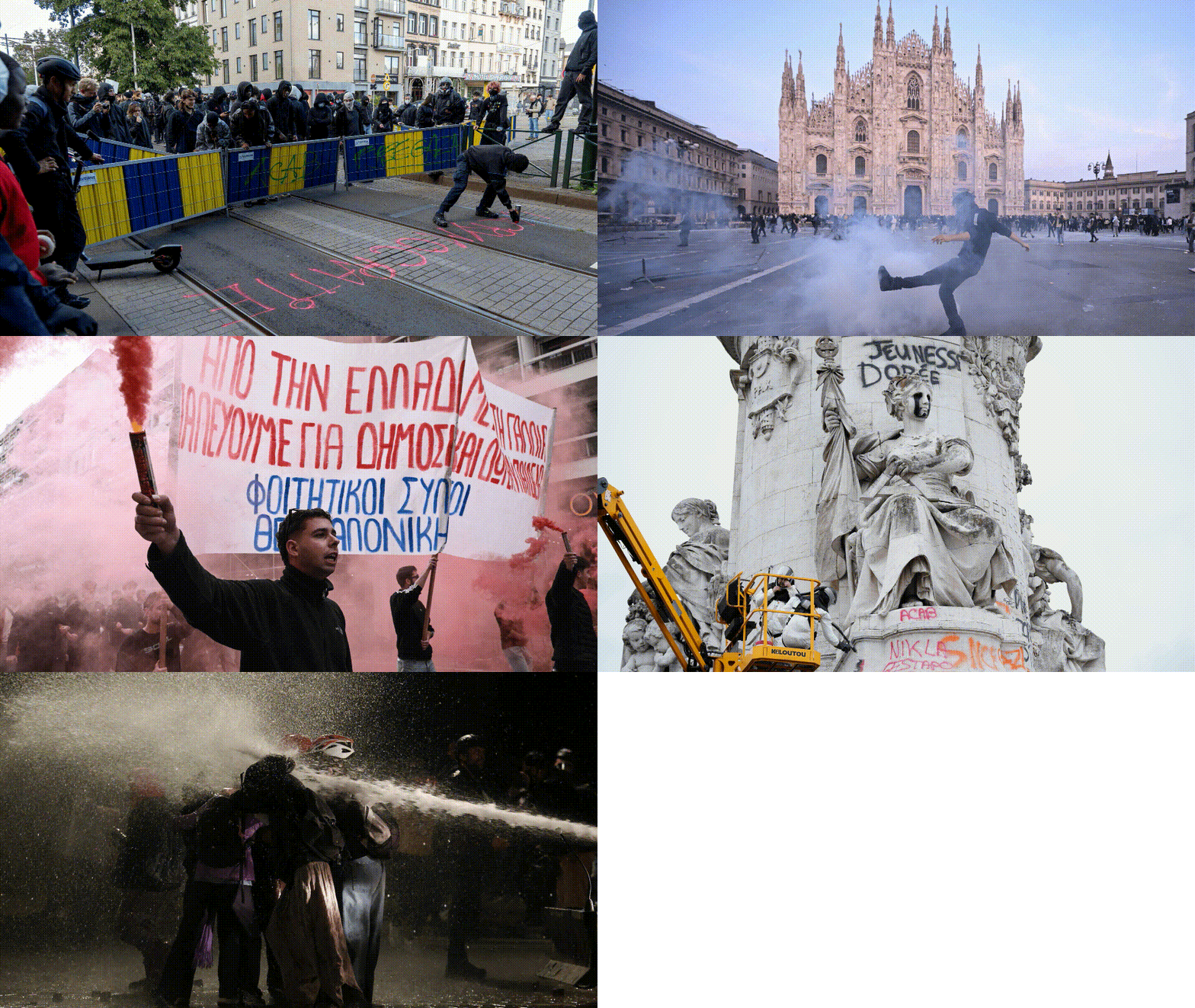
Researchers have over the years identified a handful of recurring steps. People join a protest once they see enough others joining. News and loose networks carry a protest outward. And the involvement of organisations widens it beyond the people who started it. Protests cross borders in two ways: people copy a protest that seems to be working, or the same pressures produce protests in several places at once.
"Generalised discontent is a precondition for social protests to arise, but the ability to reach, recruit, and organise participants is what allows initial sparks to spread," a team of social scientists led by Pablo Barberá of New York University's Center for Data Science wrote in a 2015 study, published in the journal PLOS One.
Protests over education and living costs have also broken out in Belgium, Italy, Portugal, Spain and Albania.
Since 2024, youth-led protests have also been recorded in Kenya, Bangladesh, Nepal, Indonesia, the Philippines, Morocco, Peru, Madagascar and in India this year.
In Europe
The current wave began weeks ago in France, where students started protesting against under-funded schools with dilapidated buildings and too few staff, the Associated Press reported. On October 17, a national day of protest drew hundreds of thousands, and police arrested at least 1,800 people as violent groups clashed with officers and looted shops.
In this timeframe, protests broke out in Belgium, Italy, Portugal and Spain. In Albania, an ongoing protest against the government gained momentum last week after school and university students joined the demonstrations.
Some pointed to France.
Hundreds of students in the Belgian city of Liège marched "inspired in part by" the unrest in France, Reuters reported. Italian students occupied high schools in Turin and Rome under the slogan, "Let's do as in France," an Axios report said.
"France is the epicentre of this movement … and there are signs now that this is spreading beyond France," Alberto Alemanno, a professor of EU law and policy at HEC Paris, told Al Jazeera. Alemanno added that the early stages of a movement were similarly visible in Greece, Germany and Austria.
Also read: From Bastille to this month's riots, the long history and culture of street protests in France
Why people join once others do
Whether a protest grows depends on how many others each person needs to see joining before they join, according to a theory floated in the 1970s.
In 1978, sociologist Mark Granovetter, then at the State University of New York in the US, proposed in a paper in the American Journal of Sociology that each person in a crowd has a threshold figure, or – put simply – the number of others who must join before that person will.
Granovetter used a riot as his main example, though he applied the same idea to strikes, voting and other decisions people take as a group. He illustrated it with 100 people in a square, their thresholds running from 0 to 99.
The person with a threshold of 0 breaks a window. That would be enough for the person with a threshold of 1, to join, and so on, until all 100 people are rioting.
If, in this case, the second person is replaced by someone with a threshold of 2, then only one person riots, Granovetter said.
Newspapers would call the first crowd 'radicals' and the second, a group of solid citizens watching one troublemaker, he wrote. The two crowds, though, are almost identical.
Granovetter's conclusion was that it is "hazardous to infer individual dispositions from aggregate outcomes". The size of a protest, in other words, says little about the people in it, and a small change in who turns up early can decide whether it grows.
Timur Kuran, now a professor of economics and political science at Duke University in the US, used similar reasoning in a 1991 paper in the journal World Politics to explain why the revolutions of 1989 in Eastern Europe were surprising. People who disliked their governments hid it, he argued, a behaviour he called preference falsification.
By hiding their views, East Europeans "conferred on their privately despised governments an aura of invincibility", Kuran wrote. Once enough people lost their fear of showing what they thought, public opposition "was poised to grow explosively", he wrote in the paper.
Also read: Rising living costs, forest fires: Indonesia sees mass protest as students take to the streets
How a protest grows within a region
Once a protest starts, something has to carry word of it.
Sociologists Kenneth Andrews and Michael Biggs studied this question through the sit-ins against racial segregation that swept the American South in 1960, when Black students sat at whites-only lunch counters and refused to leave.
The sociologists compared cities where sit-ins took place with the majority where none did.
They tested three ways a protest might travel: through movement organisations, personal networks and news coverage. News coverage carried the sit-ins from city to city. Personal ties between cities made little difference, they concluded.
Within a city, "what mattered was a cadre of activists rather than mass membership", they wrote in the American Sociological Review in 2006. They also found sit-ins were most likely where there were many college students.
How a protest reaches other groups
A protest that begins among one group, such as school students, has to draw in others to grow. Sociologists Charles Tilly and Sidney Tarrow call the work of linking groups that had little contact with each other "brokerage".
Two sociologists traced how that linking works in practice. Jürgen Gerhards and Dieter Rucht, then at the WZB Berlin Social Science Center, studied, in a 1992 paper in the American Journal of Sociology, two protest campaigns in West Berlin: one against a visit by US president Ronald Reagan in 1987, the other against the annual meeting of the International Monetary Fund and the World Bank in 1988. About 50,000 people marched the day before Reagan's visit, with 140 groups backing the call. The second campaign drew 133 groups and about 80,000 marchers.
Organisers built a common argument that each group could connect to its own cause. Gerhards and Rucht had called that connecting step "frame bridging".
In 1988, the joint call blamed the IMF and the World Bank for many problems at once, from the debts of poor countries to rainforest destruction and unemployment. The groups' leaflets showed why each joined. Peace groups argued that injustice leads to war. Environmental groups pointed to rainforest destruction**, partly through** large projects the institutions financed, and unions cited job losses.
The protests in France began with school students. By October 17, supporters of the Yellow Vests movement, university students, climate activists and farmers had joined the nationwide call for demonstrations.
Also read: How Gen Z is reshaping policy, governance, and accountability
How a protest crosses a border
Protests that break out in several countries within weeks of each other may look like a single wave. But researchers distinguish two different processes that can produce them. People in one country can copy a protest they have seen elsewhere, often one that appears to be succeeding. And people in several countries can react separately to the same pressures, such as rising prices or cuts in public spending.
Granovetter cited an example by German sociologist Max Weber to show that it may be difficult to tell the two apart. People who open their umbrellas together at the start of a shower are usually not copying each other, he noted. Instead, they are "all reacting in the same way to the like-need of protection from the rain". Granovetter added that some people's actions – to open an umbrella, in this example – could probably be influenced by those around them as well.
Two students in Liège gave both explanations. "We support each other because we're facing pretty much the same issues," Alfred, 19, told Reuters. "When we saw nothing was changing without protests, we decided we would start … France did influence us a little," said Amelia Di Salve, 19, training to be a teacher.
Some others also said they were in touch with their French counterparts.
Sociologists Doug McAdam and Dieter Rucht argued in 1993, in The Annals of the American Academy of Political and Social Science, from the case of the American and West German New Left of the 1960s, that copying across borders can start with that kind of contact. Activists in one country first come to identify with activists in another, initially through personal ties. Looser channels, such as the media, then carry the ideas.
Researchers Justus Bamert, Fabrizio Gilardi and Fabio Wasserfallen studied 20 countries in West Asia and North Africa during the Arab Spring, the wave of uprisings that began in Tunisia in December 2010 and toppled the leaders of Tunisia and Egypt within weeks.
Protests that brought down a government were much more likely to be copied, especially in the first couple of weeks, and people copied them "without taking the specificity of the context into account", the researchers said in a 2015 paper in the journal Research & Politics.
The other route across borders is a shared squeeze, in which governments in several countries make similar decisions and people in each country react to them, much like Weber's umbrellas.
Economists Jacopo Ponticelli of Northwestern University and Hans-Joachim Voth of the University of Zurich studied whether spending cuts lead to unrest, across 24 European countries from 1919 to 2008. "Expenditure cuts are particularly potent in fueling protests; tax rises have only small effects," they wrote in a 2020 paper in the Journal of Comparative Economics.
Also read: India slams UN over ‘selective targeting’ after experts flag crackdown on protests
How the channels have changed
What carries a protest from one place to the next changes with each generation of technology.
In 1960 it was news coverage. In the US riots of the 1960s, it was television. Sociologist Daniel Myers found in a 2000 study in the American Journal of Sociology that riots spread along broadcast areas.
In France in 2018, the gilets jaunes, or yellow vests movement, organised their protests on Facebook. The movement began among drivers angry about rising fuel prices, who blocked roundabouts across the country. Economists led by Pierre Boyer of CREST, a French research centre, mapped the protests in a 2020 paper in the journal Revue économique and found that areas with more members in gilets jaunes Facebook groups also had more roadblocks planned for the movement's first day of action.
Another study of social media's effect came from Russia. Economists Ruben Enikolopov, Alexey Makarin and Maria Petrova studied the protests that followed Russia's parliamentary election in December 2011. Comparing cities with more or fewer users, they found in a 2020 paper in the journal Econometrica that cities where VK had spread more widely were more likely to see protests, and saw larger ones.
Their results, they wrote, suggest that social media "induced protest activity by reducing the costs of coordination rather than by spreading information critical of the government".
But, they added, VK use also raised support for the government.


