E-Paper


History of Diwali celebrations at the White House, and the Indian diaspora’s political profile in US
Trump marked the festival on Friday. The tradition began in 2003 and has grown alongside a diaspora that both Republicans and Democrats court.

 Prefer HTon Google


US President Donald Trump marked Diwali in the Oval Office on Friday, two days before the festival, continuing a White House observance that began in 2003 and has lasted as the political weight of the Indian diaspora in the US has grown.

India’s ambassador to the US, Vinay Mohan Kwatra, was among those present, PTI reported. Trump also marked the festival in the Oval Office last year, on October 21, with senior officials including FBI director Kash Patel and director of national intelligence Tulsi Gabbard.
The Bush years
Diwali was first celebrated in the White House complex in 2003, during president George W Bush’s tenure. Karl Rove, then Bush’s senior adviser, led the celebrations that year in the Indian Treaty Room of the Eisenhower Executive Office Building, which stands beside the White House and is part of its complex.
Rove lit a brass lamp and conveyed Bush’s personal greetings to the Indian-American community at the event, HT had earlier reported.
Bush never attended the celebrations himself, and most ceremonies during his tenure were held in the Eisenhower building, PTI reported.
The Obama years
Barack Obama became the first US president to personally take part in the ceremony. On October 14, 2009, after signing an executive order on issues facing Asian American and Pacific Islander communities, he lit a diya in the East Room.
In a 2011 statement, Obama said he was “proud to be the first President to mark Diwali and light the diya at the White House, and last year, Michelle and I were honored to join in Diwali celebrations during our visit to India.” He was referring to his first visit to India as president, in November 2010, when he and first lady Michelle Obama joined schoolchildren in Mumbai for a Diwali celebration.
In 2016, his last year in office, Obama lit the first-ever diya in the Oval Office and expressed hope that future presidents would continue the practice.
“This year, I was honored to kindle the first-ever diya in the Oval Office - a lamp that symbolizes how darkness will always be overcome by light. It is a tradition that I hope future Presidents will continue,” Obama said in a statement posted on Facebook.
Trump and Biden
Trump continued the tradition in 2017 by lighting a diya in the Oval Office with his daughter Ivanka, then an adviser to the president, and Indian-American officials from his administration, including Nikki Haley, then ambassador to the UN, and Seema Verma, who ran the Centers for Medicare and Medicaid Services.
“Our nation is blessed to be home to millions of hardworking citizens of Indian and Southeast Asian heritage who enrich our country in countless ways. Together, we are one proud American family,” Trump said at the 2018 ceremony in the Roosevelt Room.
Also read: Trump celebrates Diwali at White House, Indian entrepreneur gifts him copy of Hanuman Chalisa
He also said he was “grateful to have numerous Americans of Indian and Southeast Asian heritage who fulfill critical roles” in his administration. “And they’ve done an incredible job.”
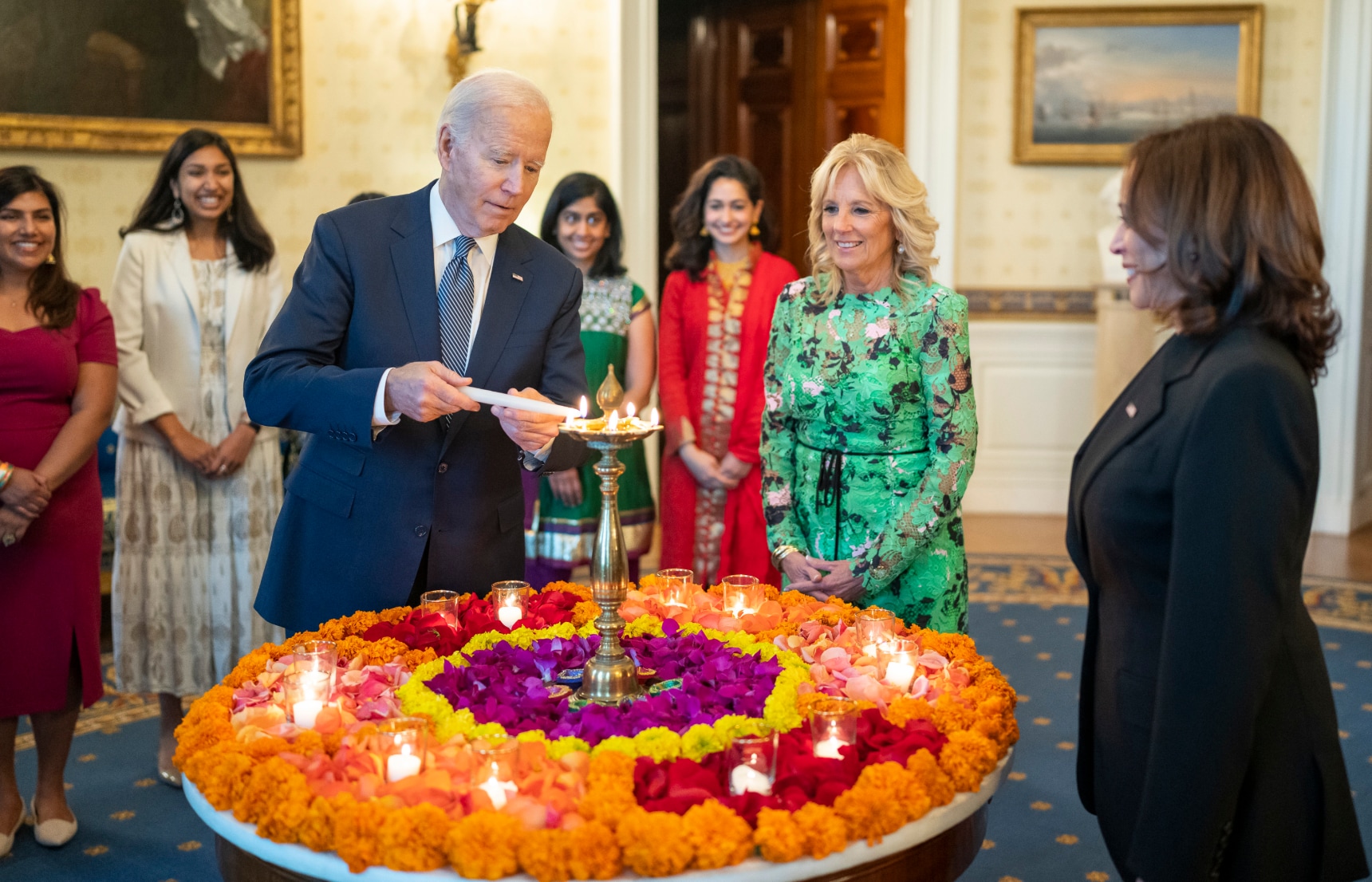
In 2021, Joe Biden and first lady Jill Biden lit a diya together, which they said made them the first president and first lady to do so at the White House. Kamala Harris, then vice-president, extended Diwali greetings.
The following year, Biden hosted more than 200 Indian-Americans at a reception in the East Room, which he called “the first Diwali reception of this scale, in this house, ever to be held”. Harris, whose mother moved to the US from India at 19 to study, recalled celebrating Diwali as a child.
“Thank you for making this celebration of Diwali such a joyous part of American culture,” Biden told the guests. At his last Diwali in office, in 2024, he said he had been “honored to host the biggest Diwali receptions ever at the White House”.
Why presidents mark the festival
Amanda Lucia, then an associate professor of religious studies at the University of California, Riverside, wrote in an October 2017 essay on the Oxford University Press blog that by celebrating Diwali at the White House in 2009, Obama “sent a message to South Asian Americans that they are a part of the American national narrative. His actions were not only about lighting lamps and the remembrance of Indic myths, but they were also about the political recognition of an influential minority group in the United States.”
Cultural and religious festivals have become a way for minority communities in the US to seek recognition in public life, Lucia argued, and official acknowledgement of a festival brings a community’s traditions into the national story.
Also read: Lights, lamps and rangolis: Foreign embassies in India take part in Diwali celebrations
State governments have also moved. Pennsylvania made Diwali an official state holiday in 2024, and Connecticut followed in 2025. California became the third state in October 2025, with a law that allowed public schools and community colleges to close and state employees to take the day off, AP reported.
In July, a California Superior Court judge, Stephen Acquisto, ruled, on a petition by the San Francisco Taxpayers Association, that the law violated provisions of the federal and state constitutions by giving Diwali special treatment based on its religious importance “without any significant secular considerations”. Reports have differed on how much of the law the ruling struck down, and a final judgment was awaited.
New York City made Diwali a public school holiday in 2023.
The diaspora’s numbers
More than 5.2 million people of Indian origin live in the US, according to a 2024 study published by the Carnegie Endowment for International Peace. The Indian-American population grew by 50% between 2010 and 2020, making it the second-largest immigrant community by country of origin after Mexican Americans, the study found. Indian-Americans make up slightly more than 1% of the US population, the researchers wrote, yet both major parties court them.
A study titled An Emerging Lobby: An Analysis of Campaign Contributions from Indian-Americans, 1998-2022, by researchers from Ashoka University and the University of Michigan, estimated that the number of Indian-American donors to political campaigns rose from around 6,700 in the 2000 election cycle to more than 43,000 in 2020. The researchers identified Indian-American donors by name.
Kamala Harris ran for president against Trump in 2024. Six Indian-Americans were elected to the House of Representatives in the 2024 elections, all of them Democrats.
In this week’s midterm elections, Indian-American Democratic lawmakers Ami Bera, Ro Khanna, Suhas Subramanyam and Pramila Jayapal were re-elected to the House. Pia Dandiya won Florida’s 22nd district, and Amish Shah, an emergency-room doctor and former Arizona state legislator, won Arizona’s 1st district. Both enter Congress for the first time. Raja Krishnamoorthi gave up his seat to run for the Senate and lost the Democratic primary in Illinois in March. Shri Thanedar lost his primary in Michigan in August. The new House will again have six Indian-American members.
Vivek Ramaswamy, the Trump-backed Republican who sought his party’s presidential nomination in 2024, lost the race for Ohio governor to Democrat Amy Acton, AP reported.
In Los Angeles, Nithya Raman, a 45-year-old city council member born in Thrissur in Kerala, was elected mayor this week, unseating Karen Bass to become the first South Asian to lead the city. Raman, who moved to the US with her family at six, is a practising Hindu and hosted Diwali celebrations at City Hall as a council member.