
 E-Paper



Two commissioners, one CEC, no veto: How the Election Commission decides
The two election commissioners' objections over SIR have put the rules governing the poll panel in focus.

 Prefer HTon Google


Election commissioners Sukhbir Singh Sandhu and Vivek Joshi, two of the Election Commission's three members, formally objected at least 14 times in 10 months on decisions related to rollout of the Special Intensive Revision (SIR) of electoral rolls, The Indian Express reported on Wednesday.
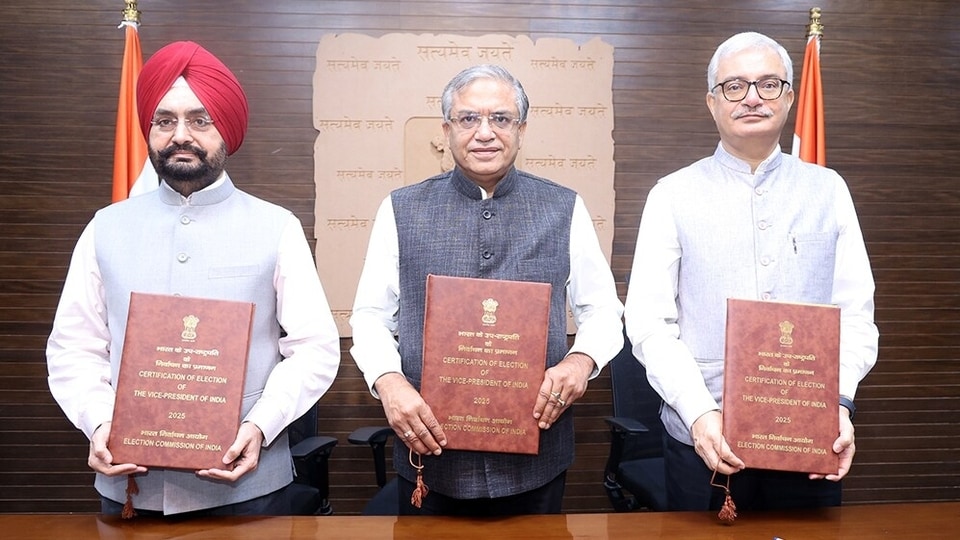
Reacting to the report, the commission said on Sunday that the objections raised by the commissioners were "part of decision-making process".
The report, though, has revived questions about the division of power between the Chief Election Commissioner (CEC), currently Gyanesh Kumar, and the other two members of the Election Commission of India (ECI), and how the commission decides when they disagree. The Supreme Court has ruled on both.
What the Constitution says
Article 324(1) of the Indian Constitution vests in the Election Commission “the superintendence, direction and control of the preparation of the electoral rolls for, and the conduct of, all elections” to Parliament, the state legislatures and the offices of President and Vice-President. The commission runs roll revisions such as SIR under this provision, read with sections of the Representation of the People Act, 1950.
The power granted under Article 324(1) is broad and plenary. In Mohinder Singh Gill v Chief Election Commissioner (1977), the Supreme Court interpreted Article 324 as giving the commission authority to act even when Parliament had not made specific laws on a subject. The commission could decide as long as its actions did not conflict with existing laws. The Election Commission enforces the model code of conduct (MCC) under this power.
Article 324(2) provides that the commission "shall consist of the Chief Election Commissioner and such number of other Election Commissioners, if any, as the President may from time to time fix". The words "if any" indicate that the Constitution does not mandate a multi-member commission.
The commission had a single member from 1950 to 1989. It became a multi-member body in October 1989, reverted to a single CEC in January 1990, and has comprised one CEC and two election commissioners since October 1993.
Also Read: Differing views are normal but decisions unanimous: Election Commission amid row
Appointments
Until 2023, the President appointed the CEC and the election commissioners on the advice of the Union Council of ministers. This arrangement was challenged by petitioners who argued that the process let the government handpick commissioners.
In Anoop Baranwal v Union of India, a five-judge Constitution bench held in 2023 that the commission must be insulated from executive influence. The bench directed that, until Parliament legislated on the matter, a committee of the Prime Minister, the Leader of the Opposition and the Chief Justice of India would select the CEC and the election commissioners.
Parliament legislated within months. The Chief Election Commissioner and Other Election Commissioners (Appointment, Conditions of Service and Term of Office) Act, 2023, passed in December that year, replaced the court's panel.
Section 7 of the Act sets up a selection committee of the Prime Minister as chairperson, along with the Leader of the Opposition in the Lok Sabha, and a Union Cabinet minister nominated by the Prime Minister. The Chief Justice no longer has a seat.
The Association for Democratic Reforms (ADR) and other petitioners have challenged the Act in the Supreme Court, arguing that it defeats the spirit of the Anoop Baranwal judgment.
The court has so far declined to stay the Act or the appointments made under it, including those of Kumar and Sandhu, both of whom were named election commissioners in March 2024. (Kumar became CEC in February 2025)
During the hearings, the court also observed that its 2023 direction to include the Chief Justice was meant only to fill a legal vacuum and cannot automatically override a law Parliament later enacted. On Wednesday, the Supreme Court referred the matter for setting up a Constitution bench to hear the legal challenge to the validity of the Act.
Power and decision-making
The ECI is meant to function as a collegiate, multi-member body in which the two election commissioners share decision-making with the CEC as colleagues.
In SS Dhanoa v Union of India (1991), the Supreme Court upheld the government's abolition of the two election commissioner posts in 1990. It observed, however, that powers as wide as the commission's were better exercised by more than one person.
In TN Seshan v Union of India (1995), then chief election commissioner TN Seshan challenged the 1993 law. The court rejected the challenge, holding that once election commissioners were appointed, the commission functions as a multi-member body in which the CEC has no primacy or veto.
The procedure was laid down in a 1993 amendment to the Election Commission (Conditions of Service of Election Commissioners and Transaction of Business) Act, 1991. Under that law, the commission transacted business unanimously as far as possible. Disagreements between the CEC and the election commissioners were decided by majority. The commission could allocate business among its members by unanimous decision.
The 2023 Act repealed the 1991 law, but retained the majority rule.
Removal of commissioners
Under Article 324(5), the CEC can be removed only in the manner and on the grounds that apply to a Supreme Court judge. That means proved misbehaviour or incapacity, established through an impeachment-style process that needs a special majority in both Houses of Parliament.
The election commissioners have no such safeguard. Article 324(5) provides that an election commissioner "shall not be removed from office except on the recommendation of the Chief Election Commissioner". Removing an election commissioner needs no vote in Parliament. Their security of tenure depends on the CEC.


