
 E-Paper



The workforce numbers that leave Indian seafarers exposed as attacks spread from Strait of Hormuz to Red Sea
Houthis said they are rescuing 14 Indian sailors from a yacht attacked off Yemen. The Indian Mission in Yemen said it was ascertaining what had happened.

 Prefer HTon Google


Yemen's Iran-aligned Houthis said on Thursday that their forces were rescuing 14 Indian sailors from a yacht that had come under attack near Zuqar Island in the Red Sea, the latest in a run of incidents at sea since the war in West Asia began in February.
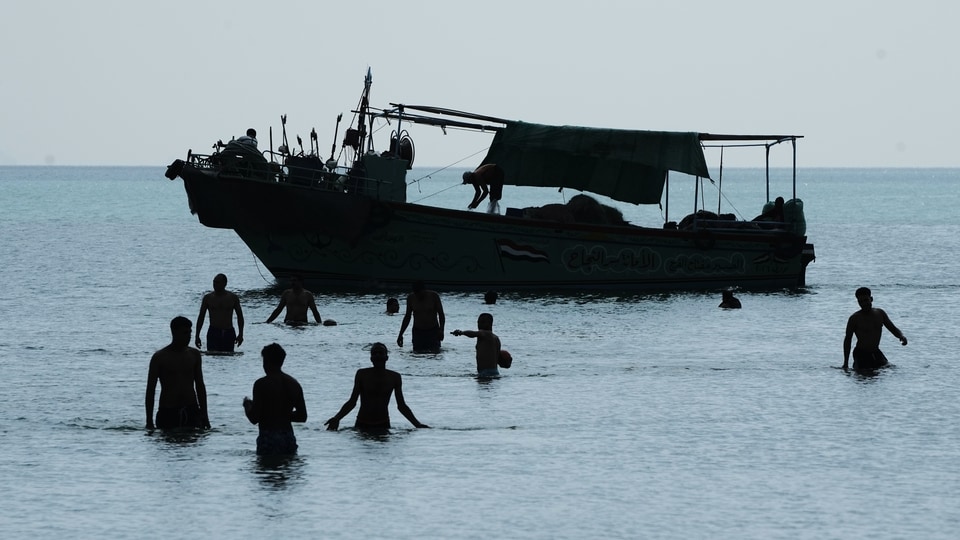
New Delhi has not confirmed the account. The Indian Mission in Yemen said on X that “apparently there were Indian nationals (sailors) on board a yacht”, and that it had reached out to different parties to establish what happened. “Given the prevailing conflict situation exact information is not currently available,” the Mission added.
Indians have been hit harder than most. About one in eight of the world’s merchant seafarers are Indians. Over a dozen Indians have been killed in the Gulf and the Black Sea by the end of July, and the Red Sea is now a third conflict zone.
The three theatres
US and Israeli strikes on Iran began on February 28, and by early March, tanker traffic through the Strait of Hormuz, the narrow channel between Iran and Oman that is the only sea route out of the Persian Gulf, had almost stopped, according to the International Energy Agency (IEA), the Paris-based body that tracks energy markets for its member countries.
Ten Indian seafarers were killed in West Asia between the start of the conflict and July 30, Kirti Vardhan Singh, the minister of state for external affairs, had told the Rajya Sabha.
In June, three Indian seafarers were killed when the tanker MT Settebello was struck off Oman. On July 12, the Cyprus-flagged container ship GFS Galaxy was attacked near Omani waters. An Indian engineer went missing and was later confirmed dead. On the night of July 20, an Indian second engineer was hospitalised after the Kuwait-flagged Kaifan was hit at Limah Anchorage off Oman.
In the Black Sea, where merchant ships have come under fire in the Russia-Ukraine war, five Indian seafarers were killed within two days in July. On July 18, the Omorfi was attacked in what the external affairs ministry described as Russian territorial waters, and one of its three Indian crew members was killed. The next evening, the Golden Leo was attacked while leaving the Ukrainian port of Odesa. Four of the five Indians in its 17-strong crew were killed, and the fifth was hospitalised in a critical condition.
In the Red Sea, the Houthis declared a naval blockade of Saudi Arabia on July 20. They then claimed attacks on vessels, and Saudi Arabia responded with air strikes.
Why Indians are so exposed
India is the second-largest source of merchant seafarers after the Philippines, according to the Seafarer Workforce Report 2026, published in June by the Baltic and International Maritime Council (BIMCO), a shipowners’ association, and the International Chamber of Shipping (ICS), the industry’s trade body. India supplies 311,936 seafarers, 12.16% of a global workforce of 2.57 million. Among officers, the senior ranks who navigate, command and run the engines, its share rises to 13.41%. About 750,000 Indian seafarers are registered with the country's shipping regulator, of whom about 320,000 are actively employed.
Indians were also the seafarers most often abandoned last year. Under international labour rules, a crew counts as abandoned when the shipowner stops paying wages for two months or more, cuts off food and supplies, or refuses to pay for the journey home.
That happened to 1,125 Indian seafarers in 2025, according to the International Transport Workers' Federation (ITF), the global union body for transport workers. They made up 18% of a record 6,223 seafarers abandoned worldwide, and Indians were the worst-affected nationality, as in 2024.
Most of the ships involved, 82%, flew flags of convenience, which means the vessels were registered in a country other than the one their owners operated from. The ITF said the Indian government had announced “blacklisting” measures at the end of 2025 against ships with a record of repeat abandonments.
India’s response
In July, after a string of attacks in and around Hormuz, India’s shipping regulator, the Directorate General of Maritime Administration (DGMA), told ship owners, ship managers and licensed recruitment agencies to avoid putting Indian seafarers on ships sailing through the strait.
Beyond that, the government relies on what Singh told Parliament was a “structured, multi-layered mechanism, consisting of regular advisories, setting up additional emergency helplines and 24x7 control rooms, and evacuation operations as necessary”.
The external affairs ministry's Rapid Response Cell coordinates with the armed forces and other departments. On July 30, the ministry said its own digital emergency response system for evacuations was in final trials.
The shipping regulator runs a 24x7 communication centre, and in early September, it launched e-Navik 24x7, a digital grievance system that gives a seafarer’s complaint a ticket number, covering cases from unpaid wages and abandonment to detention, death and missing seafarers.
Manoj Yadav, general secretary of the Forward Seamen Union of India, had told HT last month that the regulator issues new circulars and policies every month, but what matters is action.
PM Modi’s Brics proposal
At the Brics summit in September, Prime Minister Narendra Modi proposed a shared safety net for seafarers. “Seafarers contribute significantly to global trade, but they often lack support in difficult times," he said, proposing a Seafarers Emergency Support Network.
It would, he said, “connect maritime authorities and missions in the respective countries” and provide “assistance with distress alerts, medical assistance, information to families, and evacuation”.
Modi placed the proposal under the second of three tests he set out for reforming global governance. “Humanity will only gain confidence in global institutions if they are capable of effectively addressing problems,” he told Brics leaders. “We must pay attention to the speed, scale, and last-mile impact of our collective response.”
Russia and Iran, both Brics members, are parties to the conflicts in the Black Sea and the Gulf in which Indian seafarers have died.


