E-Paper



Your guide to US midterm elections 2026, from who is on the ballot to how votes are counted
Republicans hold both chambers going in. What decides control of Congress, how many seats Democrats need and why official results could take some time.

 Prefer HTon Google


Americans finish voting on Tuesday in midterm elections that could reshape the balance of power in the US Congress and influence the final two years of President Donald Trump’s second term.
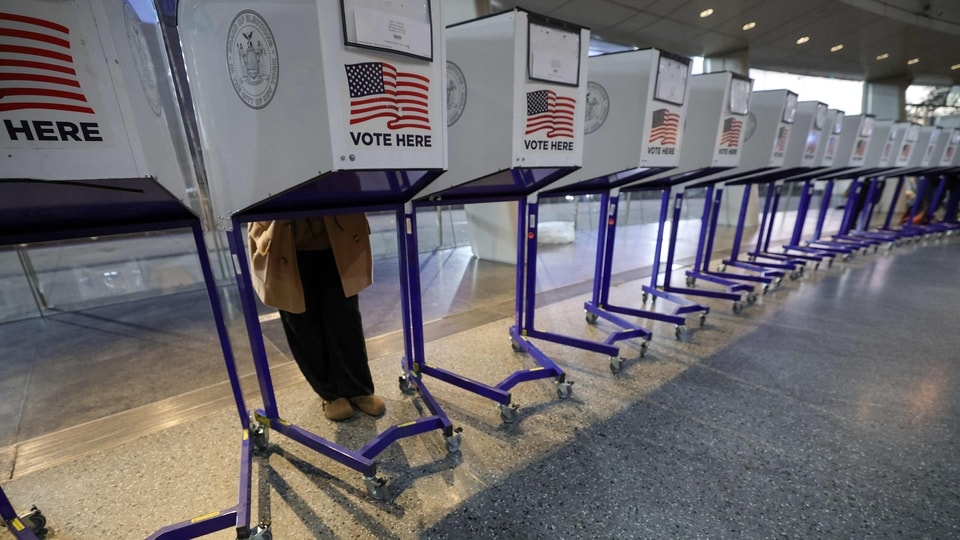
The elections, held halfway through a four-year presidential term, will decide all 435 seats in the House of Representatives and 35 Senate seats, including two special elections in Florida and Ohio. Voters will also elect governors in 36 states and decide contests for state legislatures and local offices.
Trump is not on the ballot, but the outcome could decide how easily his administration can pass legislation, how closely Congress scrutinises the White House and what political challenges the president faces ahead of the 2028 presidential election. Republicans control both chambers of Congress, and Democrats are trying to win back at least one. Republicans hold 53 Senate seats to the Democrats’ 45, with two independents who caucus with the Democrats. In the House, Republicans hold 218 seats and Democrats 214, with one independent and two seats vacant.
Here are 16 questions explaining how the US midterm elections work, who can contest them, how Americans vote and why the 2026 results matter.
1. What are US midterm elections and why are they called midterms?
The United States elects its president every four years, but congressional elections take place every two years. The elections held halfway through a president’s term are called midterms. The 2026 elections fall between the 2024 and 2028 presidential elections.
Voters do not choose a president or vice-president at the midterms. They elect members of Congress and several state and local representatives. According to USAGov, the US government’s official information portal, these elections decide which party will hold a majority in each chamber of Congress for the next two years.
2. What exactly are Americans voting for in the 2026 midterm elections?
All 435 seats in the House of Representatives, the lower chamber of Congress, are up for election. Members of the House serve two-year terms, which means every seat is contested in each election cycle. Voters are also electing 35 senators this year: 33 in the regular cycle and two in special elections. The Florida seat was vacated by Marco Rubio when he became secretary of state, and the Ohio seat by JD Vance when he became vice-president. Senators serve six-year terms. Elections are staggered so that about one-third of the chamber comes up every two years.
Beyond Congress, states are holding elections for governor, state legislative seats and local offices. According to Reuters, this cycle includes governor races in 36 states and legislative contests across nearly the entire country.
3. How does the US two-party system work? Why do Democrats and Republicans dominate?
Two major parties, the Democratic Party and the Republican Party, dominate US politics. Democrats are generally associated with more liberal positions on issues such as social welfare, healthcare and climate policy. Republicans are generally associated with conservative positions, lower taxes and fewer government regulations. Candidates within each party can differ on these positions.
The US has smaller parties, including the Libertarian and Green parties, but the electoral system makes it hard for them to win seats. House elections are held in single-member congressional districts, where the candidate with the most votes generally wins. Senate elections, meanwhile, are statewide contests. This system, particularly the use of single-member districts and plurality voting in House races, makes it difficult for smaller parties to win seats. Political scientists call this tendency Duverger’s law, after the French political scientist Maurice Duverger, who described it.
4. Why do some candidates contest elections as independents or third-party candidates?
Not every candidate for Congress belongs to the Democratic or Republican Party. An independent candidate contests an election without formally representing either major party. Such candidates may disagree with both parties, prefer to campaign on their own platform or believe they can attract voters beyond traditional party loyalties.
Third-party candidates represent political organisations other than the two major parties. An independent is not the nominee of any party; a third-party candidate is. Both must meet state requirements to appear on the ballot, which can include gathering signatures and filing nomination papers. Few have a realistic chance of winning, but they can influence close races by drawing votes away from major-party candidates.
Also read: 2026 US midterm elections: What is at stake for key players
5. How are candidates selected to represent Democrats and Republicans?
The parties do not simply appoint their congressional candidates. In most cases, people seeking a party’s nomination compete in primaries to decide who will represent the party in the general election. These contests can include sitting lawmakers seeking another term and challengers from their own party.
The rules differ across states. Open primaries let voters take part in a party’s primary whatever their registered affiliation. Closed primaries generally restrict participation to voters registered with that party. Some parties also use caucuses or conventions as part of their nomination process. A caucus is a party-organised meeting where participants discuss candidates and select or express support for a nominee. The format varies by state and party.
Some states, including California and Washington, use a top-two primary, in which candidates of all parties appear on one ballot and the two leading finishers advance to the general election, whatever their party. Alaska uses a top-four primary, in which the four candidates who receive the most votes advance to the general election, regardless of party affiliation. Nomination procedures and ballot-access rules vary by state.
6. How important are endorsements in US midterm elections?
An endorsement is a public declaration of support for a candidate by a political leader, public figure, organisation or another influential person. Candidates often seek backing from prominent members of their party, including the president, former presidents, governors and senior lawmakers. An endorsement can help a campaign attract attention, gain credibility among supporters and mobilise voters.
An endorsement does not guarantee victory. Its influence depends on how popular the endorser is, the candidate’s standing in the constituency and the issues shaping the election. An endorsement is also distinct from a financial contribution, which is regulated by the Federal Election Commission (FEC), the independent agency that enforces federal campaign finance law.
7. How do candidates raise money and fund their election campaigns?
A congressional campaign can involve heavy spending on advertising, staff, travel, rallies, voter outreach and other costs. Candidates raise money through individual donations, party support and political action committees (PACs), groups that pool contributions to back or oppose candidates. The FEC sets limits on how much individuals and certain committees can give directly to candidates. For the 2025-26 cycle, an individual can give a candidate up to $3,500 per candidate, per election. The primary and general elections are treated as separate elections for this purpose.
Super PACs work differently. According to the FEC, independent-expenditure-only committees, commonly known as super PACs, can raise unlimited sums from individuals, corporations and labour organisations to support or oppose candidates through independent spending. They cannot give money directly to candidates or coordinate their spending with a campaign. Reuters reported that the 2026 cycle was on track to be the most expensive midterm cycle in US history, with OpenSecrets, a nonpartisan group that tracks money in US politics, estimating total spending by candidates and outside groups at $11.9 billion.
Also read: US midterm elections by the numbers as polls open
8. What are swing states and swing districts? Why are they important?
A swing state is one where support for the two parties is close, which makes the result hard to predict. Swing states matter most in presidential elections, where they can decide the allocation of electoral votes. At the midterms, the term is used more broadly for states with closely fought Senate or governor races.
A swing district is a congressional constituency where candidates from either major party have a realistic chance of winning. In House elections, a small shift in voter support in such districts can decide which party wins the seat. Campaigns and political groups concentrate their money and effort on these seats rather than on areas where one party has a large advantage.
9. Who is eligible to vote in US midterm elections?
To vote in federal elections, a person must be a US citizen, meet their state’s residency requirements and be at least 18 years old on or before election day. Voters must also register by their state’s deadline. North Dakota does not require voter registration, and several states let voters register on election day too. US citizens living overseas, and members of the military serving away from home, can vote by absentee ballot.
Non-citizens, including permanent legal residents, cannot vote in federal elections. Rules for people convicted of felonies vary from state to state. Some restore voting rights after a sentence has been completed, while others impose different restrictions. According to USAGov, voters should check with their state election office for specific eligibility and registration requirements.
10. How do Americans vote?
Americans can vote in person on election day, but many had already voted before November 3. Many states offer early in-person voting, which lets registered voters cast their ballots at designated polling locations before election day. The dates, duration and availability of early voting differ across states and local jurisdictions.
Voters can also vote absentee, or by mail. Depending on state rules, voters may need to request a ballot or may receive one automatically. Some states require a valid reason for absentee voting, while others let any eligible voter request a mail-in ballot. The US Election Assistance Commission (EAC), the federal agency that issues guidance to election officials, says voters must follow their state’s instructions and deadlines for returning ballots, since these decide whether a vote can be counted.
11. How does the winner get decided in House and Senate elections?
House and Senate elections are decided by direct vote, not through the Electoral College used to elect the president. In a House election, voters choose a representative for their congressional district. In a Senate election, voters across the state choose their senator. In most cases the candidate with the most votes wins, but some states have different rules. Georgia, for instance, holds a runoff if no candidate wins a majority. Alaska uses ranked-choice voting in its general elections, while Maine uses it in federal races when more than two candidates are in the contest. In ranked-choice voting, voters rank candidates in order of preference.
The Electoral College is a separate process used only in presidential elections. Voters in each state effectively choose electors, who formally cast votes for president and vice-president, and the candidate who wins at least 270 of the 538 electoral votes wins the presidency.
The US Congress works differently: there is no national tally. Each of the 435 House races and 35 Senate races is decided on its own, and control of a chamber goes to the party that wins the most seats in it.
12. How are votes counted and when are US midterm election results declared?
After polls close, election officials process and count ballots cast in person on election day, early votes, mail-in and absentee ballots, and provisional ballots, which are cast by voters whose eligibility cannot be confirmed at the polling station. Rules on when each category can be counted vary across states, which is one reason results may not be available as soon as voting ends.
News organisations such as the Associated Press call races based on available vote counts and their analysis of outstanding ballots, but these calls are not official results. The EAC says election officials conduct a process called canvassing, which involves reconciling ballots and checking vote totals, before final results are certified. The precise procedures and timelines vary by state. Depending on how close a race is and on state procedures, final results can take days or even weeks.
13. How many seats do Democrats and Republicans need to control the House and Senate?
The House has 435 voting seats, so a party needs at least 218 for a majority when all seats are filled. The Senate has 100 seats. Democrats need at least 51 seats to control it, while Republicans can retain control with 50 because Vice-President JD Vance can cast a tie-breaking vote in a 50-50 Senate.
Republicans went into the 2026 midterms with 218 House seats to the Democrats’ 214, with one independent and two vacancies, and a 53-47 majority in the Senate. According to Reuters, Democrats need a net gain of four seats in each chamber to take control. A majority in either chamber would give Democrats more say over legislation, congressional committees and oversight of the Trump administration.
14. What happens if the party opposing the president wins control of Congress?
When the president’s party does not control one or both chambers, the situation is called divided government. The opposing party can use its majority to decide which bills are taken up, question administration officials, hold hearings and run investigations through congressional committees. A Senate majority can also block or delay many of the president’s nominees for senior administration posts and federal judgeships, which require Senate confirmation. All of this can make it harder for the president to advance legislative priorities.
15. Why are the 2026 midterms important for Donald Trump?
The midterms are often seen as a referendum on the sitting president. Trump is not contesting, but Republican losses could signal voter dissatisfaction with his policies and weaken the party’s ability to advance his legislative agenda. A Democratic majority in either chamber could also bring more congressional scrutiny and investigations of the administration.
The results will also shape the political landscape ahead of the 2028 presidential election. The 22nd Amendment bars anyone from being elected president more than twice. A strong Republican performance could strengthen Trump’s influence within his party, while Democratic gains could give the opposition momentum and a platform to challenge the administration. That makes the midterms an important test for both parties, two years before the next presidential election.