E-Paper



As Delhi, Dhaka prep to renew Ganga treaty, climate change and Mamata role are crucial
Prime Minister Narendra Modi announced during Sheikh Hasina’s visit last month that the two sides had decided to start technical negotiations to renew the pact

 Prefer HTon Google


NEW DELHI: As India and Bangladesh prepare to begin negotiations to renew a nearly three-decade-old treaty for sharing the waters of the Ganga river, the impact of climate change on water flows and the role of West Bengal chief minister Mamata Banerjee are emerging as crucial factors.
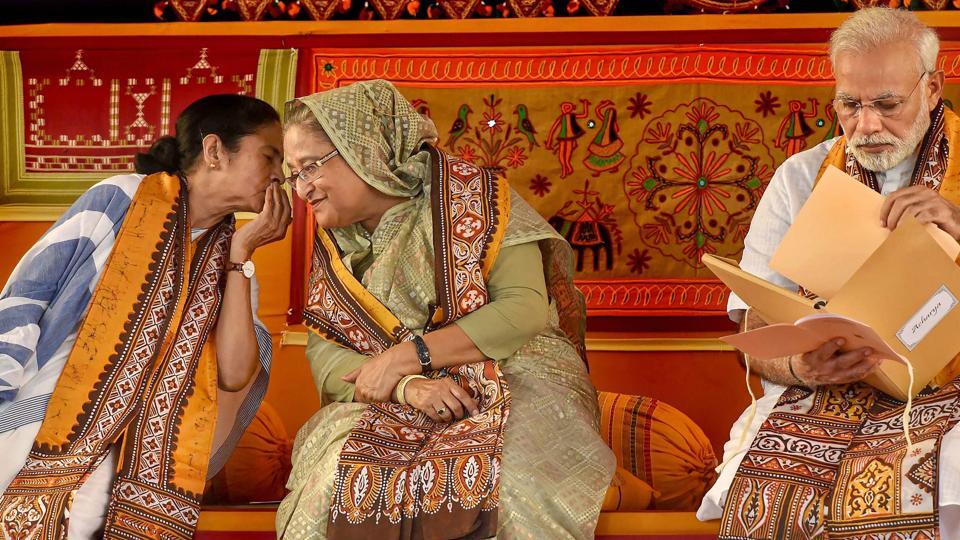
The Ganga is one of 54 rivers shared by India and Bangladesh and long-standing differences over the sharing of its waters were resolved with the signing of the Ganga Waters Treaty in December 1996 by then Indian premier HD Deve Gowda and his Bangladeshi counterpart Sheikh Hasina.
The treaty is up for renewal in 2026. Prime Minister Narendra Modi announced during Hasina’s official visit to New Delhi last month that the two sides had decided to start technical negotiations to renew the pact.
People familiar with preparatory work done by the two countries said on condition of anonymity that the effect of climate change on the flow of the Ganga is a crucial issue that has to be factored into the negotiations. This is a factor that has had an impact on the flows of numerous cross-border rivers that traverse India, they said.
“Studies on the impact of climate change on the Ganga will have to be a key part of the negotiations to ensure the treaty remains relevant and future-proof, covering all possible scenarios and contingencies,” said one of the people cited above.
People on both sides acknowledged the crucial role that will be played by the West Bengal government headed by chief minister Mamata Banerjee, given that the states through which a cross-border river passes have to sign off on a water-sharing treaty or its renewal.
In this context, the people pointed to Banerjee’s role in holding up a treaty on the Teesta river, even though India and Bangladesh had agreed on the text as far back as 2011. The signing of the pact had to be put off due to opposition from Banerjee, who contended the treaty would leave parts of West Bengal dry.
“The role of the West Bengal chief minister will be key to the efforts to renew the treaty, given that we have only about 18 months for negotiations on the renewal,” a second person said.
Banerjee recently sent a letter to the prime minister contending the move to renew the Ganga Waters Treaty was “unilateral” and that the West Bengal government had not been consulted. However, the people pointed out the Jal Shakti ministry set up an internal committee in July 2023 that included representatives of the Bihar and West Bengal governments.
West Bengal nominated its representative to the internal committee in August 2023, and participated in three of the panel’s four meetings. The West Bengal government also sent a communication to the committee on April 5, 2024, that provided its drinking and industrial water requirements for inclusion in the Ganga Waters Treaty beyond 2026, the people said.
The internal committee’s final report, submitted on June 14, 2024, is being examined by the Jal Shakti ministry, which has also formed a joint technical committee to begin discussions with Bangladesh.
On the Bangladesh side, there are concerns about any possible move to reduce the quantum of water provided to the country under the provisions of the treaty.
“The treaty has worked pretty well for three decades, including the regular sharing of data and coordination. But any reduction in the quantum of water will be disastrous and make it very difficult to sell the treaty to the public in Bangladesh,” a third person said.
Under the terms of the treaty, when the availability of water at the Farakka barrage is 70,000 cusecs or less, India and Bangladesh share the water equally. When the availability is 70,000 cusecs to 75,000 cusecs, Bangladesh gets 35,000 cusecs and India the “balance of the flow”. When the availability is 75,000 cusecs or more, India gets 40,000 cusecs and Bangladesh the balance of the flow.
This is subject to the condition that India and Bangladesh each will receive guaranteed 35,000 cusecs in three alternate 10-day periods between March 11 and May 10 every year. The quantum for both countries was decided according to the 10-day average availability of water at Farakka between 1949 and 1988.
According to a report released by Kathmandu-based International Centre for Integrated Mountain Development (ICIMOD) in 2019, climate change will begin altering water levels in the Ganga and the Brahmaputra over the next three decades, and the rivers could record an abrupt decrease in flow after 2050. This will diminish the water available for drinking, irrigation and producing electricity for roughly 250 million people living downstream.