
 E-Paper



Challenges ahead for Jyotiraditya Scindia, the new civil aviation minister
Scindia, whose father late Madhavrao Scindia served as the civil aviation minister in the 1990s, takes over when the Indian aviation sector is estimated to have suffered losses worth around $ 8 billion dollars in two years as a direct impact of the pandemic

 Prefer HTon Google


Union Cabinet minister Jyotiraditya Scindia, who took charge of the civil aviation ministry on Friday following the reshuffle in Prime Minister Narendra Modi’s council of ministers on Wednesday, faces an uphill task of reviving one of the worst-hit sectors by the Covid 19 pandemic.
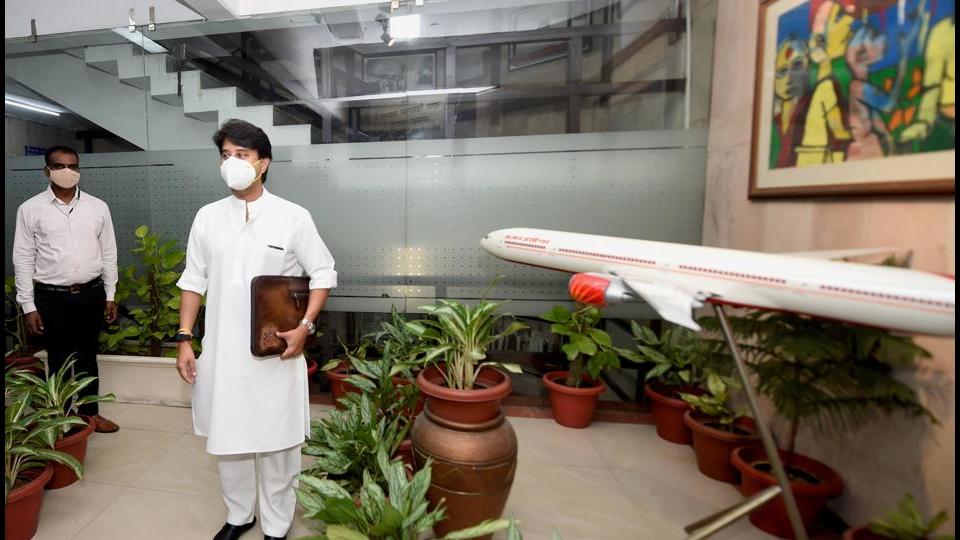
Scindia, whose father late Madhavrao Scindia served as the civil aviation minister in the 1990s, takes over when the Indian aviation sector is estimated to have suffered losses worth around $ 8 billion dollars in two years as a direct impact of the pandemic, according to aviation consultancy and research firm CAPA. Airlines have been seeking government stimulus since last year to tide over the losses. The aviation industry has also demanded lowering of the Aviation Turbine Fuel (ATF) taxation for years. It has sought the inclusion of ATF under the Goods and Services Tax (GST) regime as tax uniformity would lead to cost reduction.
Also Read | Modi’s new Cabinet: Blend of youth, skills, social engineering
Airlines in India are estimated to post a consolidated loss of $4.1 billion this fiscal--similar to what they are estimated to have incurred in 2020-21, CAPA noted in a report released last month. Full-service carrier Air India and no-frills player IndiGo are projected to represent around $ 4.5 billion of the combined around $ 8 billion of losses, CAPA said.
Kapil Kaul, the CAPA head, said the Indian aviation sector is critically placed due to back-to-back Covid impacts. He added most of the players have serious solvency risks. “The industry needs billions of dollars of solvent recapitalisation. The new minister must immediately reduce the excise duty of ATF, bring ATF under GST and provide full input credit to IGST on aircraft repairs and try to amend the AERA Act to increase the control period from 5-8 years,” he said, referring to the Airports Economic Regulatory Authority Of India Act, 2008.
“And simultaneously undertake a deep and thorough review of the sector and break all the regulatory/policy and fiscal barriers to allow aviation to realise its true economic potential... I expect the new minister to address all the structural issues,” said Kaul.
The divestment of national carrier Air India has also been pending. To be sure, the divestment comes under the Union finance ministry’s department of investment and public asset management.
Mark D Martin, MRAeS, Martin Consulting, said, “Mr Scindia has aviation in his DNA. His father was the architect of the open sky policy and airlines like Jet and Sahara and SpiceJet were all a product of that.” Martin said Scindia clearly understands aviation. “He knows where to pick up the pieces from and move on. This is his dream shot to carry forward his father’s legacy and... rationalise and make aviation radical to what his father did back in 1991, but he has a lot of challenges ahead. Among the challenges are the Pawan Hans and Air India divestment, the revamp of the DGCA (Directorate General of Civil Aviation) into a more powerful organisation… Aggressively modernising airports that are up ahead. And he has only three years to make all this happen. Only time will tell. I hope he lives up to his father’s legacy and transforms civil aviation.”
The aviation ministry also has the key role of boosting the Centre’s regional connectivity scheme and leasing out airports under the Public-Private Partnership model. Both of these have slowed down during the pandemic.
The Association of Private Airport Operators last month said they “are not generating sufficient cash flows to sustain operations and meet debt obligations.” Their downgraded credit ratings “have made it impossible to take further financing support from financial institutions.” The operators sought urgent relief from the government to sustain their operations and save jobs.


