E-Paper



Chinese-origin frog species found in Arunachal Pradesh
Details of the find and the rare species ‘Nanorana conaensis’ found at an elevation of 2844 metres above sea level was published in Zoological Survey of India’s (ZSI) latest journal on Thursday.

 Prefer HTon Google


A team of zoologists from Zoological Survey of India (ZSI) have found a frog species, with origins in the Tibet region of China, in Tawang area of Arunachal Pradesh.
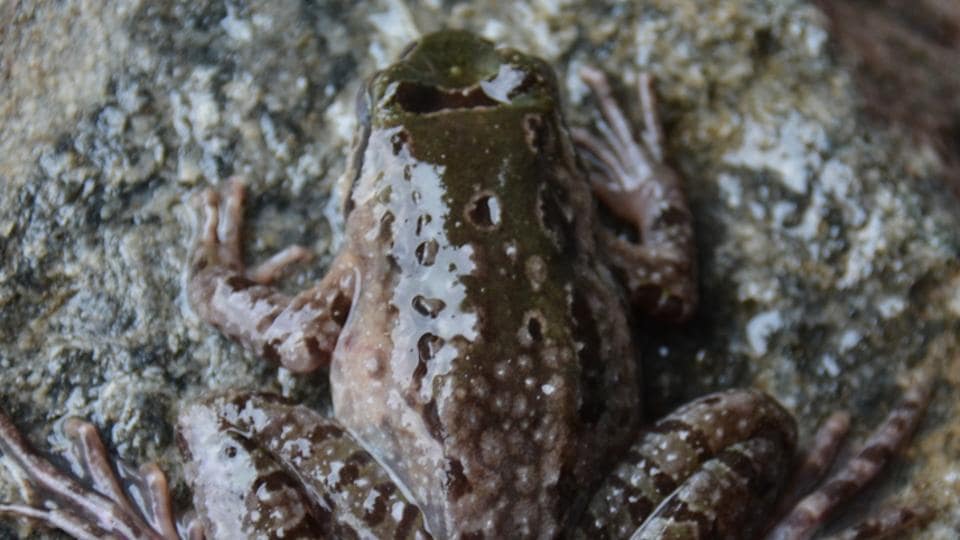
Details of the find and the rare species ‘Nanorana conaensis’ found at an elevation of 2844 metres above sea level was published in ZSI’s latest journal on Thursday.
“The species was first sighted in Tibet in 1981. There was a report of a sighting in Arunachal Pradesh in 2018 by some researchers, however, no details regarding the sighting was reported,” said Bhaskar Saikia a senior zoological assistant with ZSI’s Shillong based North Eastern Regional Centre.
“We were able to collect a specimen of the frog from Tawang in March the same year and conducted molecular studies on it. This is the first documentary confirmation of the presence of the species, which has origins in China, in India,” Saikia, one of the four zoologists involved in the study, added.
The species was found in a domestic water tank at Khremteng village on the outskirts of Tawang town. Since the first sighting in Tibet, only one specimen of the frog was collected in 2013 in Haa district of Bhutan at a height of 4066m.
“The species measuring around 5cm when fully grown is a rare one and is sighted very occasionally. One reason is that they exist at very high altitudes of above 2,500m to nearly 4,000m. Hence there is less chance of encountering them,” said Saikia.
The zoologists collected two specimens of the frog from Tawang and carried out molecular studies on them to verify their morphological structures and ascertain that it was the same species that was found in Tibet and Bhutan.
Studies have revealed that the species dwell in small streams, springs, puddles, but mostly hidden under rocks or fallen trees in shallow water. When they are scared, they immediately jump into the water.
With the find, Arunachal Pradesh now represents the eastern limit of the species habitat while western Bhutan being the western limit.