E-Paper



Five months on, peace eludes ethnic violence-hit Manipur
Families affected by the violence are still waiting for justice and closure, with some still not knowing the fate of their loved ones.

 Prefer HTon Google


For five whole months, as Manipur waits on an elusive peace, in a village in the tribal Churachandpur, a mother still waits for justice, a police investigation, or even her slain son’s body. 63 kilometres, and an intractable ethnic chasm away, in the capital Imphal, a wife waits for any information on her missing husband and his friend, not even counted among the dead, because their bodies have never been found.
Read here: Delhi court extends NIA custody of Manipur violence suspect Seiminlun Gangte
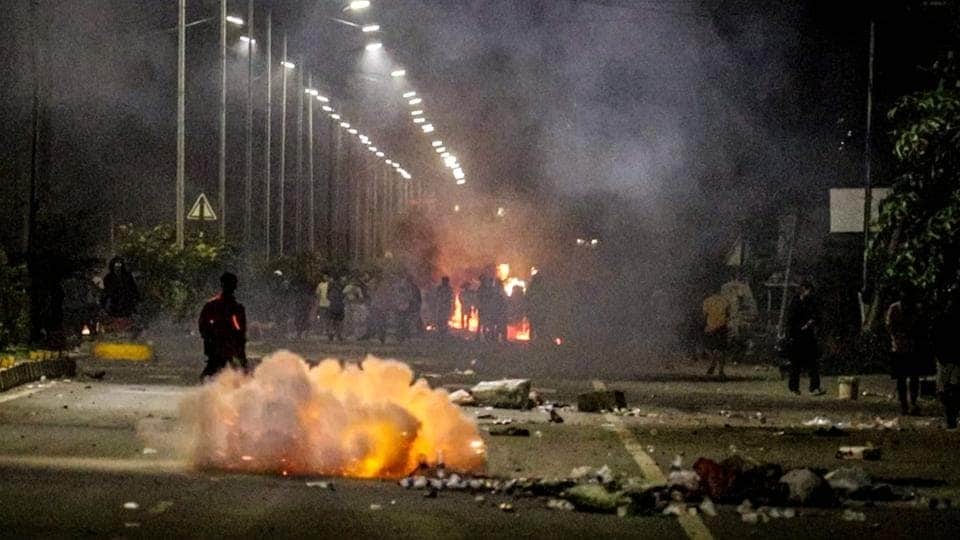
On May 3, violence began coursing through Manipur immediately after a tribal solidarity march that was protesting a Manipur High Court order that had asked the state government to consider bringing the Meiteis, the ethnic majority in the state, into the scheduled tribe fold. The state was yet to act on the court order, but the fire spread quickly, spreading all across the state. In the five months since, 178 people are dead, official numbers say, and more than 50,000 have been displaced from their homes.
In that time, homes have been burnt, businesses lost, studies affected, places of worship burnt to a cinder, the state has lived without internet for months. And there are still families that have no semblance of closure, or justice.
21-year-old college student Hanglalmuan Vaiphei, from Thinhkangphai village in Kuki-dominated Churachandpur district for instance, found himself in police custody on April 30, arrested for a Facebook post allegedly targeting the Meiteis and Chief Minister N Biren Singh. Four days later, on May 3, he was being taken by the police from a court in Imphal to the Sajiwa Jail in Imphal East, when a large armed mob comprising 800 men and women surrounded the vehicle, looted weapons from the police, and beat him to death.
Five months on, his mother Thiamneihat told HT that she still had been told nothing about the progress in her son’s case. “Nobody has contacted us to record out statement, and the police has given us no relief,” she said.
Some days after his death, the family had been told that Hanglalmuan’s body was lying in the mortuary of the Jawaharlal Nehru Institute of Medical Sciences (JNIMS) in Imphal. But so deep is the ethnic fracture, and so dangerous the 63km journey, that is where the body still lies.
In Imphal, Kavita Singh does not even know whether Atom Samarendra Singh, her husband who worked with the state government, is dead or alive. Singh and his friend Yumkhaibam Kirankumar Singh, both Meitei men aged 47 years old, had gone out in Samarendra’s car on May 6, and were last seen near Sangaithel Park, near the Kuki dominated Kangpokpi district. Five months later, there is still no trace of the two men or the car, a Renault Kwid.
“We had asked the state government to hand over the case of my missing husband and his friend to CBI, but we have no update on whether that has happened. Police have not reached our home, or updated us on any progress in investigations. There has been no relief from the government, and my husband’s salary has also not been paid to us,” she said.
In many ways, the plight of these two families frame the tragedy of Manipur, where tribal districts are now off limits for the Meiteis, and the Imphal valley are no-go areas for the tribal Kukis. Over the past five months, everything has been divided as the state struggles to return to normalcy, with periods of relative calm, almost always perforated by a breakout of violence. Everything; from civil society, police, administration, and politicians, are now divided by ethnicity.
Security personnel on the ground believe that the situation may have been easier to contain if one of the motifs of the violence had not been a widespread looting of arms and ammunition from government armouries. State government officials said that nearly 4,500 weapons and around 650,000 rounds of ammunition have gone missing. The Manipur police and security forces have thus far managed to recover 1,500 arms and around 15,000 pieces of ammunition, police officials said.
Read here: Fault lines grow deeper as ethnic violence continues to roil Manipur
A senior officer said that investigations into the myriad incidents of violence have been thrown off gear because of the widescale internal migration; Meiteis residing in Kuki-dominated areas have fled to Imphal Valley while Kukis staying there escaped to the hills. “Even now, because of the blockades and the volatile situation, the police have no access to the hills and vice versa. This has affected everything,” he said.
There is still a long way to peace, with tensions still running high. But in Churachandpur, and Imphal, and everywhere else, Manipur is still a state in mourning.