E-Paper


Crowd targets, hotels, rehearsals: How Congress mobilised the sea of supporters at Ramlila Maidan
In some states, party office-bearers also handpicked artists to showcase their regional and tribal identities through performances at the rally.

 Prefer HTon Google


The sea of supporters that gathered at Delhi’s Ramlila Maidan for the Congress-led Indian National Developmental Inclusive Alliance (INDIA)’s protest against Chief Election Commissioner (CEC) Gyanesh Kumar were the result of preparations that began days earlier. State units were assigned crowd targets for the Capital, accommodation was arranged for outstation workers, and office bearers were asked to coordinate and rehearse cultural performances.
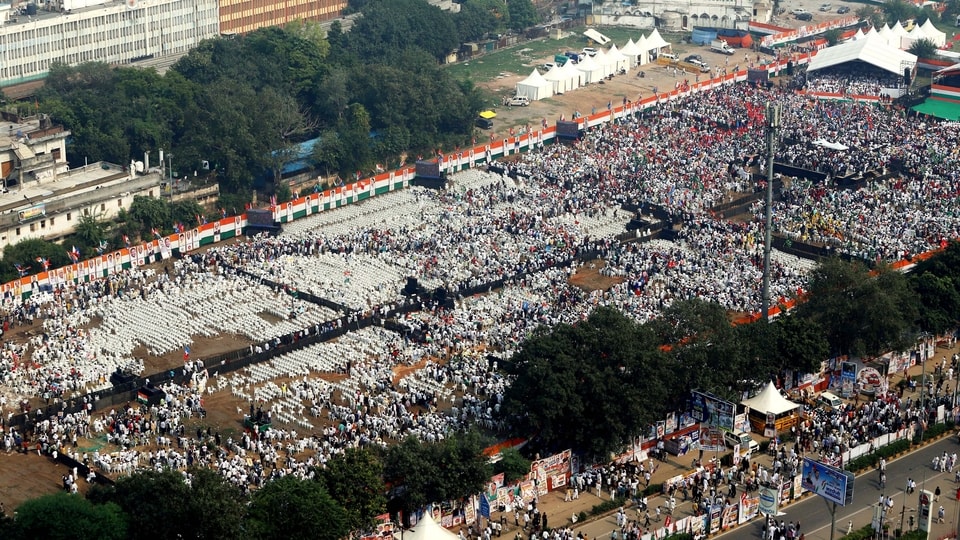
An office bearer of the Telangana Congress unit said each of the pradesh-level leaders were asked to bring around 100 supporters from their respective constituencies to Delhi for the rally, as he explained the scale of the efforts that went into assembling participants from across the country.
"Those who travelled from the state were accommodated in hotels in Vasant Kunj, where groups arrived and stayed ahead of the gathering. Some came in trains and some took the flight," the 55-year-old worker said.
Also read | INDIA bloc marches together from Delhi's Ramlila Maidan in display of force against CEC
Deep Dive

The mobilisation was not limited to transporting party workers and supporters. In some states, party office-bearers also handpicked artists to showcase their regional and tribal identities through performances at the rally.
The cultural contingents, particularly those from Chhattisgarh, Madhya Pradesh and Gujarat, rehearsed for the event well in advance before coming to the Capital. "The artists were selected by office-bearers, and the groups spent nearly a week rehearsing their performances. They also brought their traditional costumes to Delhi to display regional culture," said Ram Narayan Singh Rathiya, who brought one such group from Chhattisgarh.
The party even reached out to women workers to participate in the rally. Chanda Veragde, president of Chandrapur city Mahila Congress in Maharashtra, said around 500 women from the region had travelled to Delhi by train. The group arrived on October 30, two days before the rally.
Also read | Akhilesh Yadav sounds UP poll bugle at INDIA bloc rally, calls it next battle against BJP
"We are the voice of the country. I had never come to Delhi before this. This is my first time. We will leave tomorrow. We were planning this for two weeks and speaking to so many women to bring them together was a task," she said.
The Opposition’s march and rally on Sunday was the largest show of strength by the INDIA bloc, which has been seeking CEC Kumar’s removal over allegations of irregularities in the functioning of the Election Commission and the Special Intensive Revision, which has already removed 130 million names from India’s electoral rolls, many of them under absent, shifted or dead categories. The agitation was the first such street protest since a brief hiatus in agitation last month.
Also read | Opposition holds ‘impeachment’ of CEC Gyanesh Kumar; BJP terms it ‘drama’
The programme included a march from the edge of Connaught Place to Ramlila Maidan, a route of 1.3km touching Minto Road and Kamla Market. It began at around 12.45 pm as leaders from more than 19 parties — Congress MP Rahul Gandhi Gandhi, Samajwadi Party chief Akhilesh Yadav, former West Bengal chief minister Mamata Banerjee, Rashtriya Janata Dal (RJD) leader Tejashwi Yadav, NCP (SP) leader Supriya Sule and National Conference president Farooq Abdullah – boarded open-top buses commissioned from Rajasthan. For about 1.5 hours, the convoy of vehicles, flanked by thousands of supporters and political workers, drove around central Delhi before reaching Ramlila Maidan at 2.30pm.
After headlining a march that snaked through central Delhi for more than an hour and a rally attended by thousands of people, Gandhi trained his guns at the government, saying Prime Minister Narendra Modi and home minister Amit Shah will not be allowed to escape the law.