E-Paper



US-India resolve to elevate defence ties as China shadow looms
Austin flew into India on the last leg of a three-nation visit that included Japan and South Korea, and China’s coercion and aggression figured in the US defense secretary’s discussions in the earlier stops of his tour.

 Prefer HTon Google


India and the US on Saturday discussed ways to elevate their security ties against the backdrop of China’s growing assertiveness, with US defense secretary Lloyd Austin saying the defence partnership with India is a priority of the Biden-Harris administration.
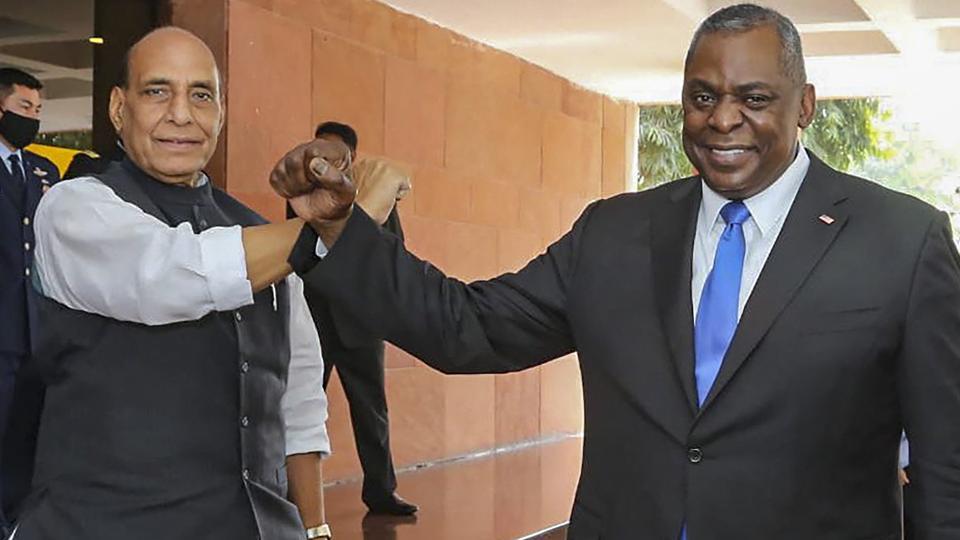
The two sides also agreed to enhance cooperation between the Indian military and the US Indo-Pacific, Central and Africa Commands, defence minister Rajnath Singh told a joint media interaction after his meeting with Austin, the first top leader of the Biden administration to visit the country.
Austin, who met Prime Minister Narendra Modi and National Security Adviser (NSA) Ajit Doval shortly after arriving in New Delhi on Friday, characterised the India-US relationship as a “stronghold of a free and open Indo-Pacific”.
Though both Singh and Austin made no reference to China in their statements to the media, the two sides are understood to have discussed the India-China standoff at the Line of Actual Control (LAC), China’s actions across the region, and the situation in Afghanistan.
Austin flew into India on the last leg of a three-nation visit that included Japan and South Korea, and China’s coercion and aggression figured in the US defense secretary’s discussions in the earlier stops of his tour. He arrived in India hours after the foreign ministers and NSAs of the US and China clashed publicly at a meeting in Alaska.
Pointing to the shared values and converging strategic interests of the US and India, Austin said: “We discussed opportunities to elevate the US-India major defence partnership, which is a priority of the Biden-Harris administration, and we’ll do that through regional security cooperation and military-to-military interactions and defence trade.”
Singh said: “The recent leaders’ summit of India, US, Japan and Australia under the Quad framework emphasised our resolve to maintain a free, open and inclusive Indo-Pacific region.”
He added, “We reviewed the wide gamut of bilateral and multilateral exercises and agreed to pursue enhanced cooperation with the US Indo-Pacific Command, Central Command and African Command.”
On the US side, defence ties with India are currently the responsibility of the Hawaii-based Indo-Pacific Command. The decision to enhance cooperation with the Florida-based Central Command and the Germany-based Africa Command is being seen as a significant outcome of Saturday’s meeting. The US Central Command’s area of responsibility includes Pakistan and Afghanistan.
The US designated India a “major defence partner” in 2016, allowing the country to have wider access to a range of military and dual-use technologies. The two sides have also signed what are known as “foundational” defence and security agreements, such as the Logistics Exchange Memorandum of Agreement (LEMOA), Communications Compatibility and Security Agreement (COMCASA) and Basic Exchange and Cooperation Agreement (BECA).
Singh said he and Austin discussed steps to realise the full potential of the foundational agreements, and expanding military-to-military engagement across services, information-sharing, cooperation in emerging sectors of defence, and mutual logistics support.
The two sides also discussed the need to enhance capacity to address non-traditional challenges such as oil spills, environmental disasters, drug trafficking, and illegal, unreported and unregulated fishing, he added.
Singh invited the US industry to take advantage of India’s liberalised foreign direct investment (FDI) policies in defence. “We both agreed that there are opportunities for collaboration in the defence industry,” he said.