E-Paper



India-Myanmar border will be fenced, no free movement: Amit Shah
The decision comes as the country aims to tackle Maoist extremism and strengthen border security.

 Prefer HTon Google


India will scrap the free movement regime it shares with Myanmar and build a fence on the border with the neighbouring country, Union home minister Amit Shah said on Saturday as he also stressed that the country will be rid of Maoist extremism within three years.
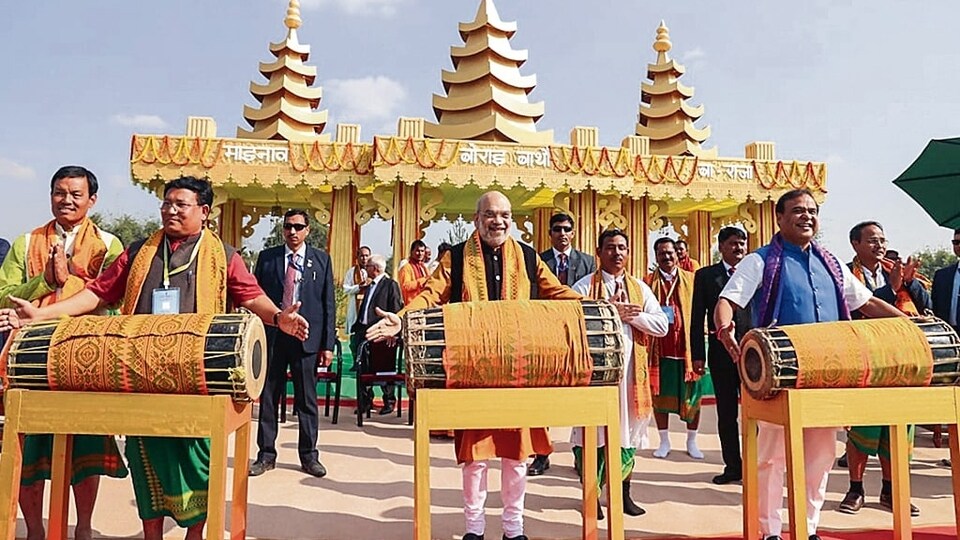
“The government under Prime Minister Narendra Modi has decided to fence the entire India-Myanmar border like it has been done along the border with Bangladesh,” Shah said at the graduation parade of 2,551 commandos of Assam Police at Guwahati, one of the five events in which he participated on Saturday. He was on a three-day tour of Meghalaya and Assam, and attended the plenary session of North Eastern Council in Shillong on Friday.
India and Myanmar share a 1,643km border in four states of the northeast — Mizoram, Nagaland, Manipur and Arunachal Pradesh. The free movement regime allows people living in border areas to travel up to 16km inside the other country without a visa.
“Our government is re-examining the free movement regime provision that exists with Myanmar and now this facility, which allows free movement, will be stopped,” said Shah.
Also Read: Govt may end ‘free movement’ along India-Myanmar border
Reacting to the home minister’s comments, Mizoram chief minister Lalduhoma said that his government was opposed to the Centre’s plan but lacked authority to stop it.
“If the Centre goes ahead with the plan to fence the Indo-Myanmar border and scrap the free movement regime (FMR), we don’t have any authority to stop it,” he said, adding that the border between Mizoram and Myanmar was decided by the British, and Mizos on both sides don’t accept it.
Also Read | Mizoram will continue to provide assistance to refugees from Myanmar: CM Lalduhoma
Mizos share ethnic, social and cultural ties with Chins from across Myanmar. Since the military coup in Myanmar in February, 2021, thousands of refugees from Myanmar have entered Mizoram and are staying in the northeastern state. The Mizoram government has refused Centre’s directives to send them back or take their bio-metrics and have provided them shelter and other basic needs. At present there are around 30,000 Myanmar refugees in Mizoram.
In his address on Saturday, Shah said that there has been a lot of change in India’s internal security scenario in the past 10 years since the government at Centre led by Prime Minister Narendra Modi came to office.
“There’s been a 73% decrease in incidents of violence in northeast, Jammu & Kashmir and Naxal-affected areas in the past 10 years. It’s a matter of happiness for all of us. In the past five years, there’s big change in Assam’s law and order situation,” said Shah.
Almost all armed terror groups have signed peace agreements, youth have joined the mainstream and the area covered under provisions of Armed Forces (Special Powers) Act has also been reduced significantly, the home minister said.
Shah lauded the state government and Assam Police for action against drug trafficking. He also praised the government led by Himanta Biswa Sarma for creating 100,000 jobs as promised in the Bharatiya Janata Party’s manifesto in the 2021 assembly polls.
“Injustices were done by previous Congress governments in Assam. Families who lost thousands of youth due to insurgency are demanding justice and opposing Rahul Gandhi’s Bharat Jodo Nyay Yatra,” Shah said.
While launching the book on Lachit Barphukan, Shah stated that Assam would have become part of Bangladesh if the Ahom army led by Lachit Barphukan had not defeated the Mughals at the Battle of Saraighat in 1671.
“If someone asks me what would have happened if in that battle Lachit’s army had lost against the Mughals? I can say without any doubt that Assam would have become a part of Bangladesh and not India,” he said.
Earlier in the day, Shah took part in the 60th raising day of Sashastra Seema Bal at Tezpur and the 13th triennial conference of the All Bathou Mahasabha at Dekhiajuli. In the evening, he launched a book titled “Assam’s Braveheart Lachit Barphukan” and inaugurated the riverfront beautification project along the Brahmaputra in Guwahati.