E-Paper



A dusty veil shrouds Delhi as desert winds, dry heat combine
This summer pollution episode brings back into the spotlight what is now a perennial environmental crisis for the Capital: hazardous air pollution levels.

 Prefer HTon Google


The national capital and its neighbouring cities on Tuesday were shrouded in a dusty haze in the morning before the afternoon sky turned virtually white as strong winds funnelled in sandy particles from the deserts of Rajasthan, and kicked up loose soil and local construction debris.
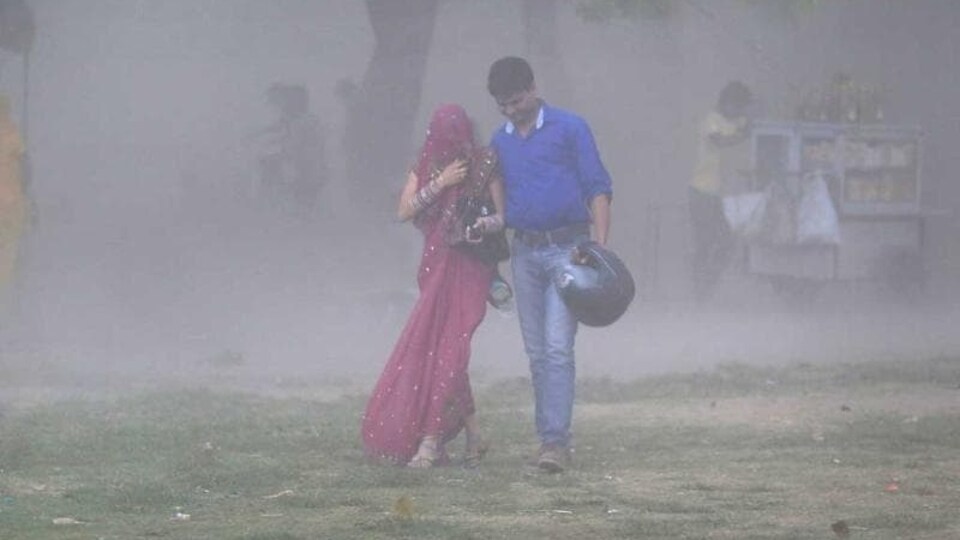
The primary pollutant was PM10 particles, which are coarser than the more harmful PM2.5 generated mostly as smoke, and its levels reached close to 30 times the safe limits in several parts of the city.
Also read: Dust storm spikes pollution levels in NCR, conditions to prevail for next two days
“Strong dust-raising winds were prevailing over Delhi NCR from 4am onwards, leading to local dust being lifted. These westerly winds also brought considerable dust from Rajasthan, which was reflected in the low visibility of 700 metres,” said Kuldeep Srivastava, scientist at the India Meteorological Department (IMD), citing a lack of rain and temperatures in excess of 40°C as factors that contributed to the phenomenon.
“This meant the top soil was also fairly dry and made it easier for these strong winds to blow it away, with it settling down gradually through the day. In such a scenario, it takes several hours for the dust to come down, unless there is rain,” he added, stating Wednesday will be another dusty day for the region, but visibility will be better. “Local dust will get lifted, but long-range transport from Rajasthan will be limited.”
This summer pollution episode brings back into the spotlight what is now a perennial environmental crisis for the Capital: hazardous air pollution levels. Most of it occurs in winter, when weak winds trap local pollutants and farm fires bring in toxic smoke, but it is now also routine in summers, when the city is gripped by dust storms of the sort recorded on Tuesday.
At fault is the erosion of the Aravalli range, which once acted as a natural barrier between the northwestern deserts, and rampant construction work within the city with little regard for mandatory dust mitigation compliances. And Tuesday’s occurrence serves as another reminder of why it is critical that the National Capital Region takes care of its lifeline, rather than prey on it.
The dusty conditions meant the average air quality index (AQI) recorded on Tuesday at 4pm shot up to 254, classified as “poor”, from 162, classified as “moderate”, on Monday, according to Central Pollution Control Board data. By 11pm, the AQI worsened to 331 in Delhi in the “very poor” zone, while NCR cities of Noida recorded (374), Ghaziabad (366) and Greater Noida (360).
The weather turned from around 4am on Tuesday, when winds began gusting from 30-40k/hr to 80k/hr hours later, taking the visibility recorded at Palam from 3,200 metre at 5:30am to a mere 900m at 6am.
The deterioration in air quality led the Commission for Air Quality Management (CAQM) in NCR to hold an emergency meeting, with the body stating that this spike was temporary and the air quality was likely to improve in the next 24 to 48 hours.
“The Sub-Committee for GRAP, after comprehensively reviewing the air quality scenario, noted this to be an exceptional episodic event, which has led to continual dispersion of dust in the ambient air over Delhi-NCR. The situation is likely to improve in the next one to two days, with rain also expected on May 18. The Sub-Committee shall be keeping a close watch on the situation in the days to come and will review the air quality scenario of Delhi-NCR accordingly.” CAQM said in a statement on Tuesday.
VK Soni, scientist at IMD and part of the CAQM subcommittee which implements the Graded Response Action Plan (Grap), said the dust is expected to settle down by Tuesday night, but the air quality will not improve significantly. “The air quality will drop from very poor to poor, but the PM 10 will still be beyond permissible levels. Strong local winds may also occur on Wednesday, which will again lift from dust locally, but we don’t expect a repeat of Tuesday,” he said.
IMD’s satellite imagery showed dust was prominent over Delhi-NCR, western Uttar Pradesh, north Haryana and parts of Rajasthan during the day.
Experts said dust particles can irritate the lungs, trigger respiratory problems, and exacerbate existing conditions such as asthma, bronchitis, and allergies.
Also read: Illinois Dust Storm: Video: Six dead after dust storm causes fatal US car crash
“People suffering from respiratory diseases such as bronchitis, bronchial asthma and chronic obstructive pulmonary disease are at a greater risk due to dust pollution. It may worsen their condition and trigger attacks,” said Dr Jugal Kishore, head of the medicine department of the Safdarjung Hospital.
Dusty conditions also aggravate rhinitis, allergy and irritation of the eyes, he said, adding that people should try and remain indoors till the air quality improves and cover their nose and mouth with a wet cloth.
He said the government can consider banning construction and demolition activities until the situation improves.