
 E-Paper



New in the Northeast | A border pact is signed
Assam and Meghalaya signed an agreement to redraw existing lines, which will now go to Parliament.


Border pact sealed, all eyes now on Parliament
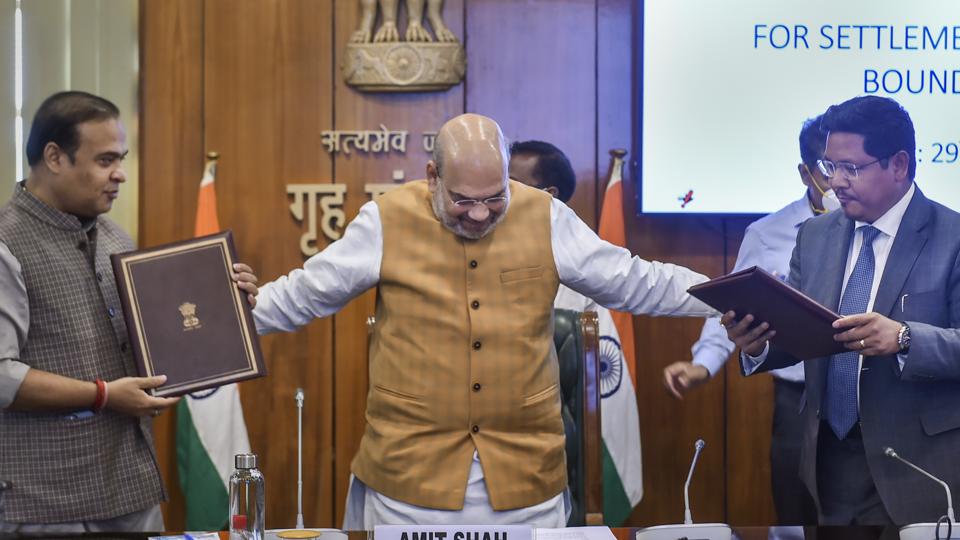
After much deliberations and speculations, Assam and Meghalaya sealed a deal in New Delhi last week to resolve six of the 12 points of dispute along the interstate border. Both states agreed on a formula of give and take to solve their nearly five decades old boundary bickering.
The agreement, considered historic, would ensure that Meghalaya would get around 18 sq km of the nearly 36 sq km of disputed areas in the six spots, while Assam would get the rest. The signing of the deal also gave hope of similar agreements with Nagaland, Arunachal Pradesh, and Mizoram — states with which Assam has long-pending border disputes.
But signing the agreement between two states to redraw their existing boundaries doesn’t mean that the matter is sorted once and for all. A day after signing the deal with Meghalaya, Assam Chief Minister Himanta Biswa Sarma told the state assembly that the agreement isn’t final and it was Parliament that will take a final decision on the issue.
“What we have done so far is executive action and now it will be sent to the legislative domain. The deal that we have signed isn’t a final one. Now, Parliament will take a final decision on it after debate and discussion,” Sarma told the assembly.
In India, as per Article 3 of the Constitution, it’s only Parliament that can decide on the formation of new states, increase or diminish areas of any state, and alter the boundaries or the name of a state.
The article provides that no Bill for the above-mentioned purposes shall be introduced in the Lok Sabha or Rajya Sabha except on the recommendation of the President. Once introduced, it requires a simple majority of both Houses of Parliament to pass the Bill for the creation of new states or re-drawing of boundaries of existing states.
Before the Bill is passed, the President is required to consult the affected states. But there is no time frame within which the state legislatures have to send back their decisions on the matter to the Centre. The Centre may, however, specify a period while referring the matter to the states. And it is the Parliament that will have the final say on the matter of whether the affected states accept the Centre’s proposal or reject it.
Hence, last week’s agreement between Meghalaya and Assam won’t become effective anytime soon and all eyes will be on parliament for the final decision and the time frame.
A battle lost even before it started
Last week’s Rajya Sabha polls in Assam in which the ruling Bharatiya Janata Party (BJP) and its allies managed to win both vacant seats, despite not having the required votes, had the ingredients of a sizzling political potboiler. While it was a continuation of its winning streak for the ruling coalition, for the Opposition, it was a battle that they lost even before it started.
When counting of all 126 votes ended close to midnight on March 31, BJP candidate Pabitra Margherita and ruling United Peoples Party Liberal candidate Rwngwra Narzary bagged 46 and 44 votes respectively to secure wins. On the other hand, Congress candidate Ripun Bora who had the support of the entire Opposition secured only 35 votes and lost. One vote was declared invalid.
A candidate needed 43 votes to secure a win and the BJP and allies had 82 votes in their camp — enough to secure Margherita’s win but Narzary fell short by 4 votes. The Congress and opposition allies had exactly 43 votes — enough to secure a win for Bora.
But the final scores revealed that one Congress MLA had voted for the ruling allies, another Congress MLA’s vote was rejected and seven legislators from the Opposition camp voted for Margherita and Narzary, enabling the ruling camp to win both seats.
While the official declaration of results was made on March 31 at midnight, the Opposition camp lost the battle two days ago when Congress state unit president Bhupen Kumar Borah addressed the media on March 29 evening and accused the opposition All India United Democratic Front (AIUDF) of “selling” 5 of their MLAs to the ruling BJP.
Terming the party as betrayers, Borah alleged that AIUDF chief Badruddin Ajmal was responsible for the sale of party legislators. The Congress chief’s allegations came after Ajmal expressed doubts that 5 Congress MLAs could vote for BJP and allies during the Rajya Sabha polls.
The accusations and counter-allegations within the opposition camp made it clear that all was not well despite Congress and AIUDF sealing a deal earlier for the polls. It also showed that both parties were unsure about how their legislators would vote and wanted to find excuses for a possible loss even before voting had taken place.
“As a former Congressman, I would say one shouldn’t fight amongst themselves two days prior to the election. If you are expecting to ‘benefit’ from someone, would you scold and abuse that person two days before the polls? One can do it after voting or when results are out. Immaturity has reached its peak in Congress. The party needs to do a rethought,” Chief Minister Himanta Biswa Sarma quipped after the results were out.
 ABOUT THE AUTHORUtpal Parashar
A seasoned senior journalist, I have nearly three decades of experience across print, digital, and online platforms, covering political transitions, insurgencies, environmental issues, and development stories in India and Nepal. I am skilled in breaking news, leading editorial teams and launch of newspaper editions. I am adept at leveraging digital trends and social media to expand global reach, with a strong ethical foundation and a reputation for impactful journalism. An alumnus of Asian College of Journalism, I joined Hindustan Times in New Delhi as a trainee reporter in May 1997. Over the years, I have been posted in Dehradun, Kathmandu (Nepal) and Guwahati. Currently, as Senior Assistant Editor at Hindustan Times, I lead a team reporting on India’s northeastern states. My work involves in-depth analysis, and engaging multimedia storytelling across formats, including text, photo, video, and interactive content. I am skilled in producing timely, shareable content, leveraging digital platforms and social media to engage global audiences. Throughout my career with the Hindustan Times, I have led diverse editorial teams, designed capacity-building activities, and supported reporters in developing strong story ideas, ethical reporting practices, digital skills, and fact-checking techniques. As Senior Assistant Editor for Northeast India, I have been responsible for guiding correspondents through complex political, humanitarian, and community-level stories using multimedia formats. Earlier, as Foreign Correspondent in Nepal, I produced extensive reporting during Nepal’s democratic transition and the 2015 earthquake and its aftermath.Read More



