E-Paper



PM Modi’s France visit will focus on defence, space
The visit to France will be “rich in substance and form” and is expected to new benchmarks for the bilateral strategic partnership, said Vinay Kwatra

 Prefer HTon Google


France will be the first stop on a two-nation tour this week by Prime Minister Narendra Modi, who will be the guest of honour at the annual Bastille Day Parade and hold talks with President Emmanuel Macron to take forward cooperation in key areas ranging from defence to space.
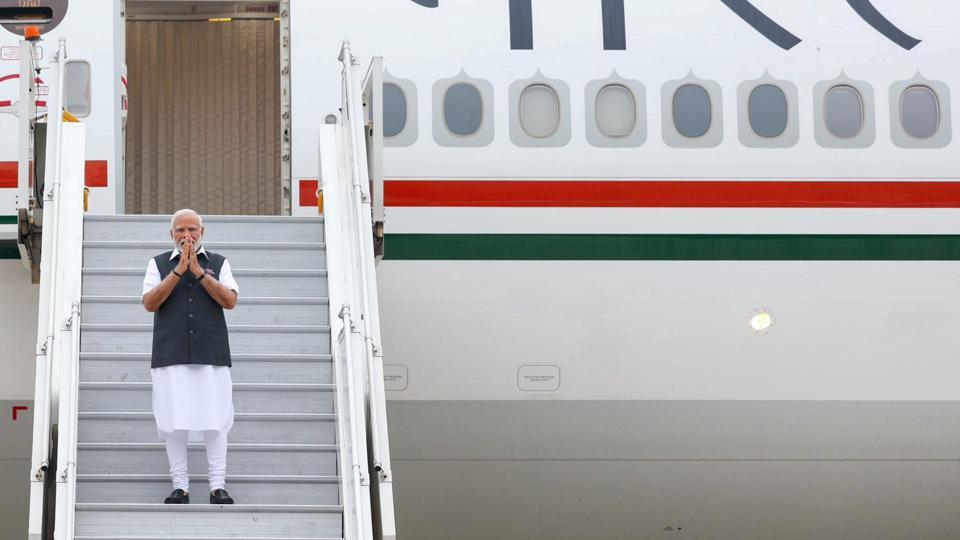
Modi is visiting France at the invitation of Macron during July 13-14. Being the chief guest at the military parade is considered a signal honour, and the last foreign leader to receive this in France was former US president Donald Trump in 2017. A 269-member Indian tri-services contingent will participate in the parade and three French-origin Rafale combat jets of the Indian Air Force (IAF) will join a flypast.
Defence is set to be a focus area during Modi’s visit to Paris, with the two sides expected to sign agreements to pave the way for India buying 26 Rafale-Marine combat jets for the navy and building three more Scorpene-class submarines in the country, officials aware of the matter said.
India’s defence acquisitions council (DAC), headed by defence minister Rajnath Singh, is expected to accord acceptance of necessity (AON) to the navy for buying the maritime fighters and for building the diesel-electric attack submarines at state-run Mazagon Dock Shipbuilders Limited (MDL). The IAF operates 36 Rafale jets bought from France at a cost of ₹59,000 crore, and the Rafale M will bring commonality with IAF’s fighters, creating advantages in training, maintenance and logistics support.
There are also reports that an arrangement for joint development of an engine for fighter jets with French aircraft equipment manufacturer Safran and a road map for defence-industrial cooperation could be finalised during the visit.
Foreign secretary Vinay Kwatra told a media briefing that defence cooperation between India and France covers several important areas, including exercises, logistics support and maritime security cooperation in the Indian Ocean and Indo-Pacific. Modi and Macron, he said, are expected to discuss ways to take forward joint research, design and production of military hardware and aligning these efforts with India’s drive to achieve self-reliance through initiatives such as “Make in India”.
MDL has built six Scorpene or Kalvari class submarines with technology from France’s Naval Group under a ₹23,562-crore programme. The sixth vessel is set to be inducted in the Indian Navy early next year.
Soon after arriving in Paris on Thursday, Modi will meet his French counterpart Élisabeth Borne and Senate President Gérard Larcher. He will interact with the Indian community before Macron hosts him for a private dinner at the Élysée Palace.
The ceremonial part of the visit will be July 14, when Modi will join the French national day celebrations at the Bastille Day Parade. This will be followed by a meeting with National Assembly President Yaël Braun-Pivet and a series of interactions with thought leaders and businesspeople.
The 68-member IAF contingent taking part in the parade will be led by Squadron Leader Sindhu Reddy, a Mi-17 pilot. She led the IAF contingent at this year’s Republic Day parade. The army contingent will be led by Capt Aman Jagtap, while the naval contingent will be headed by Commander Vrat Baghel. A French Army contingent joined the Republic Day parade in 2016 when then president Francois Hollande was the chief guest at the event in Delhi.
There will be a ceremonial reception at the Élysée Palace on July 14, which will be followed by delegation-level talks between Modi and Macron. The two leaders will also participate in the India-France CEO Forum, which will be followed by a state banquet hosted by Macron at the Louvre Museum.
The visit to France, Kwatra said, will be “rich in substance and form” and is expected to new benchmarks for the bilateral strategic partnership, which is based on a series of strategic convergences. The two leaders will review cooperation under key pillars of this partnership, including security, space, civil nuclear technology, counterterrorism, cyber security, climate change and integration of supply chains, and outline plans for the future, he said.
The two leaders are also expected to explore new areas of cooperation in space, especially since this sector in India has undergone a rapid evolution, Kwatra said. Responding to a question on French energy major EDF’s plans to build a nuclear power project at Jaitapur in India, he said agencies on the two sides are engaged in intense discussions on issues such as liability, cost of power generation, techno-commercial arrangements and engineering elements for “concretisation of the cooperation”.
While acknowledging that the two leaders will discuss developments in different parts of world, Kwatra declined to say whether the Ukraine crisis will figure in the talks. He described the recent riots that hit several French cities as an “internal matter” that had no impact on the visit.
The 25-year-old strategic partnership with France is time-tested and geopolitical developments haven’t affected the close ties, said Air Marshal Anil Chopra (retd), director general of the Centre for Air Power Studies. “The defence relationship has been especially significant in the air and maritime domains for decades. France has played a critical role in strengthening India’s military capabilities and continues to do so,” he said.
From France, Modi will travel to Abu Dhabi in the United Arab Emirates (UAE) on July 15. He will hold talks with the UAE President and ruler of Abu Dhabi, Sheikh Mohamed bin Zayed Al Nahyan.
The India-UAE comprehensive strategic partnership has been “steadily strengthening” and Modi’s visit will be an “opportunity to identify ways to take this forward in various domains such as energy, education, healthcare, food security, fintech, defence and culture”, the external affairs ministry said.
The visit will also be an opportunity to discuss cooperation on global issues, particularly in the context of the UAE’s presidency of COP28 and India’s G20 presidency, in which the Emirates is a guest country.
Since the signing of the Comprehensive Economic Partnership Agreement (CEPA) in February 2022, two-way trade is now worth $85 billion. The UAE is India’s third largest trading partner and second largest export destination. The UAE is also the fourth largest investor in India, and is home to 3.5 million Indian expatriates. “The PM’s visit provides a useful opportunity to review this important partnership and inject further momentum across the whole range of areas that we cooperate in,” Kwatra said.