
 E-Paper



25 years, many slogans: Modi's journey from 'Acche din' to 'We will do it'
The BJP’s spectacular win in the 2014 Lok Sabha elections was largely credited to Modi’s leadership, oratory and governance model in Gujarat.

 Prefer HTon Google


Prime Minister Narendra Modi has coined a new slogan to give impetus to his ambitious plan for a developed India by 2047: "We will do it".
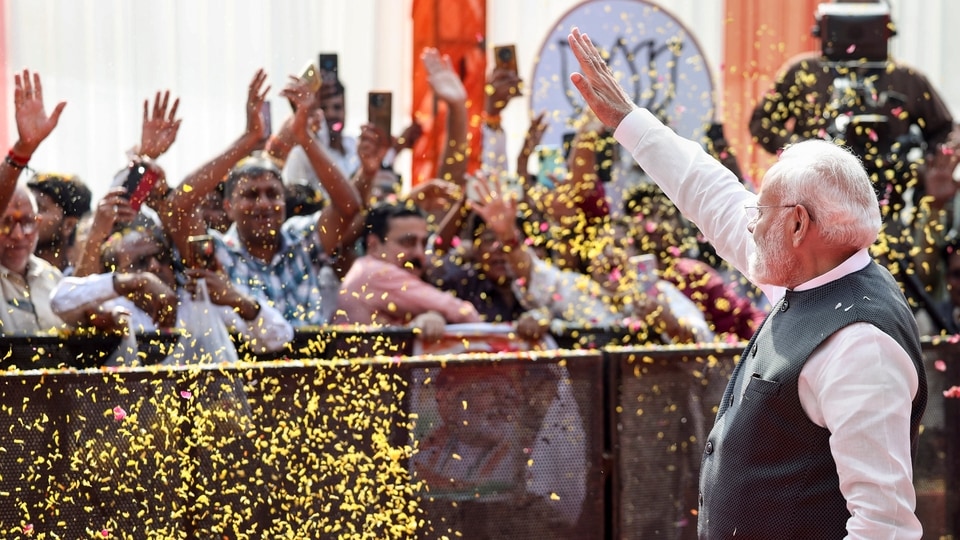
On Wednesday, he completed 25 years in public service and as head of government, first as the chief minister of Gujarat and since 2014, as the premier of India. To mark the occasion, he dwelt on the past, summarised the present, and came up with a catch phrase for the future.
The PM used the slogan to nudge people to take on the challenge of bringing about changes from the economy to the manufacturing sector. He also listed several sectors where India needs to be the leader – from artificial intelligence to the space sector, and from the environment to exports.
Also Read | 'We will do it': PM Modi's self-confidence mantra for 'Viksit Bharat' by 2047
Deep Dive

After he was named as the Bharatiya Janata Party (BJP)’s prime ministerial candidate in 2013, his political journey from the state to the national capital was pivoted on the catchy “Abki baar Modi sarkar” (this time, a Modi government) and the hope-inducing “Acche din aane wale hain” (good days are coming) slogans.
The party’s spectacular win in the 2014 Lok Sabha elections was largely credited to Modi’s leadership, oratory and governance model in Gujarat. However, opponents also saw it as the victory of a Hindu nationalist sentiment fostered by the BJP and its ideological fount, the Rashtriya Swayamsevak Sangh (RSS).
Modi then came up with the slogan of “Sabka saath, sabka vikas” (together with all, development for all), which sought to instill a sense of confidence that the government would be egalitarian and non-discriminatory. He added “vishwas” (trust) to the slogan when he returned to power for his second term in office in 2019, winning with a bigger margin and number.
Also Read | 25 years of Narendra Modi as head of state: From Gujarat to the Centre and the global stage
In its first tenure, the Modi government set itself the task of weeding out outdated laws, meeting deadlines for infrastructure development, and ushering in economic and social reforms. For this, it chose the slogan of “Minimum government, maximum governance”.
The underlying message was cutting the bureaucratic red tape.
He even relied on slogans and catchphrases to introduce and implement policy decisions. Take for instance, the "Swachh Bharat abhiyan", to drive home the need for cleanliness and sanitation or the "Make in India" tagline for giving impetus to indigenous manufacturing. To check the country’s gender imbalance and prevent female foeticide, the PM came up with the “Beti bachao, beti padhao” (Save the daughter, educate the daughter) campaign.
Key phrases and catchlines have now become central to his style.
Also Read | Allies hail 25 years of stability and continuity under Modi
The “Atmanirbhar Bharat” (Self-reliant India) and “Vocal for local” (to promote Indian made goods) taglines were used to deliver the message to cut down on imports and drive domestic manufacturing and consumption during challenges imposed by the global pandemic in 2020. These taglines were reinforced when the West Asia crisis caused havoc in supply chains and sent prices of crude, gas and other essentials skyrocketing.
Difficult political decisions that led to disagreements and disruptions in Parliament and sharpened the divisions between the political class were also padded with slogans. A case in point being the proposal to synchronise Lok Sabha and assembly elections, popularly known as “One Nation, One Election”.
As the third term nears completion, the PM who once referred to himself as the “chowkidar” (guard) and reassured the electorate with the “Modi hai toh mumkin hai” (Modi makes it possible) tagline, has now set the agenda for 2047.


