
 E-Paper



Railways plans fencing along Vande Bharat’s Mumbai-Gujarat route after 2nd cattle-hit incident
While the semi-high speed train hit some buffaloes between Gairatpur and Vatva stations in Gujarat on Thursday, it hit a cow near the state’s Anand station on Friday.

 Prefer HTon Google


The Western Railways is planning to install fences along the Gandhinagar-Mumbai route, after the newly-launched Vande Bharat Express train suffered minor damages by colliding with cattle on the railway line for two days in a row, officials said on Friday.
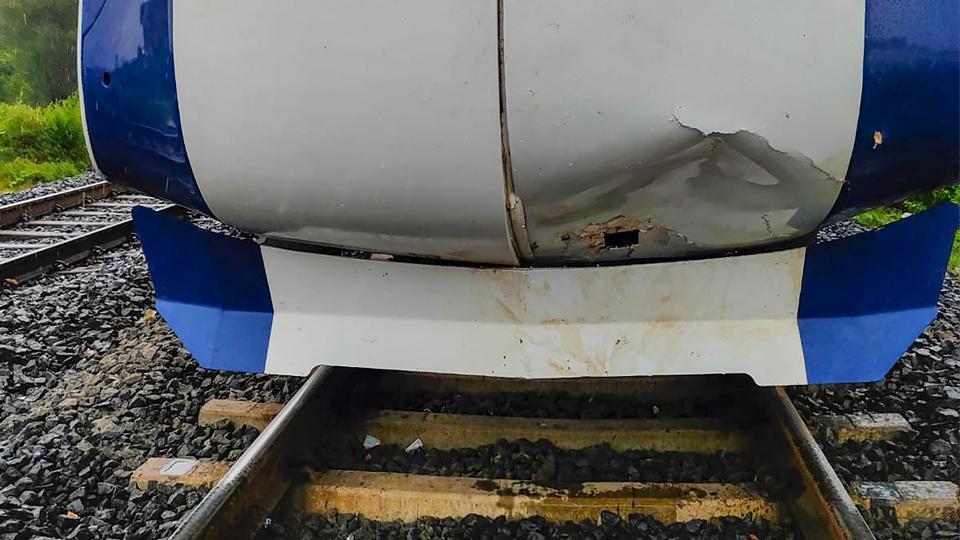
While the semi-high speed train hit some buffaloes between Gairatpur and Vatva stations in Gujarat on Thursday, it hit a cow near the state’s Anand station on Friday.
Railways minister Ashwini Vaishnaw acknowledged the problem of cattle crossing the tracks and told reporters that such collisions were kept in mind while designing the train for minimum impact.
Besides installation of fences, the railways has decided to create awareness and sensitise nearby villagers on not leaving their cattle near the track, according to the officials cited above.
“We aim to begin fencing work and complete it by 2024 to avoid such accidents in the future,” a railways official told HT on condition of anonymity.
“The local staff has also been asked to counsel the villagers on a daily basis. The sarpanch of the villages have also been called to discuss the issue,” the official added.
The Mumbai-Gandhinagar Vande Bharat Express train under the Vande Bharat series, indigenously designed and manufactured, was flagged off by Prime Minister Narendra Modi in Gandhinagar on September 30. Its commercial run started from October 1.
The front portion of the train engine was damaged after it hit some buffaloes between Gairatpur and Vatva stations around 11.15am on Thursday. The train was travelling from Mumbai to Gandhinagar when the incident occured.
While no one was injured, four buffaloes were killed in the incident. The damaged portion was later replaced by authorities and the train operated as per schedule on Friday. No functional part of the train was harmed, a Western Railways spokesperson had said.
On Friday, the train, which departed Gandhinagar at around 3pm, hit a cow near Anand station. It suffered a dent on the nose of the engine which was subsequently repaired, a Western Railways official said.
“The train hit the cow near Anand station, causing a dent on the nose of the driver coach. The nose cover was subsequently repaired. It is sacrificial by design and hence, replaceable. Railway keeps sufficient nose covers as spare,” the officer said.
Railway officials said that train services are bound to get affected due to the cattle as there are no boundary walls on either side of the tracks along the route to prevent them from entering the area.
A second railway official raised concerns over the presence of settlements on both sides of the tracks along the route. “Buffaloes were killed in the (first) accident. However, no one has claimed the cattle yet. Fencing is the only solution to restrict such accidents in future,” the official said, also seeking anonymity.
Western railways (WR) child public relations officer (CPRO) Sumit Thakur assured all necessary action was being taken to prevent such incidents.
On Thursday’s accident, he said: “Vital parts of the train remained unaffected but due to the hit, the nose cone cover of the driver coach was damaged.”
The nose cone cover is designed to absorb the impact of an accident, without transmitting the same to the functional parts of the train. It is replaceable.
Since the railways usually keep sufficient nose-cones as spare, it was easier to replace the damaged part at Mumbai Central depot on Thursday.
Vaishnaw, meanwhile, acknowledged the problems of cattle crossing the tracks.
“In India, the tracks are laid on the ground. Wherever you go, cattle will cross them, one cannot stop them. Unless we elevate the tracks in another 5-6 years, they (cattle) will come in front of the trains,” he said during an interaction with students of an engineering college at Vallabh Vidyanagar in Anand district.
“The train has been designed in such a way and it is so strong that if there is an accident, nothing will happen to the train. Its nose on the front is totally replaceable. As soon as the train reached Mumbai (after the incident on Thursday), it was completely cleaned up and its nose replaced,” he added.


