E-Paper



Search for 10 missing Odisha villagers, missing after 3 landslides in one night, halted
Kandhamal district collector Vedbhushan said the decision to halt rescue operations in Gidipabali village followed consultations with technical experts

 Prefer HTon Google


Seven days after three consecutive landslides buried seven homes in a remote Odisha village under a deluge of mud and boulders, local authorities on Wednesday temporarily suspended search operations for 10 missing residents, citing treacherous weather and the risk of further earthfalls.
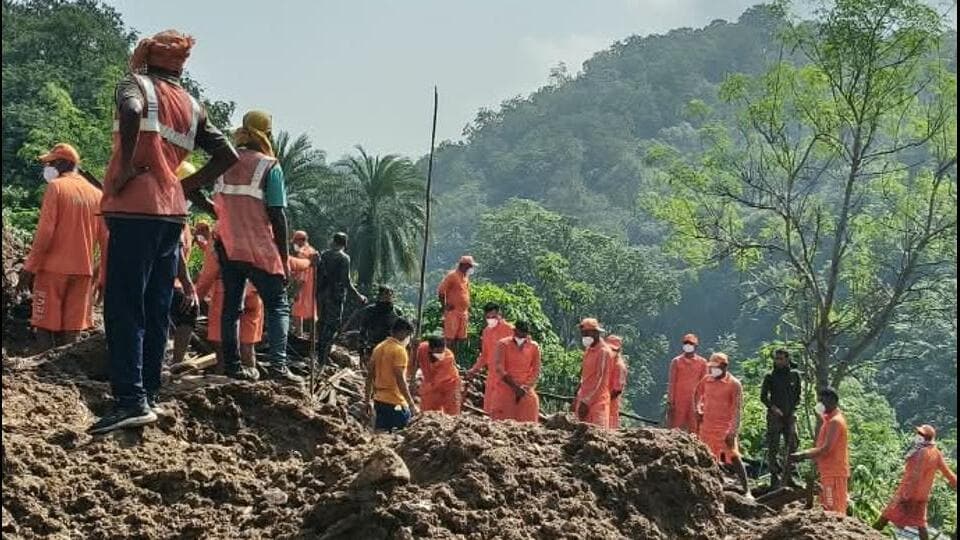
Kandhamal district collector Vedbhushan, who is leading the rescue operation, said the decision to halt operations in Gidipabali village along the Kandhamal-Ganjam boundary followed consultations with technical experts. He underlined that the operation has not been called off permanently and would resume once weather conditions improve.
“Blasting operations have yielded little result so far. It took three days to retrieve the two bodies buried in the uppermost layer of debris. The remaining bodies could be more than 30 feet below the surface, as three consecutive landslides struck the same location in a single night. The equipment currently available cannot search at such depths. Moreover, blasting could trigger further landslides. In view of these risks, we have temporarily suspended the operation,” the collector said.
The disaster struck on the night of October 28, when Cyclone Arnab made landfall along the Andhra Pradesh coast, triggering torrential rainfall in Gidipabali, a remote village surrounded by dense forests and steep hills along the Ganjam-Kandhamal border.
According to survivors, a deafening roar woke residents around 2am, as torrents of muddy water rushed through the lanes. As the hillside gave way, 25 villagers fled into the darkness.
It took two days for 13 survivors to reach a nearby cyclone shelter and alert authorities to the scale of the destruction. Due to the difficult terrain and blocked roads in an area that was once a stronghold of the Maoists, it took time for rescue teams and equipment to reach the village.
The village is located in Ganjam district. But Khandamal district led the rescue operation, since the only route to the location runs through the district.
The state government subsequently mobilised over 400 personnel, including 42 members of the anti-Maoist Special Operations Group, 15 Odisha Disaster Rapid Action Force (ODRAF) personnel, 34 National Disaster Response Force (NDRF) personnel, 35 Fire Services personnel, 35 railway workers, officials from the Mines Department, and 12 veterinary staff.
In the days that followed, rescuers could recover only two bodies despite deploying three sniffer dogs, deep-penetration radars, and life-detection equipment.
The sheer size of the debris has severely hampered logistics. Moving heavy equipment to the site has been a huge challenge, and several boulders had to be broken through controlled blasting. “Some of the boulders are as big as a room and require controlled blasting using specialised manual drill heads,” a fire services official said.
For the families of those missing, the suspension brings an agonising pause to a week-long wait for their loved ones.
Rinima Pradhan, whose husband’s body was recovered from the debris, recalled how the family was separated as they fled their home when the hillside began collapsing.
“As torrents of muddy water started flowing through the village lanes, everyone tried to flee. My husband ran out of the house with me, our twin children and his parents. We had barely gone some distance when he realised that he had left his mobile phone behind and went back home. My father-in-law also returned to get some food for the children,” she said.
Her mother-in-law told her to keep moving with the children. Rinima said she repeatedly stopped and looked back, hoping to spot her husband and father-in-law. But neither returned as the hillside collapsed onto their home.
Following two other villagers carrying lights, Pradhan and her mother-in-law waded through knee-deep water across fields to reach a temporary shelter.
“The night seemed endless. My children were drenched and shivering, but we kept moving through forest trails and over the hills to save our lives,” she said. Fearing another landslide, my mother-in-law asked us to move again. We continued walking, feeding the children along the way. After two days through forests and rough trails, we finally reached the cyclone shelter,” she said.
With search efforts stalled and little hope of finding remaining survivors alive, villagers have concurred with the administration’s decision to suspend excavation.
They have proposed a mass funeral for all the victims at a site near the village and to construct a memorial in their memory. The Ganjam and Kandhamal district officials will discuss the proposal at a meeting.