
 E-Paper



Stalin, Vijayan join centenary event of Vaikom protests
Tamil Nadu and Kerala CMs MK Stalin and Pinarayi Vijayan came together in Chennai to mark the centenary of the 1924 Vaikom protests against untouchability

 Prefer HTon Google


Chief ministers of Tamil Nadu and Kerala, M K Stalin and Pinarayi Vijayan came together in Chennai on Thursday to mark the centenary years of the 1924 Vaikom protests.
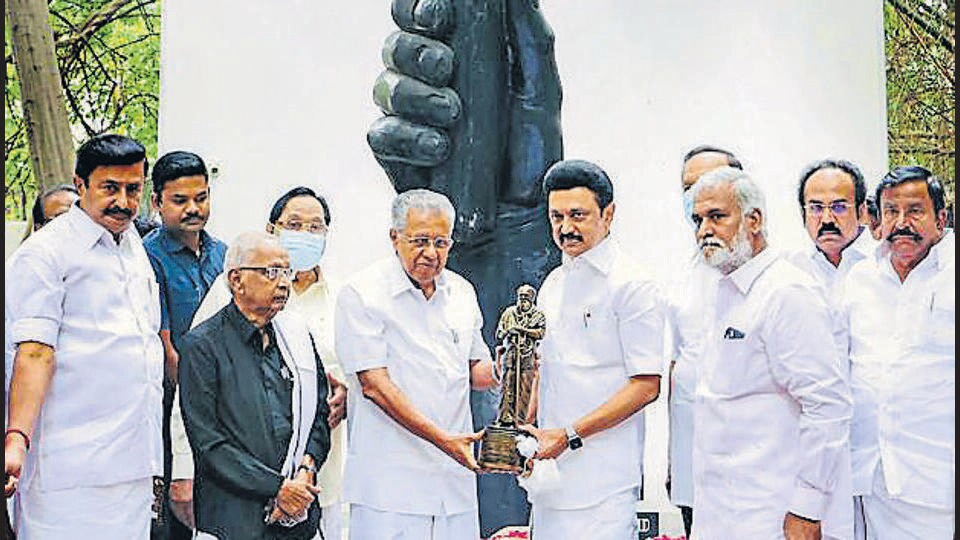
“Vaikkom Satyagraha is a people’s movement that is unparalleled in Indian history,” Vijayan said here. “I do not think that there has been such a struggle anywhere else against social evils, under the leadership of both reform movements and political movements.”
On March 30, 1924, the renaissance movement started from Vaikom, a nondescript village in Kerala, to abolish the practice of untouchability which restricted people from lower castes to access streets close to the Mahadeva Temple. On that day, three participants of the satyagraha proceeded towards the roads near the temple after bathing. They were Kunjappi–a Pulaya (SC), Bahuleyan–an Ezhava (OBC) and Govinda Panikar– a Nair and they were arrested.
It was unique that even upper castes men and those from other religions supported the cause against caste-based discrimination and against restrictions imposed by the upper castes, particularly Namboodiri Brahmins, on the access of roads to the temple. Discriminatory boards, called ‘theendal palaka’, were set up at the entry of specific roads declaring that the ‘untouchables’ could not proceed beyond that point.
In the beginning, the movement lacked popular support but it gained momentum after the participation of several leaders from other states. From Tamil Nadu leaders including then state Congress chief E V Ramasamy revered as ‘Periyar’ and the father of the Dravidian movement, and C Rajagopalachari, Srinivasa Iyenkar, Aiyyamuthu Gounder particpated. “With scant regard for his failing health, he (Periyar) took part in the struggle, and was imprisoned twice,” Vijayan added. This earned him name ‘Vaikom Veerar’ meaning hero if Vaikom.
Mahatma Gandhi too had visited the village in Kottayam district in March 1925. “When Gandhiji visited Vaikkom, he was denied entry into the indamthuruthi mana which had administrative control over the temple, as he was an ‘avarnna’. When he requested that the public roads surrounding the temple should be open to all, the authorities of the mana, the savarnnas, declined to do so,” Vijayan recalled on Thursday. “Today, that mana functions as the office of a workers’ organisation who are considered as ‘avarnna’ in those days. This is a telling example of how history ultimately goes ahead, moves forward, in a progressive direction.”
The struggle was also led by several women. On Jan 20, 1924, a committee was formed by the Kerala Pradesh Congress Committee (KPCC) for the eradication of untouchability movement. “The message of satyagraha was spread in a non-religious manner and sympathisers from other states visited to show their support. The most significant of these was a delegation of 12 people from Punjab, led by Akali Dal leaders Lala Lal Singh and Kripa Singh. They established a ‘langar’ free food hall for the satyagrahis,” professor V Karthikeyan Nair wrote in a booklet for the Kerala government’s PRD department.
Their movement succeeded in 1925. On November 23, 1925, the satyagraha came to an end after 603 days with the then government dismantling the boards and all roads leading to the temple were opened to everyone.
To mark the centenary, the DMK government in Tamil Nadu has planned year-long celebrations, including taking Periyar’s works and ideals to the younger generation. Though a massive event had been planned, it was sized down due to the death of former leader of opposition Vijayakanth in Chennai on Thursday morning. Earlier, in April, Stalin shared stage with Vijayan in Kerala for Vaikom protests’ centenary year.


