E-Paper



UN chief Antonio Guterres pays tribute to victims of ‘barbaric’ Mumbai attacks
The 73-year-old former prime minister of Portugal said his first reform after becoming the UN secretary-general in 2017 was to propose the creation of the office of counter-terrorism

 Prefer HTon Google


United Nations Secretary-General Antonio Guterres on Wednesday said all countries must collectively fight terrorism and violent extremism as he paid tribute to the 166 people killed in the “barbaric” terror attacks in Mumbai in November 2008.
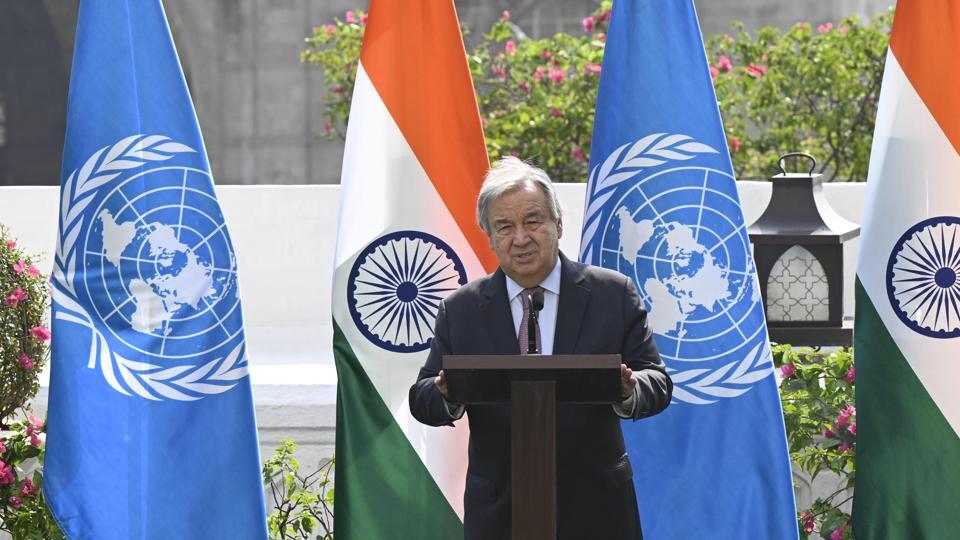
Guterres, who is on a two-day visit to India, participated in a simple ceremony at Taj Mahal Palace Hotel in Mumbai – one of the main targets in the attacks carried out in India’s financial hub by a 10-member squad from Pakistan-based Lashkar-e-Taiba (LeT) – and later described terrorism as “absolute evil”.
“Terrorism is absolute evil. There are no reasons, no pretexts, no causes, no grievances that can justify terrorism. Terrorism is absolute evil and terrorism has no room in today’s world,” he told a small gathering that included Maharashtra chief minister Eknath Shinde and Ruchira Kamboj, India’s envoy to the UN.
Also Read: Thailand shooting: UN chief Antonio Guterres says he is ‘profoundly saddened’
“So I feel deeply moved to be here, where one of most barbaric terrorist acts in history took place, where 166 people lost their lives. I want to pay tribute to the victims, they are heroes of our world,” he said, extending his deepest condolences to the families and friends of the victims, the people of India and “all those coming from other parts of the world have lost their lives in Mumbai”.
Guterres, who made no reference to Pakistan or the LeT in his brief speech, said: “Fighting terrorism must be a global priority for every country on earth, and fighting terrorism is a central priority for the United Nations.”
“We need to attack those roots of violent extremism that try to provide justification for so many times for terrorist acts. We need to be able to live with each other, to understand each other, to recognise that diversity is a richness,” he added.
Guterres noted that he was in “one of the most diverse countries in the world”, and said: “We need to stay together and we need to be much more effective in eliminating the root causes of terrorism and much more united in fighting terrorism in all its expressions and in making sure that terrorists will have no more place in our world.”
The 73-year-old former prime minister of Portugal said his first reform after becoming the UN secretary-general in 2017 was to propose the creation of the office of counter-terrorism, which is “today in full strength, able to cooperate with member states in order to provide the kind of assistance, training and advice that is necessary for all countries to be prepared to be able to prevent and simultaneously to fight against terrorist acts like the ones we have witnessed”.
He added, “At the same time, this office is fighting the roots of violent extremism. There are no reasons to justify violent extremism, be it because of religion, because of ethnicity, because of whatever belief that people might have.”
Guterres thanked the Indian government for its support for all UN actions to fight terrorism, and said: “May I end with the same words that I have started – terrorism is absolute evil. It is the duty of all of us to fight it without any kind of hesitation.”
The UN chief also signed a memorial book and went around a photo exhibition on the Mumbai attacks along with Shombi Sharp, the UN resident coordinator in India.
Twenty-nine foreign nationals from 16 countries, including the US, Israel, Germany, Canada and the UK, were among the 166 people killed in the Mumbai attacks. Only one of the 10 attackers – Ajmal Kasab – was captured alive. He was subsequently convicted and hanged.
Pakistan arrested seven LeT operatives, including the group’s operations commander Zakiur Rehman Lakhvi, and put them on trial in an anti-terrorism court. Lakhvi was released on bail in 2015 and there has been little progress in the Mumbai attacks case in Pakistan.
India will host two special meetings of the UN Security Council Counter-Terrorism Committee at the end of this month, including an informal meeting at the Taj Mahal Palace Hotel in Mumbai.