E-Paper



US sending team to India for talks to sell more P-8 surveillance aircraft
The delegation from the US defence dept and Boeing will be in Delhi on September 16-19 for detailed discussions on the current offer for six more P-8I aircraft

 Prefer HTon Google


NEW DELHI: A US delegation is set to visit India next week for negotiations on selling six more P-8I maritime patrol aircraft to the Indian military as background contacts continue between the two sides to get bilateral relations back on track after a trade row, people familiar with the matter said on Wednesday.
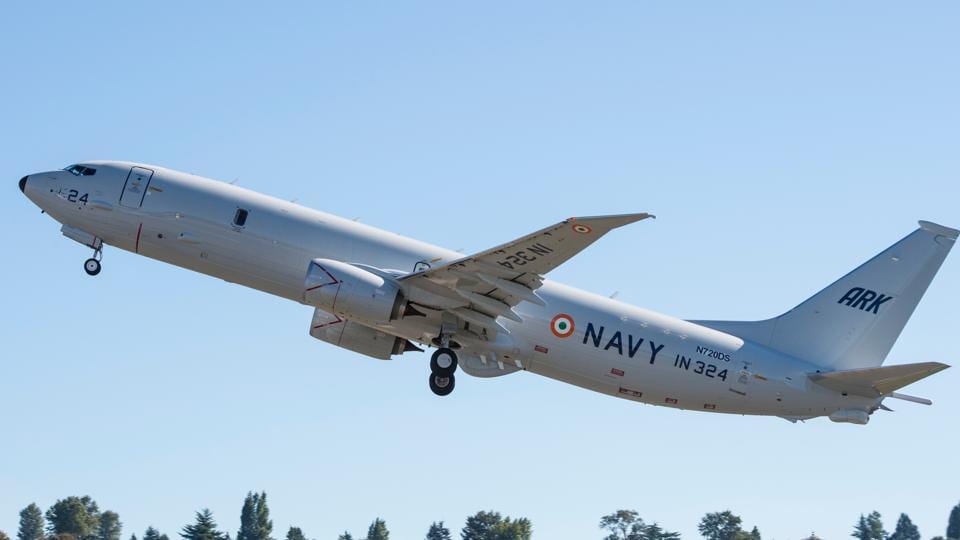
The American team, comprising senior officials of the defence department and Boeing, the manufacturer of the P-8 Poseidon aircraft already in service with the Indian Navy, will visit at a time when senior officials of the Trump administration have repeatedly excoriated India for buying Russian military hardware.
While US President Donald Trump’s decision to double tariffs on Indian goods by imposing a 25% punitive levy over Russian oil purchases has led to strains in bilateral ties not witnessed in almost two decades, signs have emerged of the two sides working to repair the relationship. On Wednesday, Prime Minister Narendra Modi and Trump had their second positive exchange on social media in four days, with both leaders pointing to the early conclusion of trade negotiations.
The delegation from the US defence department and Boeing will visit Delhi during September 16-19 for detailed discussions on the current offer to the Indian government on procuring six P-8I aircraft, the people said on condition of anonymity.
The delegation will include senior US officials handling relations with India from the office of the undersecretary of defence for policy, Navy International Programs Office (NIPO), Maritime Patrol and Reconnaissance Aircraft Program Office (PMA 290), and Defense Security Cooperation Agency (DSCA), the people said.
NIPO oversees global maritime partnerships by focusing on export and transfer of capabilities that support the strategic security interests of the US, while PMA 290 manages the acquisition, support and delivery of maritime patrol aircraft.
While the final cost of the six aircraft will be hammered out during negotiations, the people said the deal will be in the range of about $4 billion.
The navy has a fleet of 12 P-8I planes, split into two squadrons operating from Arakkonam and Goa. These planes were bought in two batches, eight under a $2.2-billion deal in 2009 and four more in 2016, to sharpen the navy’s anti-submarine and anti-surface warfare capabilities.
The aircraft were also used in an intelligence, surveillance and reconnaissance (ISR) role during the Doklam and Ladakh standoffs with China. India and fellow Quad member Australia, which too operates the P-8, have conducted joint exercises and maritime surveillance patrols with the aircraft to forge inter-operability.
When Modi and Trump met in Washington on February 13, a joint statement issued by the two sides had spoken of the two sides expecting the “completion of procurement for six additional P-8I maritime patrol aircraft to enhance India’s maritime surveillance reach”. In the months since then, the Trump administration has pushed the Indian side to purchase more American military equipment, the people said.
“Some of the things the US is offering, such as the F-35 combat jets, are unsuitable for Indian needs. The P-8I is a good fit as the navy already operates the aircraft and it has proved its worth in an intelligence, surveillance and reconnaissance (ISR) role,” one of the people said.
A second person pointed to institutional contacts between India and the US that had continued despite the trade row, including a visit of an American team for talks under the Defence Policy Group mechanism and virtual talks between senior officials of the defence and foreign ministries under the 2+2 mechanism, and said the focus was on getting the overall relationship back on track.
The Indian PM’s recent visit to China, his first in seven years, to attend the Shanghai Cooperation Organisation (SCO) Summit and images of Modi in the company of Chinese President Xi Jinping and Russian President Vladimir Putin are understood to be a factor behind the recent change in the Trump administration’s approach.
The US deputy assistant secretary for defence for South Asia, Andrew Byers, visited India during August 16-20 for meetings in the defence external affairs ministries, while Alka Patel, senior adviser in the US state department’s cyber and digital policy bureau travelled to New Delhi during September 6-12 for talks aimed at taking forward initiatives such as the AI Roadmap. John Tengalia, the principal director for defence pricing and contacting, too visited India in July to discuss a proposed reciprocal defence procurement agreement.
Though Russia continues to account for nearly 60% of the inventory of India’s armed forces, the US has become a key supplier of sophisticated systems over the past two decades. Since 2008, India has contracted for US military equipment worth at least $24 billion, including C-130J Super Hercules and C-17 Globemaster III transport aircraft, Apache attack helicopters, CH-47F Chinook helicopters, M777 howitzers, Harpoon anti-ship missiles, and MQ-9B drones.
The US designated India as a “major defence partner” in 2016, giving the country licence-free access to a range of military and dual-use technologies. The US has signed three so-called foundational agreements with India – Logistics Exchange Memorandum of Agreement (LEMOA), Communications, Compatibility and Security Agreement (COMCASA) and Industrial Security Agreement (ISA) – that are required for bolstering defence cooperation.
As the trade row worsened in recent weeks, the Indian side has sought to focus on the long-term relationship and areas of convergence with the US, such as collaboration on defence and security assiduously built up in the past two decades. The external affairs ministry said India is committed to take forward ties with the US on the basis of mutual respect and shared interests, and there were several defence-related engagements and the Yudh Abhyas military exercise in August.
At the same time, India has defended its purchases of Russian oil and military hardware, saying such procurements are based on energy security and national security interests.