E-Paper



Number Theory: What to expect from air quality tonight
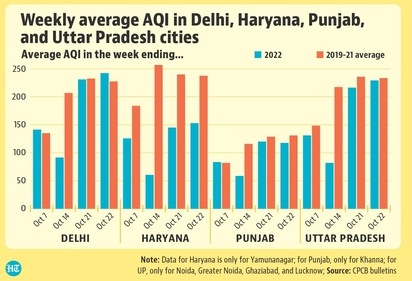
The average Air Quality Index (AQI) from consistently available data from Central Pollution Control Board (CPCB) bulletins shows that as recently as in the week ending October 21, the AQI in 2022 was better than the 2019-2021 average in Punjab, Haryana, Delhi, and Uttar Pradesh.

 Prefer HTon Google


How polluted will the air in north India be this Diwali? According to the System of Air Quality and Weather Forecasting And Research (SAFAR), which forecasts air quality for only Delhi in the belt that runs from Punjab to Bihar, air quality is likely to be “very poor” on Diwali and is likely to worsen to the lower end of “severe” by night. This grim forecast notwithstanding, the real situation can turn out to be much worse if people burn firecrackers on Diwali.
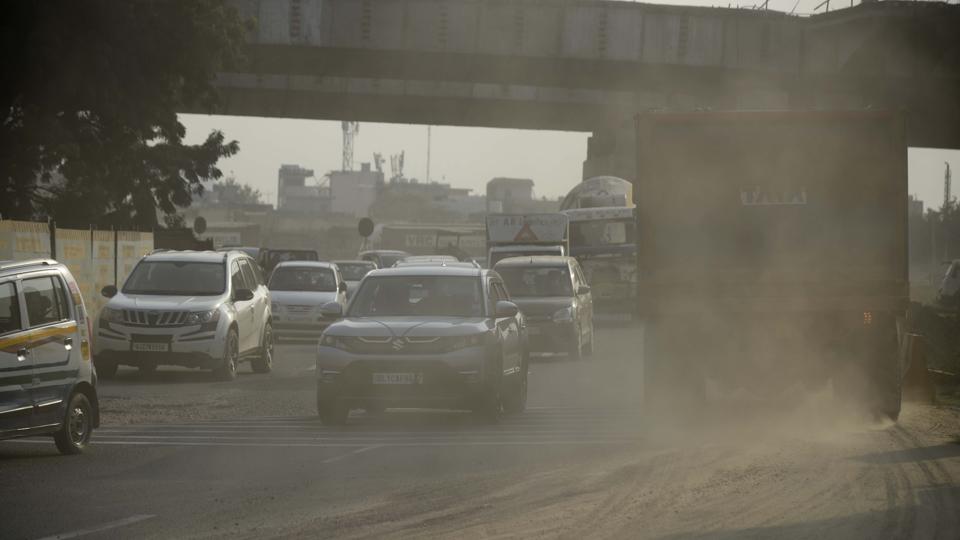
Therefore, it is important to take note of how air quality and meteorological conditions are doing currently. Here are four charts that show the good, the bad, and the ugly developments happening on those fronts.
The good news is this is a relatively cleaner October so far
The average Air Quality Index (AQI) from consistently available data from Central Pollution Control Board (CPCB) bulletins shows that as recently as in the week ending October 21, the AQI in 2022 was better than the 2019-2021 average in Punjab, Haryana, Delhi, and Uttar Pradesh. To be sure, the improvement in Delhi’s AQI was insignificant, and in the week ending October 22, Delhi’s air was marginally worse than the 2019-2021 average.
The statistics for states other than Delhi also need to be taken with more than a grain of salt. Outside of big metros, the government has started monitoring air quality only recently. There are only four cities in Uttar Pradesh, one in Haryana and Punjab each, and none in Bihar for which the Central Pollution Control Board (CPCB) has published AQI for every October day since 2019. This means that the inter-state comparisons do not amount to much and the inter-year comparisons for the state end up just being inter-year comparisons within a handful of cities.
The bad news is that better air than last year does not really mean good air…
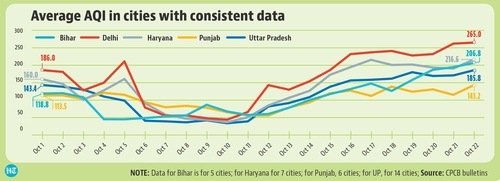
Unfortunately, the improvement over the average air quality in 2019-2021 does not really amount to much of a relief. Since the rain-washed second week of October, which cleared the air of pollutants across northern India, air quality has steadily worsened. On October 22, the average AQI in Bihar, Uttar Pradesh, Delhi, Haryana, and Punjab was 207, 186, 265, 217, and 143 which falls in the lower end of “poor”, higher end of “moderate”, middle of “poor”, lower end of “poor”, and in the middle of the “moderate” category. This data for 2022 is also from a larger pool of cities than used in the analysis in the previous section. Data for October 2022 is available for every day of October from 5, 7, 6, and 14 cities in Bihar, Haryana, Punjab, and Uttar Pradesh.
… And the temperature is now below 2019-21 average
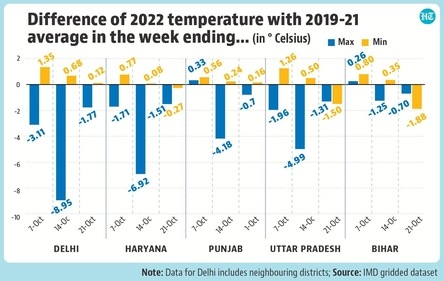
When rain washed the pollutants from the air in the second week of October, it decreased day temperatures substantially, but kept night temperatures above normal and the average for 2019-21 (the period with which air quality comparisons are made above). These trends in temperature are expected with rain, as clouds prevent the sun from heating up the earth substantially during the day, but also prevent the accumulated heat from leaving at night. These conditions do not prevail any more. Both day and night temperatures were either slightly lower than the 2019-21 average or very close to it in the week ending 21.
Therefore, in the absence of rain or strong winds, it will not be surprising if the day after Diwali is as bad as in the past – especially if people burn firecrackers.
Even if the day after Diwali is not as bad, the coming weeks can still get ugly
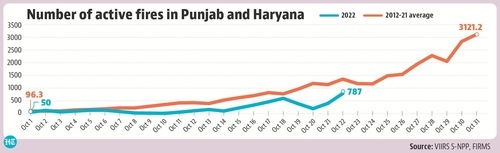
As the charts above show, the current meteorological conditions do not favour a day of good air quality. That current AQI is still better than in the recent past is because one source of pollutants – the smoke from the farm fires burnt in Punjab and Haryana – has been missing in action. So far, this is not the proof of farmers adopting alternate methods of removing stubble from their field.
As HT reported on October 21, only 15% of land under paddy cultivation had been cleared out by October 14, when it should have been around 25%. This delay was the result of the rain in the second week of October and is likely to force a larger number of farmers to burn stubble at the same time. This combined with bad meterological conditions can produce a Diwali-like day of air quality even after Diwali.
Furthermore, the smoke let out on Diwali day might not have gone away completely when the farm fires start if they are not blown away by wind or washed by rain. Therefore, it is best to avoid the non-essential firecracker part of this cocktail on Diwali.