
 E-Paper



Crack team of women military engineers to spearhead project to upgrade LAC airfield
India is upgrading an airfield near the Line of Actual Control (LAC) in eastern Ladakh to a full-fledged base for fighter operations. The project will be led by a crew of women officers and is part of India's efforts to counter Chinese infrastructure construction along the contested border. The Nyoma airfield will be extended and strengthened, and the project is expected to be completed by September 2025. Additionally, a high-altitude road in Ladakh's Demchok sector is being constructed by the same crew, which will be the world's highest motorable road when completed.

 Prefer HTon Google


A crew of women officers will spearhead a key project to upgrade an advanced landing ground near the Line of Actual Control (LAC) in eastern Ladakh to a full-fledged base for fighter operations as India steps up infrastructure development along its farthest frontiers to support military operations and counter Chinese infrastructure construction across the contested border where the two countries have been locked in a standoff for more than three years, officials aware of the development said on Friday.
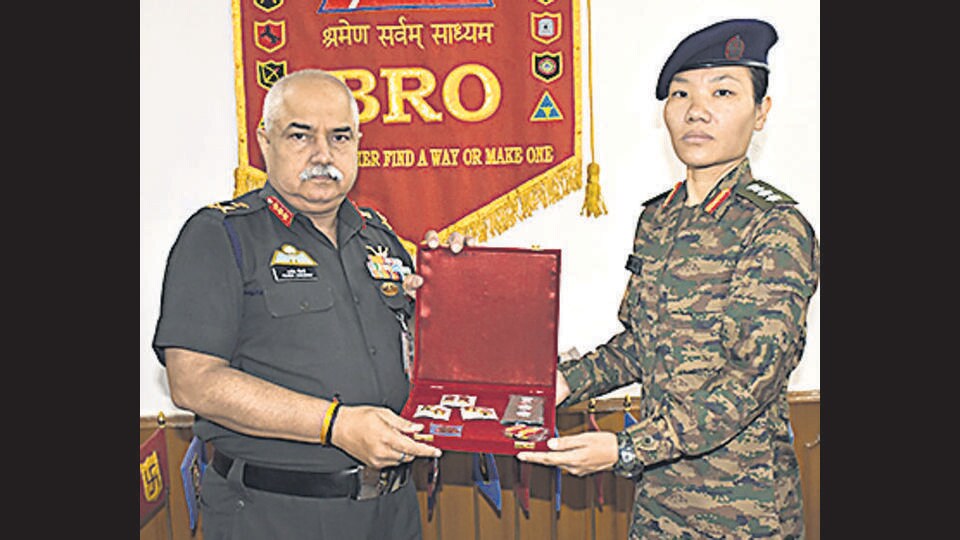
The upgradation of the Nyoma airfield to support offensive and defensive operations will involve a Border Roads Organisation (BRO) task force led by a woman combat engineer, Colonel Ponung Doming, who will have five women engineers under her command, said one of the officials cited above, asking not to be named. The scope of the work will include extending and strengthening the existing airstrip and building allied infrastructure for fighter operations.
BRO will begin work on upgrading of the Nyoma airfield, located at a height of 13,300 feet above sea level and 23km from the LAC, in a few days after defence minister Rajnath Singh remotely lays the foundation stone of the ₹214 crore project on September 12, said a second official, who also asked not to be named. The foundation stone of the Indian Air Force’s (IAF) Nyoma fighter base will be laid on the day Singh inaugurates the BRO’s Devak bridge near Jammu, and dedicates around 90 other infrastructure projects to the nation including roads, tunnels and bridges.
The project is expected to be completed by September 2025, the officials said.
The Nyoma airstrip was out of use for decades after the 1962 India-China war before IAF reactivated it in September 2009 and landed an AN-32 transport aircraft there for the first time. IAF has operated its C-130J special operations aircraft, AN-32s and helicopters from Nyoma in support of the military’s forward deployments, including during the ongoing LAC row with China. IAF reactivated its other two airstrips at Daulet Beg Oldi (16,614 feet) and Fukche (13,000 feet) in May 2008 and November 2008.
The upgradation of the Nyoma advanced landing ground is not the only project being spearheaded by the BRO task force with women engineers.
Colonel Doming’s unit is also constructing a high-altitude road in Ladakh’s Demchok sector to provide connectivity to one of the military’s farthest outposts in the sensitive sector, Fukche, which is just 3km from the LAC, the officials said. The construction of the 64-km Likaru-Mig La-Fukche road began on August 15.
At its highest point, the road will roll over an altitude of 19,400 feet, and when ready by mid-2025, it will be the highest motorable road in the world. The existing highest motorable road in the world has also been built by BRO. Two years ago, BRO created a world record by constructing and blacktopping the world’s highest motorable road at Umling La in Ladakh at a height of 19,024 feet.
Recognising the contribution of BRO workers, the government invited 50 of them as special guests at the 77th Independence Day celebrations at Red Fort.
After the India-China border row began in May 2000, India has built infrastructure at a swift pace in eastern Ladakh with focus on better living experience and improved facilities for soldiers, conservation of modern weapons and equipment deployed there, and supporting faster movement of men and material to deal with any contingency.
India inducted thousands of extra troops and modern military weaponry into the Ladakh sector to counter the Chinese military build-up after the standoff began, and the changed dynamics along the LAC necessitated the infrastructure push aimed at enhancing efficiency of the military’s deployments.
The steps taken by the army to support its forward deployments along LAC include building of modular shelters for troops deployed at heights of up to 18,000 feet, habitat for reserve troops in rear locations, storage facilities for tanks, artillery guns and other equipment, underground facilities for ammunition storage, airfields, and new roads, bridges and tunnels in difficult terrain for improved connectivity in forward areas.
This has come in the backdrop of China’s unrelenting infrastructure push.
An analysis of satellite imagery from Aksai Chin, a region that India has for long accused China of occupying illegally, shows the Chinese side has ramped up the construction of reinforced bunkers and underground facilities to better protect military assets from aerial or missile strikes.
A comparison of satellite images from December 2021 and August this year – provided to Hindustan Times by Maxar Technologies earlier this week – shows the Chinese side has built reinforced bunkers and underground facilities at six locations within an area of roughly 15 sq km in Aksai Chin.
This area is located about 70km from the LAC, and while troops were deployed in the region following the start of the standoff in May 2020, most of the land was barren and with few signs of construction activity, apart from some overground facilities to host equipment.
At the 19th round of talks between corps commanders of the two armies on August 13 and 14, the two sides agreed to resolve the remaining issues along the LAC in a speedy manner through continued dialogue. That was the first time military talks were held over two days.
Despite four rounds of disengagement from Galwan Valley, Pangong Tso, Gogra (PP-17A) and Hot Springs (PP-15), the Indian and Chinese armies still have tens of thousands of troops each and advanced weaponry deployed in the Ladakh theatre. Problems at Depsang in Daulet Beg Oldi sector and CNN junction in Demchok are still on the negotiating table.


