E-Paper



How are children faring on anxiety, loneliness, hope?

 Prefer HTon Google



How does social media play into it all? How is our world affecting the teen ‘Ferrari brain’? Anesha George offers an overview of surprising recent studies.
“Young people today are contending with more powerful forces than I ever faced.”
That was British clinical psychologist Peter Fonagy, in a report on mental health conditions that has come to be known as the Fonagy review.
Released last month, this landmark study, commissioned by the UK government, ended up being 607 pages long, and made headlines for its findings on loneliness, ADHD and autism, particularly among children, adolescents, and young adults.
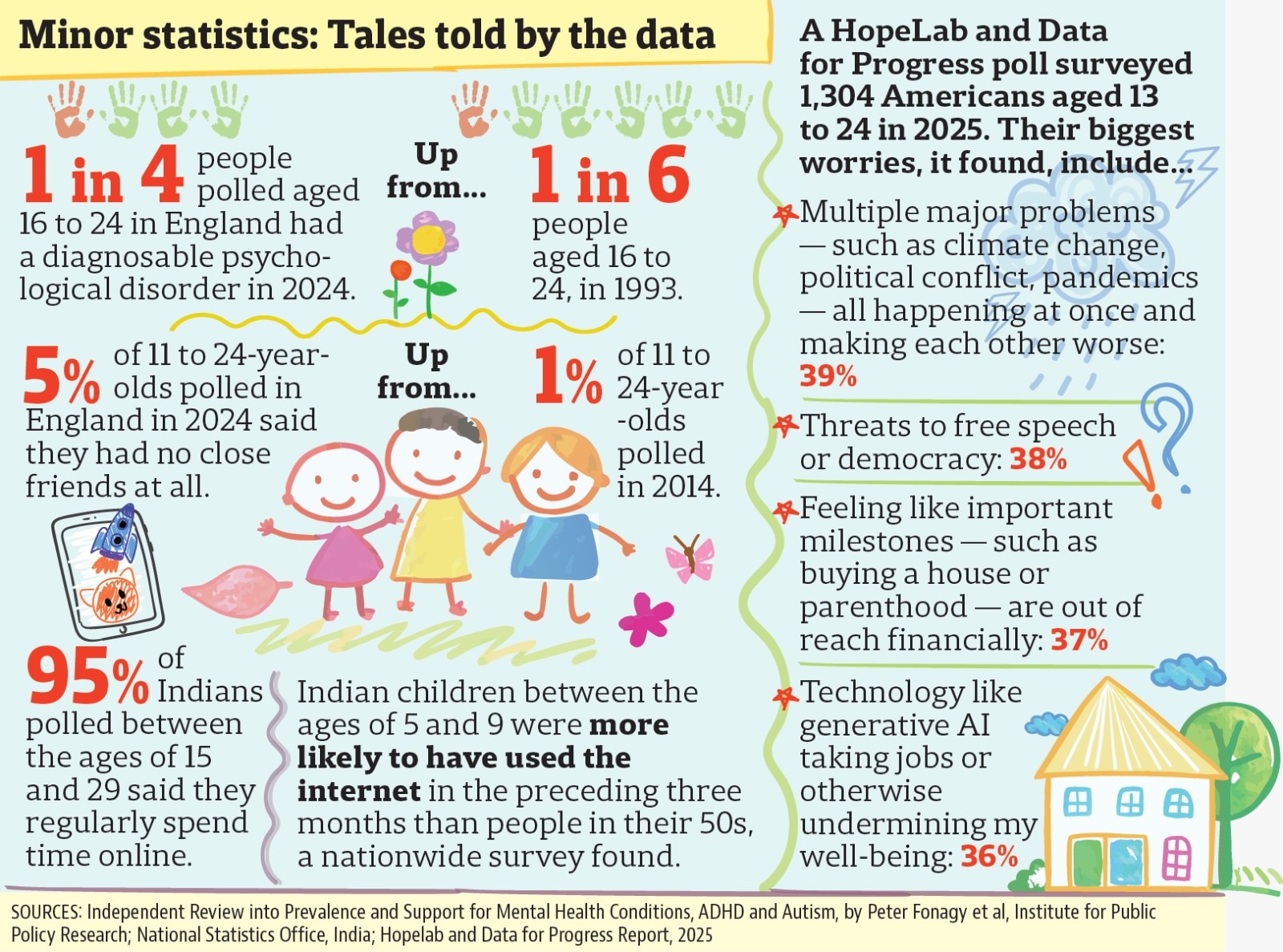
The review analysed scores of data sources, with a special focus on people under 25, where the steepest rises in distress were identified. Diagnosable psychological disorders among 16- to 24-year-olds have risen from one in six in 1993 to one in four in 2024, the report found.
Back to the quote on powerful forces, Fonagy, 74, included a personal perspective in his report, because he knows first-hand the difference that psychological care can make.
He arrived in London as a war-displaced, “severely-depressed” 15-year-old from Hungary, in 1967. He didn’t speak English, and struggled in school. A kind neighbour noticed his troubles and helped him get help, he says in the report.
“The therapy saved my life. What made it work was not a technique. It was that the person seeing me could look past everything that was wrong and see that there was someone there who might yet do quite well.”
What makes him, a clinician and father of two, say life has become harder since he was a young man?
Things are more uncertain, more relentlessly observed and appraised, with less of a sense of belonging and fewer opportunities to take time out to recuperate and recover, he notes in the report. “The cacophony of voices now available to a young person – most of them digital, many of them confident, few of them accountable – has made the ordinary developmental process of understanding oneself far harder than it was for me,” he writes, “and the consequences for how young people function are correspondingly greater.”
BIG LITTLE MINDS
How does that “cacophony of voices” affect the young mind?
“Think of the average teenager’s as a ‘Ferrari brain’: A powerful accelerator with no brakes to match,” says biological scientist Sujata Kelkar Shetty, author of Resilience Decoded: What Every Parent Needs to Know About Teen Mental Health (2025).
During adolescence, the brain undergoes a period of remodelling and restructuring that is second only to the rapid development seen in the first two years of life.
This makes adolescents hyper-sensitive to dopamine. Chasing that high can see them do the kinds of things that cause parents to shout: How could you be so stupid?
“Social media can act as a multiplier for this inherent vulnerability,” Kelkar Shetty says.
The online world, with its endless buffet of games, feeds, chatting and scrolling, becomes a sort of snare, and this is just the bedrock of the problem.
Healthy sleep patterns, strong ties with the community, interaction with loved ones and other children, and physical activity would all help the prefrontal cortex regulate itself better, but locked into the scroll or screen, this becomes less likely, Kelkar Shetty says.
“It is the responsibility of parents and society at large to establish the necessary guard-rails to make the world they inhabit more hospitable for their development.”
Data from India’s National Statistics Office (NSO) indicates that internet usage is highest in the 15-29 demographic. Just under 95% of those polled said they regularly spend time online. Children between the ages of five and nine, meanwhile, were more likely to have used the internet in the preceding three months than people in their 50s, the nationwide survey found.
SCROLL MATES
Even the teens know there’s something wrong.
“They have had key development milestones impacted by the pandemic, and are coming of age during a cost-of-living crisis in an ever-less-certain world,” says researcher Conor Carleton.
He worked on a September report by think tank Institute for Public Policy Research that found rising rates of loneliness among young people in England.
In nationwide surveys of over 40,000 households, 5% of 11- to 24-year-olds polled said they had no close friends at all, up from 1% in 2014.
Many of those surveyed were aware of the downsides of a life lived online, Carleton says.
“They were angry with the government or technology companies for building an addictive product, and felt they were being unfairly blamed for using it.”
DOOM AND BLOOM
* What issues impact your mental health to a point that it disrupts your daily life?
* Do you feel optimistic or pessimistic about your own future or that of your country or planet?
Asked how they feel about their present and future, loneliness reared its head again, in a survey of 1,304 Americans aged 13 to 24.
The poll was conducted by US-based not-for-profit organisation Hopelab and Data for Progress, in 2025.
More than 1 in 3 (35%) said loneliness impacts their mental health or well-being. An equal number (35%) said having no clear path did this too.
Meanwhile, 43% of those polled said face-to-face interactions with friends helped support their mental health.
The biggest worries about the future included: “Multiple major problems — like climate change, political conflict, pandemics, etc — all happening at once and making each other worse” (39%), “Threats to free speech or democracy” (38%), “Feeling like important milestones — like buying a house or parenthood — are out of reach financially” (37%) and “Technology, like generative AI, taking jobs or otherwise undermining my well-being” (36%).
The survey offered notes of hope. More than half (57%) of those polled were optimistic about their future.
“What brings me a sense of hope when I think about the future is… people,” noted one 12th grade student. “Even in hard times, I notice how families, friends, and even strangers come together… and that reminds me that good things are possible.”