
 E-Paper



Is Buying Every $7 Stuffie Teaching My Son Bad Money Habits?


 Prefer HTon Google



There are lots of reasons it is hard to say no to a child whose heart is set on a stuffed animal collection.
I stand in the grocery store with my 5-year-old son, dreading the request I’ve heard dozens of times before.
“Mama, can I have a stuffie?”
Our local grocery store has a rack of small plush toys that cost about $7 apiece. My son has been wanting to collect all the pups from the Paw Patrol movie ever since my husband and I took him to see it. On this recent trip, he was hunting for Marshall, the firefighter.
I pride myself on being decisive, but at this moment I find myself stammering for an answer. It isn’t a hard question: yes or no. But saying yes doesn’t feel right, and saying no doesn’t either.
Like so much in parenting, there is endless conflicting advice, and what works for one family might not work for another. Moreover, the longtime personal finance reporter in me wonders whether we’re teaching him the right money lessons. Does any of it really matter?
When my son asks, I think of the hundreds of financial planners I’ve interviewed over the years. They love to extol the merits of delayed gratification and distinguishing between wants and needs.
Some of them might be doing the math right now: $7 a week is $364 a year. Do that for three years and you’re spending about $1,100. If you invested that $7 a week over three years at a 7% annual return, you would end up with and more than $1,200, and more if you let it keep growing. But a 5-year-old can’t cuddle a compound-interest chart.
I think of the people who specialize in financial literacy for kids. Some advise taking a photo of the item for a birthday wish list, or using three jars—Save, Spend, Give—to build goal-oriented habits. Make trade-offs, they say. I think about a parent I once interviewed who effectively gave her high-school age children paychecks and had them figure out how to divvy it up between needs and wants. Impressive, but perhaps too mature for a 5-year-old.
I consider the parenting gurus, some of whom say you can tell your children “no” in a way that leaves them feeling secure and loved. Meanwhile, some social-media influencers remind parents that kids are only young once. Time is short and precious. Buy the stuffie. Take the vacation. Give them positive core memories.
But how do I know which memories will stick? Will he remember all the stuffies we bought him, or will he remember the ones we gave away? What will he tell a therapist one day?
Our family is fortunate to have the option to spend on these small treats, and we try to instill a sense of gratitude. We take him with us when we drop toys off at a donation bin. And, yes, that is where many of these stuffies end up.
He gamely appears on camera when we ask him to record a thank-you video for relatives who give him gifts. On special occasions like his birthday, my husband or I try to write thank-you notes. We have him sign them and draw a picture.
At 5, his understanding of money is, understandably, a work in progress. Two of his aunts sweetly send him cash for his piggy bank when he loses a tooth or for Halloween. He dutifully stuffs the bills into the slot. But it doesn’t fully click. When I handed him a dollar bill a few months ago, I gasped as he tore it up like a piece of scrap paper.
Most of the time, he puts away his toys before our five-minute cleanup timer goes off. He brings his breakfast dish to the counter and washes his own grapes. He does his homework every morning without a battle (so far!), and his teachers say he’s a good listener.
For nearly all of the first four years of his life, croup repeatedly sent us to the emergency room, often at 3 a.m., as he struggled to breathe. He was sick almost every other week and missed birthday parties, playdates and holidays. Being able to go to a store with him today and buy a gift feels like a mini-celebration of his health.
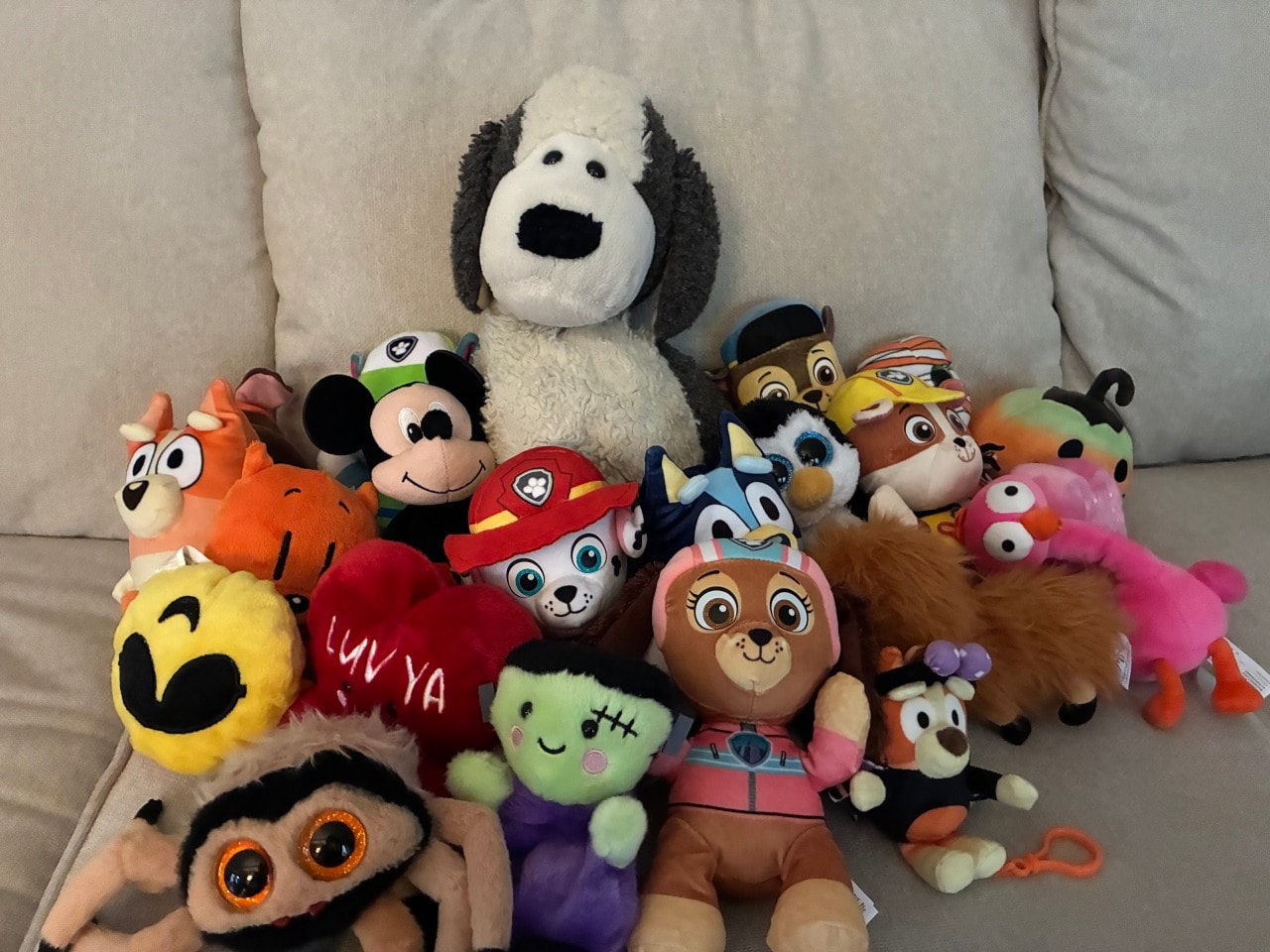
The advice reel in my head keeps going until I get back to my own childhood. When I wanted another stuffie or a small trinket, my mom’s default answer was almost always no. She didn’t want more stuff in the house and thought it was a waste of money. (Funny enough, she has yet to visit my son without bringing him a gift.)
My dad, on the other hand, almost always said yes. Nearly every Saturday morning, I’d ride along with him to run errands. We’d stop at the card-and-gift store, where he would buy a lottery ticket and I’d get a new stuffie or stickers.
Between the two of them, I wasn’t exactly detecting decisiveness, but I turned out OK.
I still have one of those stuffed animals, a dog named Bou my dad bought me just a few years before he suddenly died when I was a child. My son plays with Bou today—even though his head might pop off at any moment. That stuffed black-and-white dog is a bridge between my son and my dad, two generations who never met.
But that doesn’t stop my son from wanting another stuffie at the grocery store. And I’m getting to the front of the checkout line. I hear myself mumbling to my son, “I guess,” and buy the toy.


