
 E-Paper



How service dogs are helping veterans overcome PTSD and reclaim their lives

 Prefer HTon Google


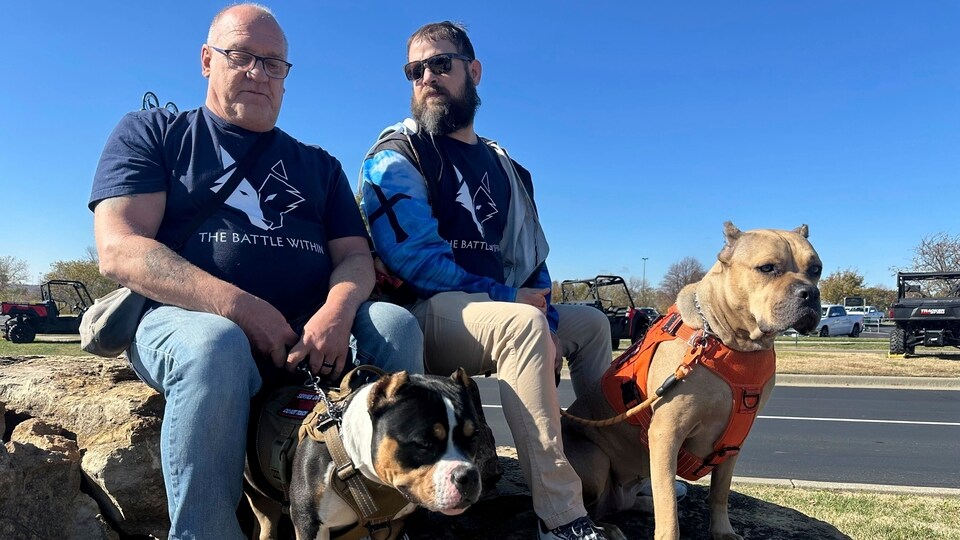
Veterans like Heather O'Brien and Mark Atkinson find relief from PTSD through Dogs 4 Valor, a program connecting them with service dogs.
After working at a crowded and dangerous internment camp in Iraq, Air Force Staff Sgt. Heather O'Brien brought home with her anxiety and post-traumatic stress disorder. A bouncy labradoodle and a Kansas City-area program helped her get back on her feet. Dogs 4 Valor, operated through the Olathe, Kansas-based organization called The Battle Within, helps retired veterans and first responders work with their service dogs to help manage depression, anxiety and other challenges.
How Dogs 4 Valor helps veterans overcome PTSD
“A lot of times the veteran with severe PTSD is homebound,” said Sandra Sindeldecker, program manager for Dogs 4 Valor. “They’re isolated. They’re very nervous. They won’t make eye contact. Some won’t leave the house at all.”
The program involves both group and one-on-one training. The goal is to get the veteran and the dog comfortable with each other and understanding each other. The group takes outings to help the veterans regain their footing in public places like airports. Program leaders also provide mental health therapy at no cost. The veterans and dogs graduate in six to nine months, but group gatherings continue.
There is growing evidence of the value of service dogs for veterans with PTSD. A small study published in JAMA Network Open in June looked at a program operated by K9s For Warriors. Service dogs in the program are taught to pick up a veteran’s physical signs of distress and can interrupt panic attacks and nightmares with a loving nudge.
Researchers compared 81 veterans who received service dogs with 75 veterans on the waiting list for a trained dog. After three months, PTSD symptoms improved in both groups, but the veterans with dogs saw a bigger improvement on average. O'Brien, 40, recalled that the camp where she worked in Iraq sometimes had over 20,000 detainees. Violence and rioting were common and it left her with severe anxiety.
“When I got out of the military, I just assumed that you’re supposed to be on edge all the time as a veteran,” O’Brien said. O’Brien’s mother spotted the frisky lab-poodle mix on Facebook and convinced her daughter to adopt the dog she named Albus. Months later, O'Brien learned about Dogs 4 Valor, and the pair joined the program in October 2023.
O’Brien says she can now go out in public again — she even went on vacation to Branson, Missouri, “things that I never would have thought I would do really, probably ever again.” Mark Atkinson, 38, served in Afghanistan as a corporal in the Marine Corps. He returned home with PTSD and major depressive disorder, causing sleeplessness and anxiety. He adopted Lexi, now 5, in 2020.
Life-changing impact of service dogs on veterans' mental health
Lexi, a muscular cane corso breed, needed Atkinson as much as he needed her. Her previous owner had kept Lexi in chains before surrendering her. Since joining Dogs 4 Valor, the two can get out together and enjoy life. “I don’t really like leaving the house because I’m safe there, you know?" Atkinson said. “And having Lexi has just made me get out to be more social.”
Having a group of fellow veterans facing the same challenges has also helped, Atkinson said. “We come from the same backgrounds, different branches,” Atkinson said. “Same issues. You know, PTSD or traumatic brain injuries. And they’re all very welcoming, as well. There’s no judgment.” O’Brien compared living with Albus to a relationship with a sometimes pushy best friend who often wants to go out.
“The best friend constantly wants to make you do things that make you nervous,” O’Brien laughed, acknowledging that it is ultimately up to her. “I have to decide to walk out and just deal with life," O'Brien said. "And so that has been hard. And it still is hard from time to time, but it’s it’s getting manageable.” Some veterans said their family relationships have improved since they started the program.
“I’m able to talk, not fly off the handle and just get along with people and not be as stressed, not have as much anxiety,” Atkinson said. “Or even if I do, she (Lexi) is right there with me.” Timothy Siebenmorgen, 61, said his relationships also are better with help from his 1-year-old American bulldog, Rosie, and Dogs 4 Valor, which he joined in July. He served in both the Marines and the Army, deploying 18 times.
“You’re in the military, kind of taught not to show weakness," Siebenmorgen said. "So you figure you can tackle everything yourself and you honestly believe that. And then you realize you can’t do it on your own.” Veterans said the dogs, and the program, have given them new hope and a renewed ability to move forward. “I got my life back,” O’Brien said.


