
 E-Paper



Distantly Close | In MP, Kamal Nath is CM face, Congress bets on “deity with doles”
In the over 90 per cent Hindu state, the party's gameplan could be explained as an attempt to stall the Hindutva party’s 18-year-long ‘free run’

 Prefer HTon Google


In Madhya Pradesh (MP), the Congress has its ducks in a row and is some distance removed from an intra-party detente in Rajasthan, the other Hindi belt state headed for polls by the year-end.
A lot has been said on the lack of chemistry between chief minister Ashok Gehlot and the man-in-perpetual-waiting, Sachin Pilot in the desert state. But there hasn’t been enough focus on the amicable settlement of the vexed leadership question in MP.
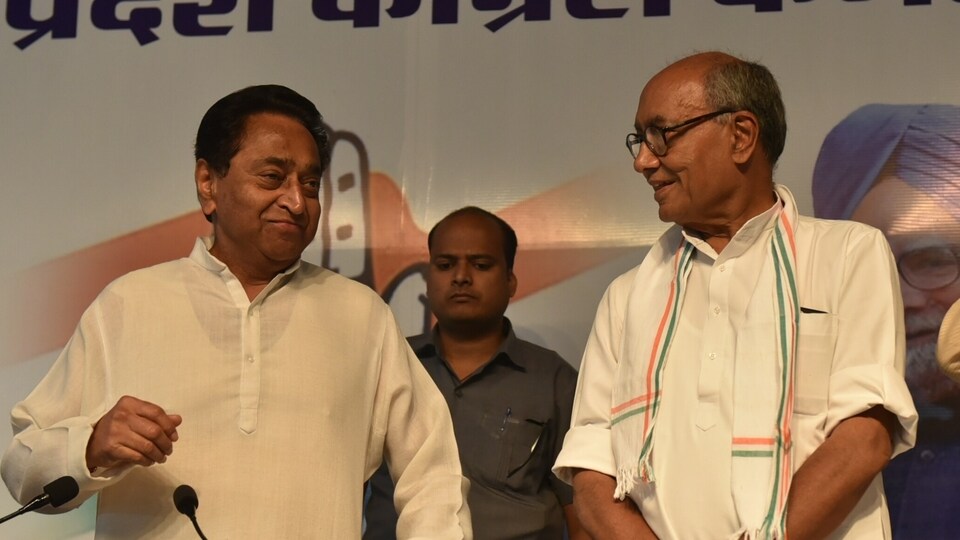
Short of a formal announcement, former chief minister Kamal Nath is the Congress’s face here. Doubts, if any, on that score were quelled by Priyanka Gandhi Vadra’s inaugural June 12 election meeting in Jabalpur. The catbird seat there was for Nath, while another party veteran and one-time contender, Digvijay Singh kept an extraordinarily low profile. So understated was the latter’s presence that he wasn’t among those listed to address the gathering besides Nath and Vadra.
The consensus on Nath’s stewardship in the party’s bid for power was reached at a meeting Congress president Mallikarjun Kharge and Rahul Gandhi had on May 29 in Delhi with senior leaders from MP. Among those present besides Nath, who currently heads the Pradesh Congress Committee, and Singh were all former state unit and legislature party chiefs.
Not only did Singh, himself a two-term CM, propose Nath’s name for the leadership position, he volunteered to restrict his role in the upcoming polls to the 68 seats that the Congress hasn’t won for the past two decades. Nath was agreeable to the task Singh chose for himself.
Singh’s mellowing is explained by party insiders as “payback” for “the support he received (from Nath) during his 1993-2003 stint as CM.” The other more expedient reason behind his conciliatory approach is his desire to promote his son, Jaivardhan, who served as a minister under Nath in the truncated 2018-20 Congress government.
Does the early resolution of the leadership question in MP mean the party is better placed than it was in Karnataka to take on its principal rival, the Bharatiya Janata Party (BJP)? The parallel seems far-fetched, as the states are politically poles apart, even after discounting their similarly bipolar polity and the palpable anti-incumbency and organisational atrophy that had hurt the BJP in Karnataka.
The crucial difference between Karnataka and MP-Rajasthan combine is that the latter are Hindi belt states where the BJP bats better on the strength of its leadership’s communication flair that has a relatively faint reach and appeal in southern India. In that limited sense, the Congress’s match in the Hindi heartland will mostly be with Narendra Modi’s oratorical skills, his personal charisma and the Rashtriya Swayamsevak Sangh’s cadre-entrenchment.
If factionalism continues to fester, Gehlot’s overdrive on directly transferring benefits to the electorate might fall short of its objectives in Rajasthan. Being in power, the party there has its share of anti-incumbency accentuated by the hiatus that separates its two prominent faces. The peace formula envisaging Pilot as chairman of the Congress’s campaign committee is in the works. A final word on it is yet to be heard for a lack of common ground on probing corruption cases dating back to the BJP’s Vasundhara Raje’s tenure as CM.
The Modi magic that brought the BJP big victories in the 2019 Lok Sabha polls, had not worked in 2018 in Rajasthan and MP. While Gehlot, an amateur jadugar survived Pilot’s concomitant 2020 rebellion, Nath got ousted the same year when several legislators led by Jyotiraditya Scindia deserted the Congress to join the BJP.
In fact, the setback in MP strengthened Gehlot in the internal Congress power-play. Loath as it was to losing power in another state, the party high command considered it imprudent to disturb a CM who could keep his flock of MLAs together. A senior party official had at that time told this writer: “We cannot afford the tag of being a party that cannot retain talent; that wins elections but loses its legislators midway through....”
It’s anybody’s guess whether history will repeat itself in 2023. For starters, the Congress, while relying heavily on welfarism in Rajasthan, has loaded its MP campaign with the arsenal of religion that has been the BJP’s USP. The Bajrang Bali leitmotif the party appropriated in Karnataka was in full display at Jabalpur where Nath, the self-professed “Hanuman bhakt,” was presented with a mace identified with the deity. Not just that. Before assembling for the public meeting, the leaders including Vadra offered prayers on the banks of Narmada. The revered river was a theme as much in the 2018 polls when Digvijay Singh undertook its 3,300 km parikrama (circumambulation) on foot.
The deity, so to speak, comes with doles. The giveaway mix of faith and freebies is completed by the Congress’s “five promises” entailing monthly cash transfers to women, cheap gas cylinders, free electricity, farm loan waivers and implementation of the old pension scheme.
Regardless of the outcome, the strategy to play on the BJP’s turf isn’t new. It was first seen in Gujarat-2017 when the Congress came close to giving the incumbent party a real scare. The additional element this time is the party’s attempt to develop its own constituency of labharthis (beneficiaries) which Amit Shah described in Karnataka as the “new caste” created by Modi’s welfarism.
The falling apart in a thunderstorm of Saptrishi statues in the Mahakaal temple corridor inaugurated by the PM in Ujjain last year, lends force to the Congress’s charge of the BJP having “beguiled” people in the name of religion. In the over 90 per cent Hindu MP, its game plan could be worth a try and explained in terms of stalling the Hindutva party’s 18-year-long ‘free run’ of the majoritarian space.
HT’s veteran political editor, Vinod Sharma, brings together his four-decade-long experience of closely tracking Indian politics, his intimate knowledge of the actors who dominate the political theatre, and his keen eye which can juxtapose the past and the present in his weekly column, Distantly Close
vinodsharma@hindustasntimes.com
The views expressed are personal


